Electronics 1978
Pioneer
We wouldn’t have called it the SX1980 if it wasn’t years ahead of everything else.
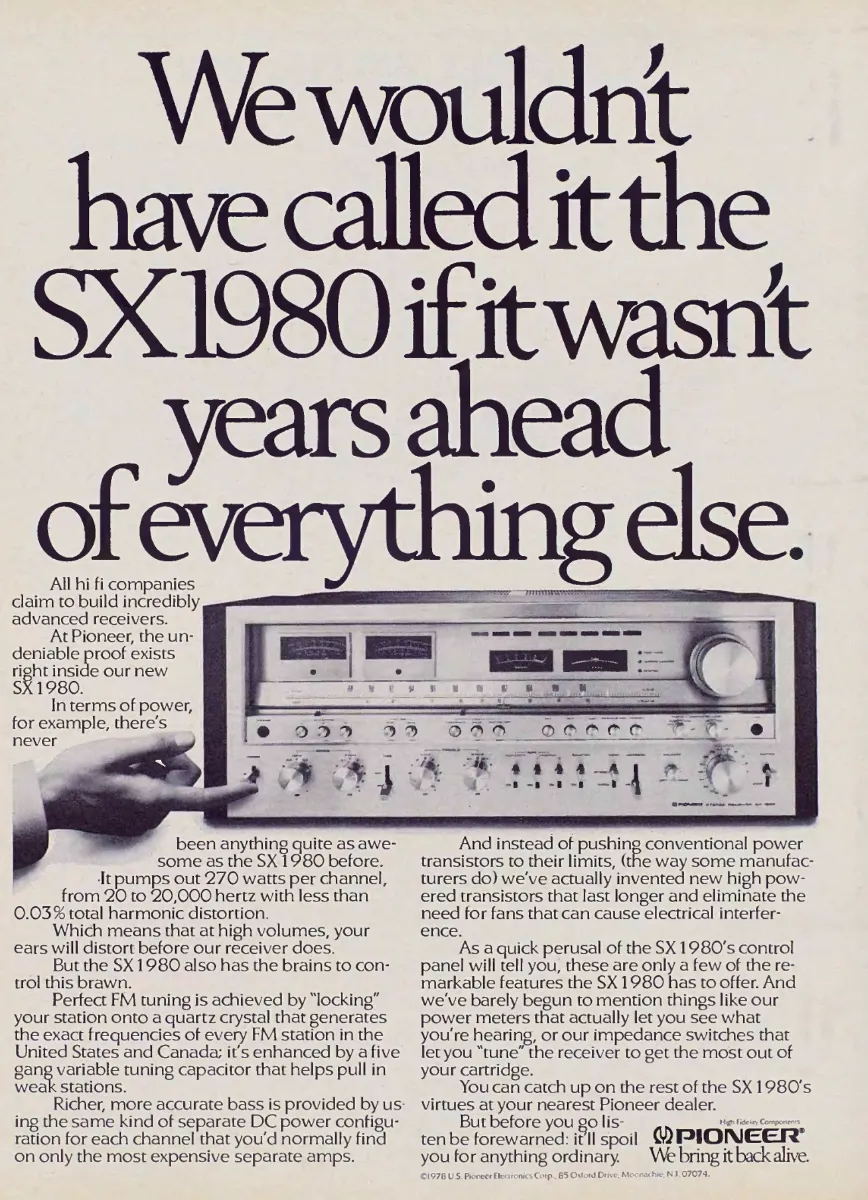
FROM THE PRINTED PAGEOriginal ad copy
OCR transcription from the archived page. Scanning and reading-order errors may remain.
We wouldn’t have called it the SX1980 if it wasn’t years ahead of everything else. All hi fi companies claim to build incredibly advanced receivers. At Pioneer, the undeniable proof exists right inside our new SX1980. In terms of power, for example, there’s never been anything quite as awesome as the SX1980 before. It pumps out 270 watts per channel, from 20 to 20,000 hertz with less than 0.03% total harmonic distortion. Which means that at high volumes, your ears will distort before our receiver does. But the SX1980 also has the brains to control this brawn. Perfect FM tuning is achieved by “locking” your station onto a quartz crystal that generates the exact frequencies of every FM station in the United States and Canada; it’s enhanced by a five gang variable tuning capacitor that helps pull in weak stations. Richer, more accurate bass is provided by using the same kind of separate DC power configuration for each channel that you’d normally find on only the most expensive separate amps. And instead of pushing conventional power transistors to their limits, (the way some manufacturers do) we’ve actually invented new high powered transistors that last longer and eliminate the need for fans that can cause electrical interference. As a quick perusal of the SX1980’s control panel will tell you, these are only a few of the remarkable features the SX1980 has to offer. And we’ve barely begun to mention things like our power meters that actually let you see what you’re hearing, or our impedance switches that let you “tune” the receiver to get the most out of your cartridge. You can catch up on the rest of the SX1980’s virtues at your nearest Pioneer dealer. But before you go listen be forewarned: it’ll spoil you for anything ordinary. High Fidelity Components PIONEER® We bring it back alive. ©1978 U.S. Pioneer Electronics Corp., 85 Oxford Drive, Moonachie, N.J. 07074.
Commentary
I tried to finish the headline before looking at the receiver. The huge serif letters take up so much of the page that the equipment seems almost tucked beneath an announcement from the future. In a 1978 ad, “SX1980” conveniently sounds like a date just ahead. The model name becomes the evidence for a claim about being ahead of everything else, and the body must work hard to repay that confidence.
It does so with abundance: 270 watts per channel, a distortion figure, quartz-controlled tuning, separate channel power arrangements, new transistors, visible power meters, and cartridge-matching controls. A pointing hand directs attention to the machine as if someone were demonstrating it across a counter. The copy even flows around the receiver and hand, making the object interrupt the explanation. The hardware looks too substantial to remain an abstract specification.
There is a tension worth preserving. The line about ears distorting before the receiver is a theatrical claim about power, not responsible listening advice. The engineering detail supplies seriousness while the boast supplies appetite. Later, “we’ve barely begun” recasts an already crowded account as a mere sample. The intended reader seems willing to acquire knowledge alongside equipment and to regard the control panel as a field of possibilities.
The invitation to finish learning at a dealer places the page before an audition. Today a buyer can encounter measurements, recordings, and discussion before meeting a salesperson. Here the ad itself rehearses the demonstration: look where the hand points, imagine the sound, then go listen. Its information density helps create the desire for that next encounter.
For young copywriters, “brains to control this brawn” bridges raw wattage and tuning sophistication with a compact rhyme. The opening’s model-number wordplay gives the product name a memorable job. Notice that both devices lead into features: a verbal hook needs a route back to the object, especially when a headline makes such a sweeping comparative claim.
Pioneer’s corporate chronology records its beginnings in speaker development and its 1938 foundation. Today Pioneer Corporation describes businesses including car entertainment and sound technologies; its current corporate activities should not be confused with an unchanged version of this home-receiver operation.
The enduring appeal is capable equipment that makes an enthusiast feel prepared for more demanding listening. This ad’s FM tuning architecture and wall of physical controls belong to its period. The useful advertising idea is the coordination of a bold name, visible hardware, and enough explanation to make ambition tangible.