Electronics 1978
JVC
Great music must be created twice.
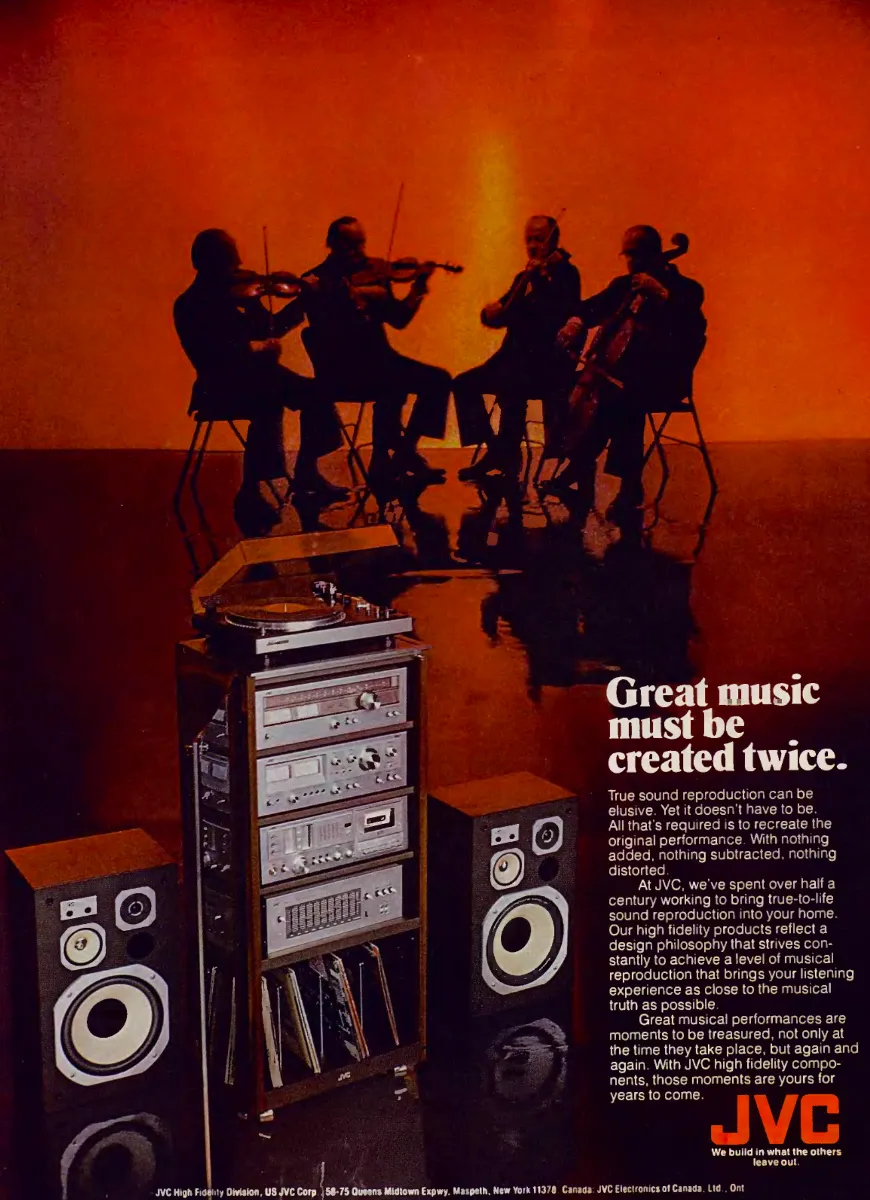
FROM THE PRINTED PAGEOriginal ad copy
OCR transcription from the archived page. Scanning and reading-order errors may remain.
Great music must be created twice. True sound reproduction can be elusive. Yet it doesn’t have to be. All that’s required is to recreate the original performance. With nothing added, nothing subtracted, nothing distorted. At JVC, we’ve spent over half a century working to bring true-to-life sound reproduction into your home. Our high fidelity products reflect a design philosophy that strives constantly to achieve a level of musical reproduction that brings your listening experience as close to the musical truth as possible. Great musical performances are moments to be treasured, not only at the time they take place, but again and again. With JVC high fidelity components, those moments are yours for years to come. JVC We build in what the others leave out. JVC High Fidelity Division, US JVC Corp., 58-75 Queens Midtown Expwy, Maspeth, New York 11378. Canada: JVC Electronics of Canada, Ltd., Ont.
Commentary
I counted four musicians and then followed their reflections down to the equipment. The string quartet and the component system inhabit the same orange world, joined by a glossy floor. There is no diagram connecting microphone to record to loudspeaker. The composition makes that connection spatially: performers above, playback below, one atmosphere surrounding both.
“Great music must be created twice” initially sounds like an argument about composition or rehearsal. The body resolves it as reproduction. The second creation should add, subtract, and distort nothing. That is an austere standard for a photograph so rich in color and reflections. JVC sells invisible fidelity through an image designed to be remembered; the dramatic setting gives a technical ideal an emotional surface.
The cabinet is unusually important. Records stand in its lower compartment beneath a turntable and a stack of components, with two speakers framing the system. Listening is represented as a furnished activity, with objects to select, handle, and keep. The quartet lends cultural seriousness, but the promise eventually becomes personal ownership of a moment: performances can be heard again for years. I infer the intended appeal from those props and words; the page supplies no evidence of who bought the system.
That promise looks different beside on-demand listening. The ad imagines access being secured through a collection in the room and equipment ready to replay it. A stream changes the location of the collection and the conditions of access. The old page’s emotional center—wanting a performance to remain available after it ends—survives that change more easily than its furniture does.
For new copywriters, “nothing added, nothing subtracted, nothing distorted” earns its rhythm through parallel grammar. Three negatives make absence feel like a positive achievement. The headline’s “twice” is then quietly multiplied by “again and again” and “years to come.” A useful lesson is to let repeated words carry the customer from a technical principle into an enduring benefit, without claiming that repetition proves results.
JVC began in 1927 and joined Kenwood in 2008, as JVCKENWOOD’s history records. The group continues work in audio, visual, and communications technologies, including its documented audio technology programs.
Faithful, repeatable listening remains the central desire. This ad’s particular expression depends on records, separate components, and a domestic cabinet. Its useful contemporary lesson is to show what technical fidelity protects: the experience a listener wants to revisit.