Consumer Goods 1980
Monsanto
Chew on the bark of 2 willows and call me in the morning.
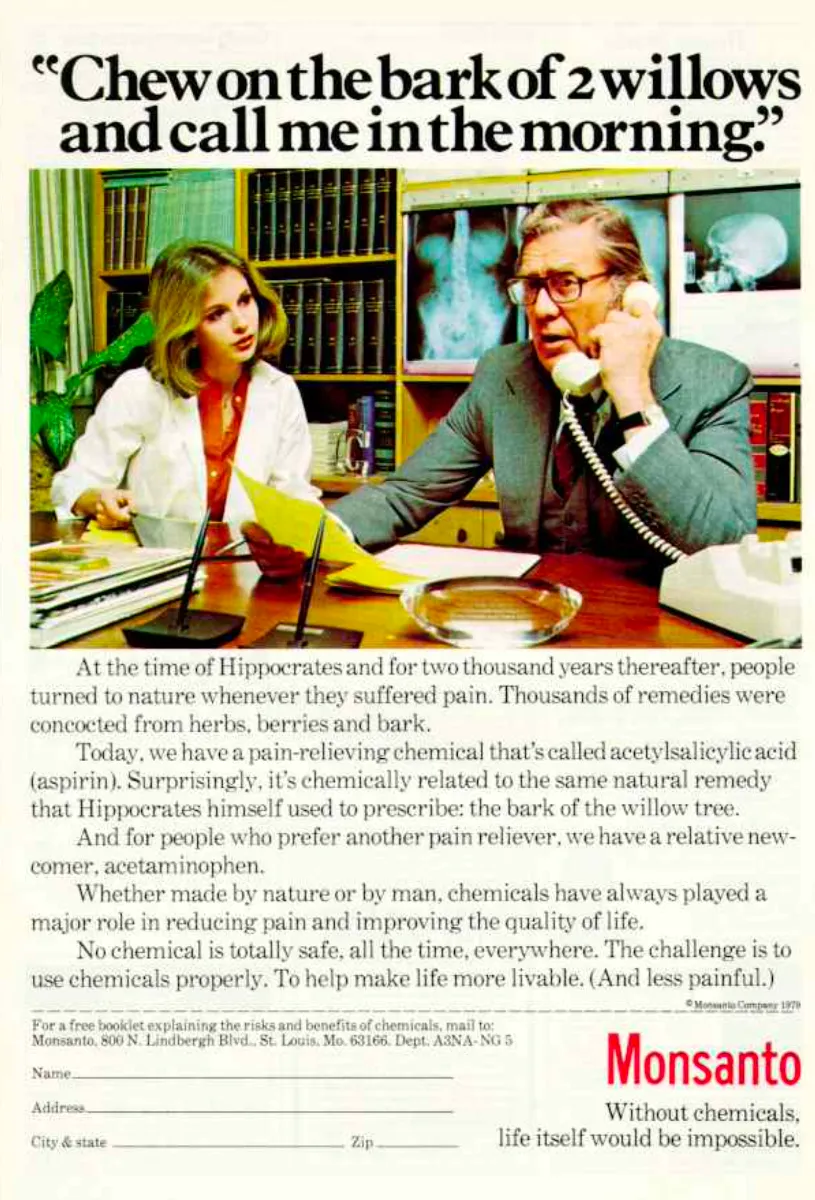
FROM THE PRINTED PAGEOriginal ad copy
OCR transcription from the archived page. Scanning and reading-order errors may remain.
“Chew on the bark of 2 willows and call me in the morning.” At the time of Hippocrates and for two thousand years thereafter, people turned to nature whenever they suffered pain. Thousands of remedies were concocted from herbs, berries and bark. Today, we have a pain-relieving chemical that's called acetylsalicylic acid (aspirin). Surprisingly, it's chemically related to the same natural remedy that Hippocrates himself used to prescribe: the bark of the willow tree. And for people who prefer another pain reliever, we have a relative newcomer, acetaminophen. Whether made by nature or by man, chemicals have always played a major role in reducing pain and improving the quality of life. No chemical is totally safe, all the time, everywhere. The challenge is to use chemicals properly. To help make life more livable. (And less painful.) For a free booklet explaining the risks and benefits of chemicals, mail to: Monsanto, 800 N. Lindbergh Blvd., St. Louis, Mo. 63166, Dept. A3NA-NG 5. Name Address City & state Zip Monsanto Without chemicals, life itself would be impossible. © Monsanto Company 1979
Commentary
The headline made me expect a medicine advertisement. A doctor is on the phone, a younger colleague sits beside him, and the line sounds like the old joke about taking two pills and calling in the morning. But the instruction is to chew willow bark. Monsanto is borrowing the trust of the clinic to make a broader claim about chemicals, rather than selling a branded painkiller on this page.
The copy moves from ancient remedies to aspirin, then to acetaminophen. Its pivot is “Whether made by nature or by man”: the natural and the manufactured are placed in one long account of pain relief. The move is clever because it answers a likely suspicion of synthetic chemistry by pointing to chemical relationships in familiar remedies. The pamphlet offer at the bottom promises more detail on risks and benefits, giving the reader a postal next step. The ad’s safety sentence deserves close attention too. “No chemical is totally safe, all the time, everywhere” sounds candid, while shifting the conversation toward proper use. That is the argument the page asks readers to accept; the scan does not establish the safety of any particular product.
The mail-in form records a slower path for a public-relations argument. Someone interested in the claim would write a name and address, send away, and wait for a booklet. Today the same assertion could be checked, challenged and circulated almost immediately. The altered pace changes how much work a single printed page must do before a reader encounters a second source.
For a new copywriter, the headline’s numerical “2” is doing more than saving a character. It echoes the stock doctor’s instruction to take two tablets, then substitutes a cumbersome piece of tree for the pill. The joke gives the long explanatory copy an opening, while the final sentence “Without chemicals, life itself would be impossible” expands the frame from pain relief to life itself. The lesson is that a familiar phrase can draw readers into an argument, but the argument still has to carry its own qualifications.
Monsanto was a St. Louis chemical and agricultural company. Bayer’s acquisition notice records its purchase in 2018; Bayer describes the former Monsanto businesses within its Crop Science operations in its company history. Monsanto no longer operates as an independent public company.
The need to explain what a chemical is, and to address benefits alongside risks, remains current. The ad’s broad reassurance, doctor’s-office authority and booklet-by-mail route are more specific to its time. Its central move is worth studying precisely because it makes a corporate argument through an ordinary household ache.