Automotive 1981
Ford
World praise for the new World Car
FROM THE PRINTED PAGEOriginal ad copy
OCR transcription from the archived page. Scanning and reading-order errors may remain.
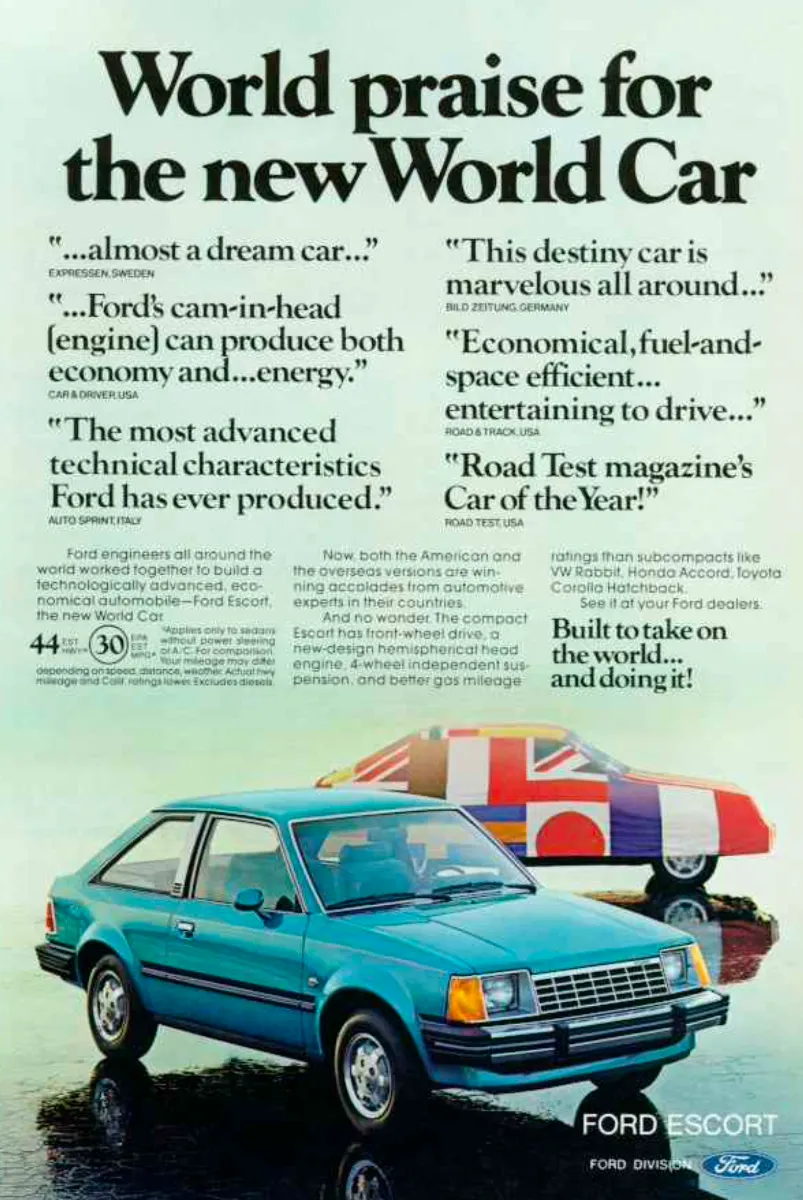
World praise for the new World Car “...almost a dream car...” EXPRESSEN, SWEDEN “...Ford’s cam-in-head (engine) can produce both economy and...energy.” CAR & DRIVER, USA “The most advanced technical characteristics Ford has ever produced.” AUTO SPRINT, ITALY “This destiny car is marvelous all around...” BILD ZEITUNG, GERMANY “Economical, fuel-and-space efficient...entertaining to drive...” ROAD & TRACK, USA “Road Test magazine’s Car of the Year!” ROAD TEST, USA Ford engineers all around the world worked together to build a technologically advanced, economical automobile—Ford Escort, the new World Car. Now, both the American and the overseas versions are winning accolades from automotive experts in their countries. And no wonder. The compact Escort has front-wheel drive, a new-design hemispherical head engine, 4-wheel independent suspension, and better gas mileage ratings than subcompacts like VW Rabbit, Honda Accord, Toyota Corolla Hatchback. See it at your Ford dealers. Built to take on the world... and doing it! 44 EST. HWY. MPG 30 EPA EST. MPG Applies only to sedans equipped with 4-speed manual transmission. Your mileage may differ depending on condition, speed, trip length and weather. Actual highway mileage will probably be lower than EPA highway MPG. Excludes diesels. FORD ESCORT FORD DIVISION Ford
Commentary
I read the press notices before I get to the car. Sweden, Germany, Italy and the United States occupy the upper half of the page, each quotation lending another accent to “World Car.” Only then does the turquoise Escort appear, with another car behind it wrapped in national flags. Ford is asking a domestic buyer to see this compact hatchback as an international undertaking with international witnesses.
The quotations do several jobs at once. “Dream car” offers desire; “economy and…energy” solves an expected trade-off; “most advanced technical characteristics” supplies engineering authority. The small body copy translates the chorus into a sales case: engineers across countries, front-wheel drive, a new engine, four-wheel independent suspension and comparative mileage ratings. A buyer can reasonably pause at the compressed phrase “better gas mileage ratings than” named rivals: the ad provides its own estimate and qualifications, but the comparison rests on carefully chosen versions and rating methods. The compact’s worldliness is a claim built from both flags and footnotes.
The ad also captures a specific route from acclaim to purchase. Reviews are clipped into an advertisement, and the reader is told to see the car at Ford dealers. Today, a shopper could look up a much wider set of reviews and specifications before visiting a showroom. That change makes the ad’s curated newspaper chorus especially visible as a persuasion device.
For a young copywriter, “World praise for the new World Car” shows how repetition can turn a corporate product description into a public verdict. “World” first names the source of approval, then the car’s design ambition. The large headline holds those claims together while the attributed quotations give the abstraction places and voices. The device works here because the visual flag motif keeps repeating the same idea without needing another paragraph to explain it.
Ford’s history of the Escort as a world car describes the project’s shared design and components. Ford remains an automaker selling vehicles through its current showroom, though this particular Escort is historical.
The persistent promise is that engineering developed for many markets can benefit an individual driver. The dated part is the near-complete authority granted to a small selection of press excerpts and standardized mileage figures. The ad is useful precisely because it shows how a car maker tries to make collective expertise feel personal at the point of sale.