Electronics 1979
General Electric
The computer radio. At 6:00 AM, it's smarter than you are.
FROM THE PRINTED PAGEOriginal ad copy
OCR transcription from the archived page. Scanning and reading-order errors may remain.
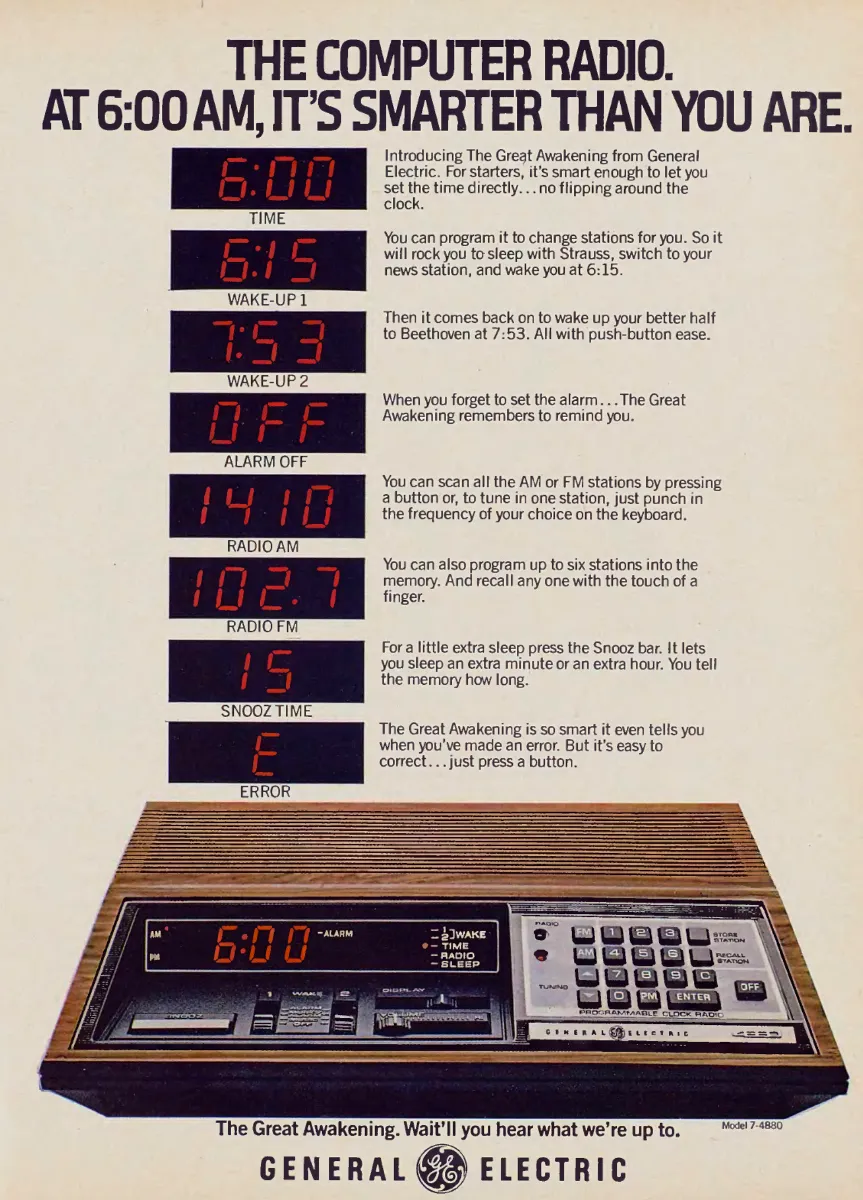
THE COMPUTER RADIO. AT 6:00 AM, IT'S SMARTER THAN YOU ARE. 6:00 — TIME Introducing The Great Awakening from General Electric. For starters, it's smart enough to let you set the time directly...no flipping around the clock. 6:15 — WAKE-UP 1 You can program it to change stations for you. So it will rock you to sleep with Strauss, switch to your news station, and wake you at 6:15. 7:53 — WAKE-UP 2 Then it comes back on to wake up your better half to Beethoven at 7:53. All with push-button ease. OFF — ALARM OFF When you forget to set the alarm...The Great Awakening remembers to remind you. 1410 — RADIO AM You can scan all the AM or FM stations by pressing a button or, to tune in one station, just punch in the frequency of your choice on the keyboard. 102.7 — RADIO FM You can also program up to six stations into the memory. And recall any one with the touch of a finger. 15 — SNOOZ TIME For a little extra sleep press the Snooz bar. It lets you sleep an extra minute or an extra hour. You tell the memory how long. E — ERROR The Great Awakening is so smart it even tells you when you've made an error. But it's easy to correct...just press a button. The Great Awakening. Wait'll you hear what we're up to. Model 7-4880 GENERAL ELECTRIC
Commentary
The first clue is the row of red numerals. Each display is a little scene in a morning routine: 6:00 for the time, 6:15 for one wake-up, 7:53 for another, then an alarm setting, AM and FM frequencies, a snooze interval, and finally an error code. The woodgrain radio waits at the bottom like the machine that can keep all these promises. General Electric calls it “The Computer Radio,” but the ad does not show a screen or an office. It puts computing power on a bedside table.
The headline teases a tired reader: at 6:00 AM, the radio is “smarter than you are.” The body turns that joke into a list of programmable conveniences. The listener can go to sleep with Strauss, wake to news, and let a “better half” wake later to Beethoven. Station presets and direct frequency entry avoid turning a tuning dial. The snooze bar can allow a minute or an hour. These are claims visible in the scan, not a test of the hardware. Their arrangement matters: each feature gets a red display and a use case, so a novel electronic control system becomes a sequence of familiar domestic decisions.
The two wake-up times reveal an assumption about shared space and different daily schedules. The radio is imagined as a household coordinator, not simply a music player. Today’s phone can set many alarms, stream music, and display reminders in a smaller object. Yet the physical radio’s large buttons and glowing numerals make its operations visible across a room. The old ad treats programmability itself as an event worth explaining; now it is an expectation.
For a new copywriter, notice how “smarter” personifies the product before the list begins. “You” appears repeatedly, moving each function from a specification to something the reader will do. The eight display labels break up dense explanation into small promises, and “Wait’ll you hear what we’re up to” closes with a radio pun. When a product has many controls, show the user moments those controls solve rather than offering a bare feature inventory.
General Electric traces its history to 1892. The historic GE company now continues through separate businesses including GE Aerospace, GE Vernova, and GE HealthCare; GE says its home appliances business was sold to Haier in 2016. GE’s own home electronics support page includes clock radios among its legacy products.
The promise of a machine that quietly organizes the morning persists in today’s alarms and smart speakers. The ad’s separate AM/FM presets, keypad tuning, and self-consciously “computer” identity have changed. Its lasting design move is to translate technical memory into small gifts of time and control for the household.