Back to the collection259 / 281
Electronics 1976
Memorex
Is it live, or is it Memorex?
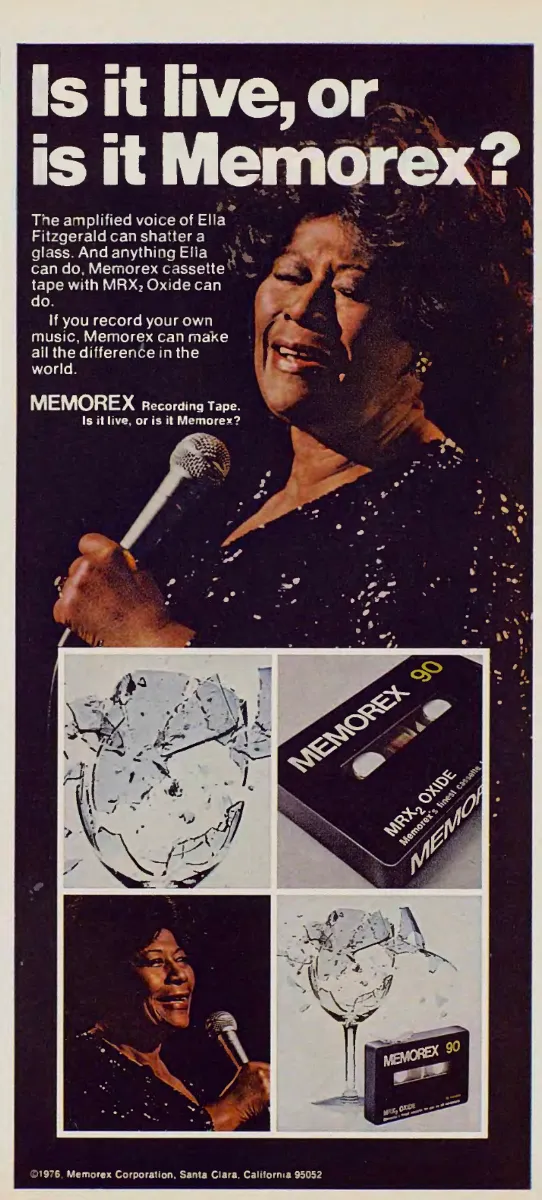
FROM THE PRINTED PAGEOriginal ad copy
OCR transcription from the archived page. Scanning and reading-order errors may remain.
Is it live, or is it Memorex? The amplified voice of Ella Fitzgerald can shatter a glass. And anything Ella can do, Memorex cassette tape with MRX₂ Oxide can do. If you record your own music, Memorex can make all the difference in the world. MEMOREX Recording Tape. Is it live, or is it Memorex? MEMOREX 90 MRX₂ OXIDE Memorex’s finest cassette ©1976, Memorex Corporation, Santa Clara, California 95052
Commentary
I looked for the cassette and found it in the supporting cast. Ella Fitzgerald occupies the large photograph, singing into a microphone; the product appears below among broken glasses and another image of her performance. Memorex lets a person establish the standard and asks a small plastic object to inherit it.
The body copy makes that transfer explicit. Fitzgerald’s amplified voice can shatter glass, it says, and the tape can reproduce what she can do. The four-panel arrangement supplies the shape of a comparison: singer, cassette, visible consequences. Print cannot play either version for us. The glass becomes a visual substitute for hearing, turning a claim about fidelity into a memorable physical event.
That substitution deserves care. A photograph of broken stemware does not establish every property of a recording medium, and the ad supplies no measurement protocol. Its persuasive claim is equivalence in a spectacular demonstration. The phrase “amplified voice” is an important qualification: this is not simply a claim about an unassisted human voice. Keeping that word preserves the argument the advertiser actually made.
The second paragraph tells us why the demonstration matters to an ordinary buyer: “If you record your own music.” The reader is expected to choose the material on which a performance will survive. Today many listeners encounter music through files or services without selecting a physical recording stock. Fidelity still matters, but the decision has moved across a larger chain of recording, encoding, delivery and playback, making a branded blank cassette a less familiar place to locate responsibility.
For beginning copywriters, the headline offers a useful lesson in category confidence. “Live” names a condition; “Memorex” names a brand. Putting them on opposite sides of “or” invites readers to treat the brand as a plausible alternative to the original event. The repeated question keeps that challenge available at both large and small sizes. It works here because the supporting scene gives the otherwise abstract comparison a specific voice and consequence.
Memorex began in 1961 producing professional magnetic tape, according to the Computer History Museum. The name now appears across a broader consumer electronics assortment on the current Memorex storefront, including personal audio, speakers and tablets.
The desire to preserve a performance remains understandable, and the headline still expresses it with unusual economy. The present storefront’s varied products should not be confused with continuity of this particular tape formulation. MRX₂, a ninety-minute cassette and the glass-breaking comparison belong to the historical offer on this page.