Consumer Goods 1976
Jack Daniel’s
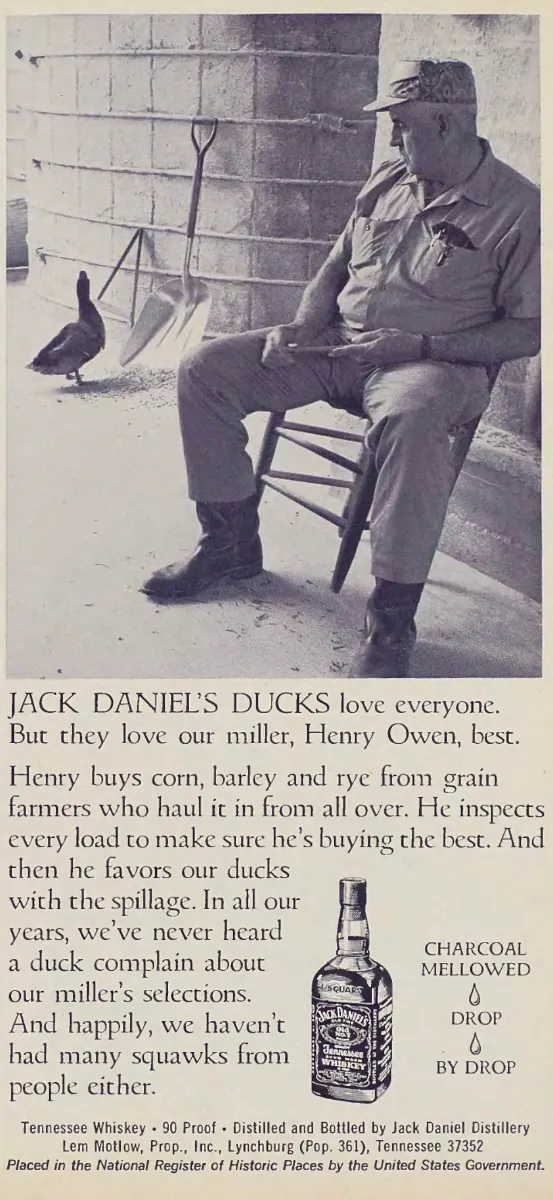
Jack Daniel’s ducks love everyone. But they love our miller, Henry Owen, best.
FROM THE PRINTED PAGEOriginal ad copy
OCR transcription from the archived page. Scanning and reading-order errors may remain.
JACK DANIEL’S DUCKS love everyone. But they love our miller, Henry Owen, best. Henry buys corn, barley and rye from grain farmers who haul it in from all over. He inspects every load to make sure he’s buying the best. And then he favors our ducks with the spillage. In all our years, we’ve never heard a duck complain about our miller’s selections. And happily, we haven’t had many squawks from people either. JACK DANIEL’S Old No. 7 Brand Tennessee WHISKEY CHARCOAL MELLOWED DROP BY DROP Tennessee Whiskey • 90 Proof • Distilled and Bottled by Jack Daniel Distillery Lem Motlow, Prop., Inc., Lynchburg (Pop. 361), Tennessee 37352 Placed in the National Register of Historic Places by the United States Government.
Commentary
I followed Henry Owen’s gaze down to the duck. He sits beside a rough wall with a shovel nearby, looking at a bird rather than presenting a bottle. The photograph gives almost all its space to an interval around work. Jack Daniel’s then uses the caption to tell us why this particular man matters.
Henry buys corn, barley and rye and inspects every incoming load. That is the substantive quality argument. The ducks receive the spillage, turning a routine material-handling detail into a second, comic inspection system. Their appetite cannot prove the quality of finished whiskey. It can, however, give readers an easy way to remember the person responsible for selecting its ingredients.
The page’s restraint is deliberate. The bottle is small, the photograph monochrome, the chair ordinary. Beneath the anecdote, the charcoal-mellowing statement and formal distillery address return the reader to the product. Even the parenthetical population figure makes the place feel inspectably small. My reading is that the ad wants industrial production to remain imaginable at the scale of a named worker, a delivery and a few birds.
There is a changed expectation here about access to work. The magazine supplies one selected glimpse behind the distillery wall, enough to suggest familiarity without revealing the whole operation. A present-day visitor can seek tours, videos and extensive production accounts before buying. The useful comparison is about evidence: a quiet photograph can still humanize a process, but it is one editorially chosen view rather than a complete account of labor or quality control.
For a young copywriter, the hinge is “squawks.” The word belongs literally to birds and figuratively to complaints, allowing the final sentence to move from ducks to customers without a new argument. “Our miller” and the full name give the company a neighborly voice while keeping a specific job in view. The lesson is to make the human detail explain a product-relevant action before the joke closes it.
Jack Daniel’s is a Tennessee whiskey brand made in Lynchburg and owned by Brown-Forman, which acquired the distillery in 1956. The company’s brand profile describes its continuing charcoal-mellowed whiskey production, while the distillery background documents its ownership and product range.
Care in ingredient selection and a recognizable place of origin remain intelligible promises. This scan establishes neither today’s population nor the present workforce, and its 90-proof specification is part of the historical advertisement. The enduring technique is to let a small event make a production standard easier to picture.