Electronics 1976
JBL
Turn it up.
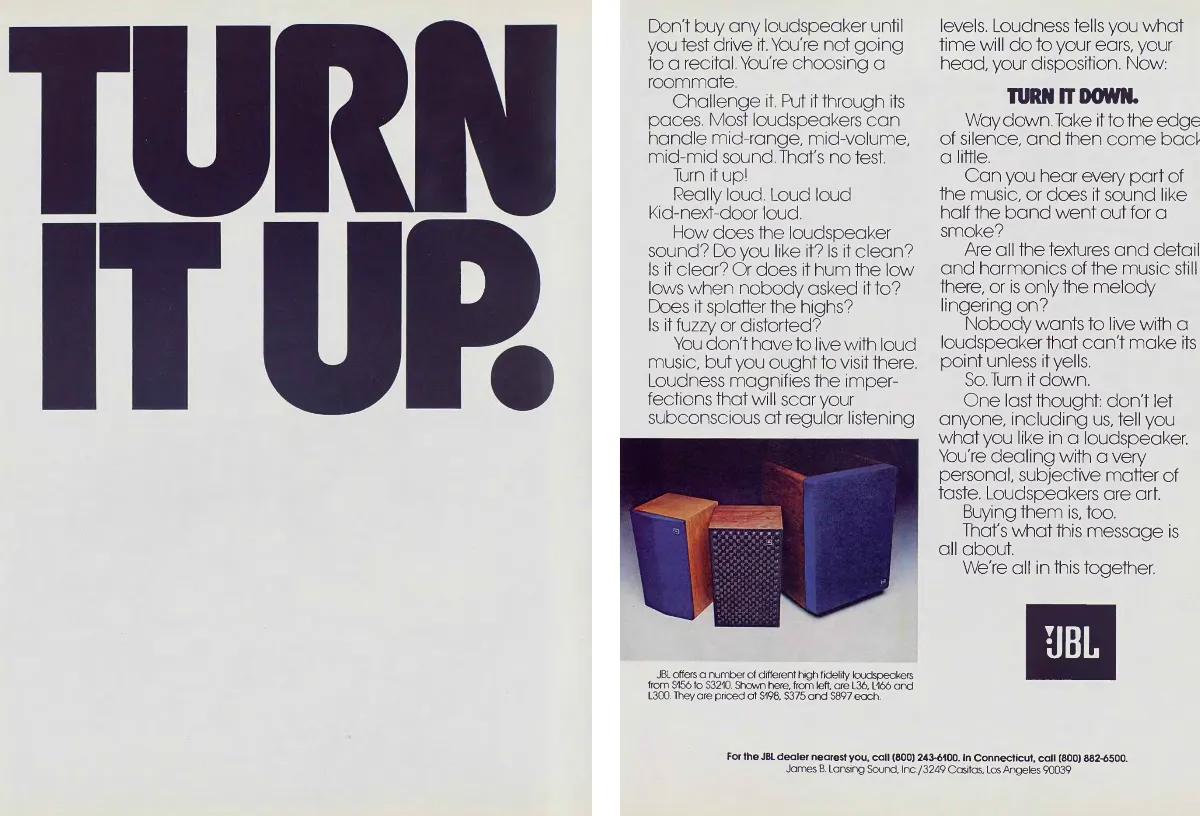
FROM THE PRINTED PAGEOriginal ad copy
OCR transcription from the archived page. Scanning and reading-order errors may remain.
TURN IT UP. Don’t buy any loudspeaker until you test drive it. You’re not going to a recital. You’re choosing a roommate. Challenge it. Put it through its paces. Most loudspeakers can handle mid-range, mid-volume, mid-mid sound. That’s no test. Turn it up! Really loud. Loud loud. Kid-next-door loud. How does the loudspeaker sound? Do you like it? Is it clean? Is it clear? Or does it hum the low lows when nobody asked it to? Does it splatter the highs? Is it fuzzy or distorted? You don’t have to live with loud music, but you ought to visit there. Loudness magnifies the imperfections that will scar your subconscious at regular listening levels. Loudness tells you what time will do to your ears, your head, your disposition. Now: TURN IT DOWN. Way down. Take it to the edge of silence, and then come back a little. Can you hear every part of the music, or does it sound like half the band went out for a smoke? Are all the textures and detail and harmonics of the music still there, or is only the melody lingering on? Nobody wants to live with a loudspeaker that can’t make its point unless it yells. So. Turn it down. One last thought: don’t let anyone, including us, tell you what you like in a loudspeaker. You’re dealing with a very personal, subjective matter of taste. Loudspeakers are art. Buying them is, too. That’s what this message is all about. We’re all in this together. JBL offers a number of different high fidelity loudspeakers from $156 to $3210. Shown here, from left, are L36, L166 and L300. They are priced at $198, $375 and $897 each. JBL For the JBL dealer nearest you, call (800) 243-6100. In Connecticut, call (800) 882-6500. James B. Lansing Sound, Inc./3249 Casitas, Los Angeles 90039
Commentary
I initially read only three words. JBL gives “TURN IT UP” nearly an entire page, then lets the reader cross the gutter into a much quieter arrangement of narrow columns. The spread demonstrates a change of volume before its instructions explain why that change matters.
The useful surprise is the second command: turn it down. Loud playback is presented as a way to expose distortion; quiet playback becomes a test of whether the musical parts remain audible. The copy asks readers to notice textures, harmonics and missing instruments rather than surrender to sheer force. I read the giant opening as bait that earns a more discriminating argument. These are the advertiser’s listening instructions, not a standardized laboratory test.
JBL also makes a conspicuous concession. Buyers should refuse anyone’s taste judgment, “including us.” That can sound disinterested, but the brand still chooses the examination and offers its own products underneath it. Three wooden cabinets anchor the essay in a purchase: L36, L166 and L300, with prices quoted per speaker. The brand gives away a method while placing its merchandise conveniently beside the lesson.
The dealer-finding telephone numbers show how much work stood between a magazine reader and an audition. Product discovery had a separate conversational step before the listening began. Online specifications and reviews can now compress that search, but a recording of a speaker cannot reproduce every aspect of hearing it in a particular room. The page’s insistence on personal experience retains a practical reason to exist.
For new copywriters, study the household vocabulary. A speaker is a “roommate,” a band might leave “for a smoke,” and an inadequate cabinet “yells.” Those images translate audio evaluation into social behavior. “Loud loud” gains insistence through repetition, while “So. Turn it down.” slows the voice with a full stop. Matching sentence rhythm to the action makes technical advice feel like a person guiding an audition.
JBL’s history traces its founding by James B. Lansing to 1946. Now a HARMAN audio brand, it supplies portable speakers, headphones and home audio alongside its professional sound heritage; its 80th-anniversary account describes that continuing range.
Listening for oneself remains a credible promise in a market full of specifications. The telephone directory service, cabinet models and prices are historical particulars. What carries forward is the confidence to teach customers a demanding way to choose, then accept that their preference is part of the answer.