Electronics 1981
Mattel Electronics
Computer Chess checkmates the leading competitor.
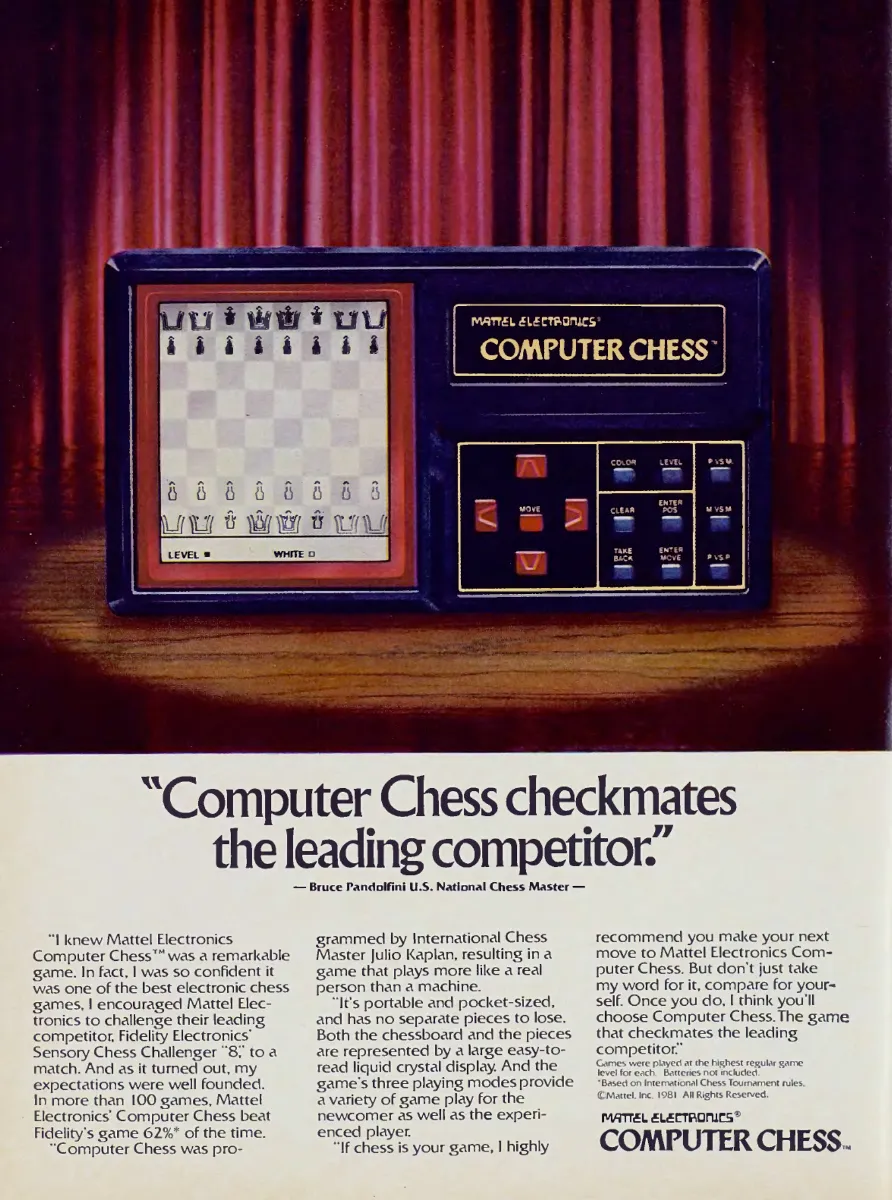
FROM THE PRINTED PAGEOriginal ad copy
OCR transcription from the archived page. Scanning and reading-order errors may remain.
MATTEL ELECTRONICS’ COMPUTER CHESS™ LEVEL ■ WHITE □ COLOR LEVEL P VS U MOVE CLEAR ENTER POS M VS M TAKE BACK ENTER MOVE P VS P “Computer Chess checkmates the leading competitor.” — Bruce Pandolfini U.S. National Chess Master — “I knew Mattel Electronics Computer Chess™ was a remarkable game. In fact, I was so confident it was one of the best electronic chess games, I encouraged Mattel Electronics to challenge their leading competitor, Fidelity Electronics’ Sensory Chess Challenger ‘8’, to a match. And as it turned out, my expectations were well founded. In more than 100 games, Mattel Electronics’ Computer Chess beat Fidelity’s game 62%* of the time. “Computer Chess was programmed by International Chess Master Julio Kaplan, resulting in a game that plays more like a real person than a machine. “It's portable and pocket-sized, and has no separate pieces to lose. Both the chessboard and the pieces are represented by a large easy-to-read liquid crystal display. And the game's three playing modes provide a variety of game play for the newcomer as well as the experienced player. “If chess is your game, I highly recommend you make your next move to Mattel Electronics Computer Chess. But don't just take my word for it, compare for yourself. Once you do, I think you'll choose Computer Chess. The game that checkmates the leading competitor.” Games were played at the highest regular game level for each. Batteries not included. *Based on International Chess Tournament rules. ©Mattel, Inc. 1981 All Rights Reserved. MATTEL ELECTRONICS® COMPUTER CHESS™
Commentary
I started with the curtains. They give the little electronic chessboard a surprisingly formal entrance, as though a small tournament were about to begin on the wooden table. The screen shows the opening arrangement of pieces, not a spectacular victory. To establish superiority, the picture has to hand the argument to the man speaking beneath it.
Bruce Pandolfini’s name and U.S. National Chess Master credential sit directly under the headline. His account then makes expertise active: he says he encouraged Mattel to challenge Fidelity’s Sensory Chess Challenger “8.” That named opponent matters. “Leading competitor” becomes a particular machine, and the claimed 62% win rate becomes a reported result from more than 100 games. The small print qualifies the comparison with the highest regular game level for each and International Chess Tournament rules. It does not give us the game records, so I would read the figure as Mattel’s published claim, not an independently reproduced test.
The testimonial quietly changes subjects halfway through. Programming by Julio Kaplan promises a more human opponent; the LCD promises fewer lost pieces; three modes accommodate different players. Competitive strength gets attention, but convenience gives the reader a reason to keep the machine nearby. “Batteries not included” is the least glamorous sentence on the page and perhaps the most useful at the shop counter.
A dedicated object was needed here to make a board and opponent portable together. A phone can now put both on a general-purpose screen, making the absence of loose pieces seem unremarkable. The ad catches that convenience before it disappeared into everyday expectation: electronic representation itself could be a selling point.
For new copywriters, “checkmates” lets one verb describe a chess result and a commercial defeat. “Make your next move” extends the same vocabulary into the buying instruction. Notice that the headline’s neat wordplay is followed by a number and a named rival. A practical lesson is to make a metaphor carry the opening, then supply evidence precise enough for readers to examine.
Mattel was founded in 1945 and today describes a business spanning toys, content and digital experiences. Mattel Electronics belongs to an earlier chapter in that history; Atari’s Intellivision history documents the division’s console activity and Mattel’s withdrawal from that software business in 1984.
The need to judge an electronic opponent’s strength survives, as does the usefulness of a knowledgeable endorser. The particular machine, battery requirement and comparison set do not. The most durable advertising idea is to connect a test result to the ordinary pleasure of having someone—or something—ready for a game.