Automotive 1981
Honda
Today, building a motorcycle has become practically a science. At Honda it’s still an art.
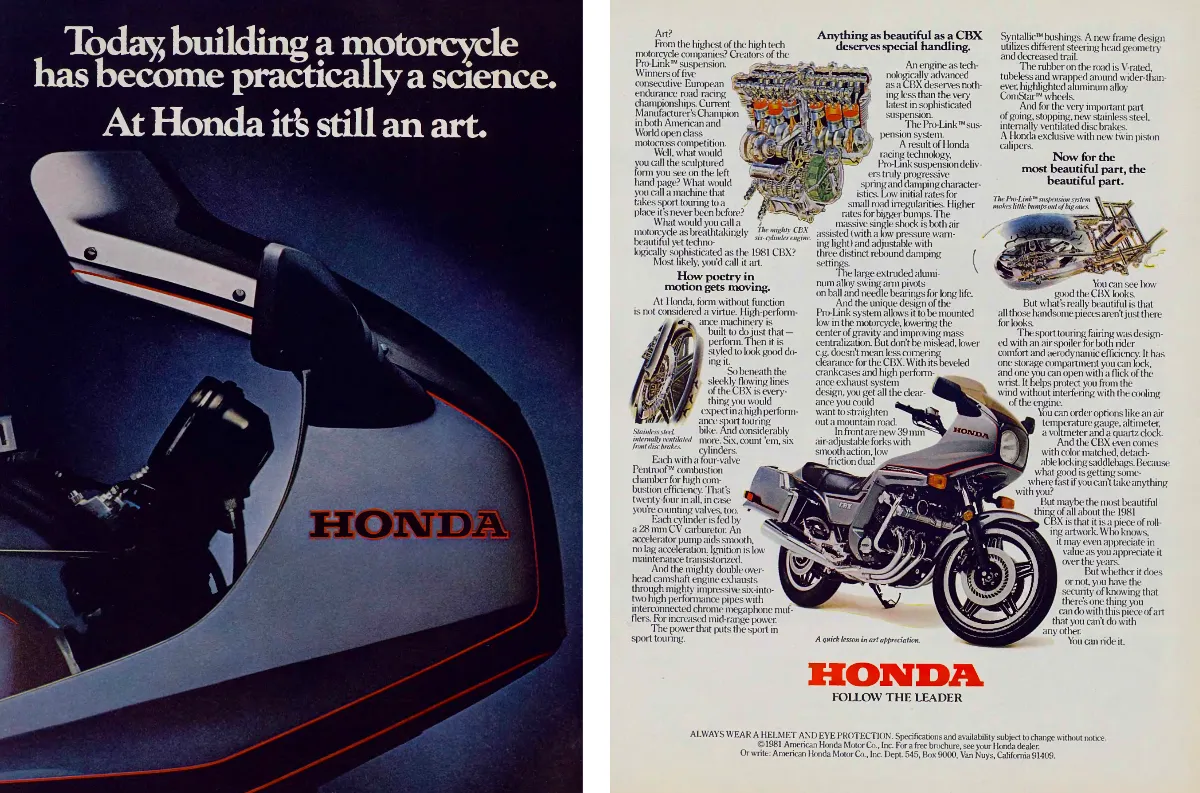
FROM THE PRINTED PAGEOriginal ad copy
OCR transcription from the archived page. Scanning and reading-order errors may remain.
Today, building a motorcycle has become practically a science. At Honda it's still an art. HONDA Art? From the highest of the high tech motorcycle companies? Creators of the Pro-Link™ suspension. Winners of five consecutive European endurance road racing championships. Current Manufacturer's Champion in both American and World open class motocross competition. Well, what would you call the sculptured form you see on the left hand page? What would you call a machine that takes sport touring to a place it's never been before? What would you call a motorcycle as breathtakingly beautiful yet technologically sophisticated as the 1981 CBX? Most likely, you'd call it art. The mighty CBX six-cylinder engine. How poetry in motion gets moving. At Honda, form without function is not considered a virtue. High-performance machinery is built to do just that—perform. Then it is styled to look good doing it. So beneath the sleekly flowing lines of the CBX is everything you would expect in a high performance sport touring bike. And considerably more. Six, count 'em, six cylinders. Each with a four-valve Pentroof™ combustion chamber for high combustion efficiency. That's twenty-four in all, in case you're counting valves, too. Each cylinder is fed by a 28 mm CV carburetor. An accelerator pump aids smooth, no lag acceleration. Ignition is low maintenance transistorized. And the mighty double overhead camshaft engine exhausts through mighty impressive six-into-two high performance pipes with interconnected chrome megaphone mufflers. For increased mid-range power. The power that puts the sport in sport touring. Stainless steel, internally ventilated front disc brakes. Anything as beautiful as a CBX deserves special handling. An engine as technologically advanced as a CBX deserves nothing less than the very latest in sophisticated suspension. The Pro-Link™ suspension system. A result of Honda racing technology, Pro-Link suspension delivers truly progressive spring and damping characteristics. Low initial rates for small road irregularities. Higher rates for bigger bumps. The massive single shock is both air assisted (with a low pressure warning light) and adjustable with three distinct rebound damping settings. The large extruded aluminum alloy swing arm pivots on ball and needle bearings for long life. And the unique design of the Pro-Link system allows it to be mounted low in the motorcycle, lowering the center of gravity and improving mass centralization. But don't be mislead, lower cg. doesn't mean less cornering clearance for the CBX. With its beveled crankcases and high performance exhaust system design, you get all the clearance you could want to straighten out a mountain road. In front are new 39 mm air-adjustable forks with smooth action, low friction dual Syntallic™ bushings. A new frame design utilizes different steering head geometry and decreased trail. The rubber on the road is V-rated, tubeless and wrapped around wider-than-ever, highlighted aluminum alloy ComStar™ wheels. And for the very important part of going, stopping, new stainless steel, internally ventilated disc brakes. A Honda exclusive with new twin piston calipers. Now for the most beautiful part, the beautiful part. The Pro-Link™ suspension system makes little bumps out of big ones. You can see how good the CBX looks. But what's really beautiful is that all those handsome pieces aren't just there for looks. The sport touring fairing was designed with an air spoiler for both rider comfort and aerodynamic efficiency. It has one storage compartment you can lock, and one you can open with a flick of the wrist. It helps protect you from the wind without interfering with the cooling of the engine. You can order options like an air temperature gauge, altimeter, a voltmeter and a quartz clock. And the CBX even comes with color matched, detachable locking saddlebags. Because what good is getting somewhere fast if you can't take anything with you? But maybe the most beautiful thing of all about the 1981 CBX is that it is a piece of rolling artwork. Who knows, it may even appreciate in value as you appreciate it over the years. But whether it does or not, you have the security of knowing that there's one thing you can do with this piece of art that you can't do with any other. You can ride it. A quick lesson in art appreciation. HONDA FOLLOW THE LEADER ALWAYS WEAR A HELMET AND EYE PROTECTION. Specifications and availability subject to change without notice. ©1981 American Honda Motor Co., Inc. For a free brochure, see your Honda dealer. Or write: American Honda Motor Co., Inc. Dept. 545, Box 9000, Van Nuys, California 91409.
Commentary
I had to turn from the left-hand photograph to learn what I was looking at. The close crop makes a mirror, fairing and windscreen into a piece of industrial sculpture. Most of the motorcycle is withheld. Across the gutter, a complete CBX with saddlebags and several cutaway illustrations supply the identification and the explanation. Desire gets a whole page; the evidence is asked to work in much narrower columns.
The advertised change is more substantial than a flattering photograph suggests. Honda Italia’s historical account describes the CBX’s 1981 turn toward touring, with a fairing, luggage and Pro-Link rear suspension. That makes the page’s recurring defence of beauty especially interesting. Honda is asking a reader to find art in equipment that also solves practical problems: wind protection, carrying things, dealing with bumps.
I followed the copy’s cylinder count into a thicket of specifics. Six cylinders become twenty-four valves, then carburettors, suspension rates, a low-pressure warning light and brake construction. This is not an escape from engineering. It is an attempt to make engineering the reason the object deserves admiration. Even “special handling” has two jobs: treatment appropriate to a beautiful possession, and suspension appropriate to a powerful motorcycle.
The optional quartz clock and altimeter make touring feel like an expedition equipped one instrument at a time. Today, Honda’s touring range advertises smartphone integration alongside luggage and mechanical specifications. The comparison is useful because it shows how expectations of information on a journey have changed. Time and navigation can arrive through a connected interface, while comfort and somewhere to put one’s belongings remain stubbornly physical requirements.
For young copywriters, notice how the first sentence establishes a norm and the second makes a brand exception. “Practically” gently qualifies the scientific claim; “still” suggests a quality Honda has preserved. Later, “appreciate” shifts between enjoying an object and gaining value, before “You can ride it” releases the reader from the investment speculation. A lesson here is to let a repeated word gather meanings, then finish with a plain, usable benefit.
Honda was founded in 1948, and motorcycles remain part of its current business. Its touring line now includes the Gold Wing and NT1100, offering different contemporary answers to the combination of distance, performance and comfort.
The CBX’s particular engine and Pro-Link specification belong to this offer, as does the invitation to request a printed brochure by post. The enduring proposition is less exotic: a useful machine can deserve affection for the way its usefulness has been designed. The ad finally makes riding, rather than displaying, the strongest argument for owning its artwork.