Electronics 1987
Magnavox
Magnavox controls Sony.
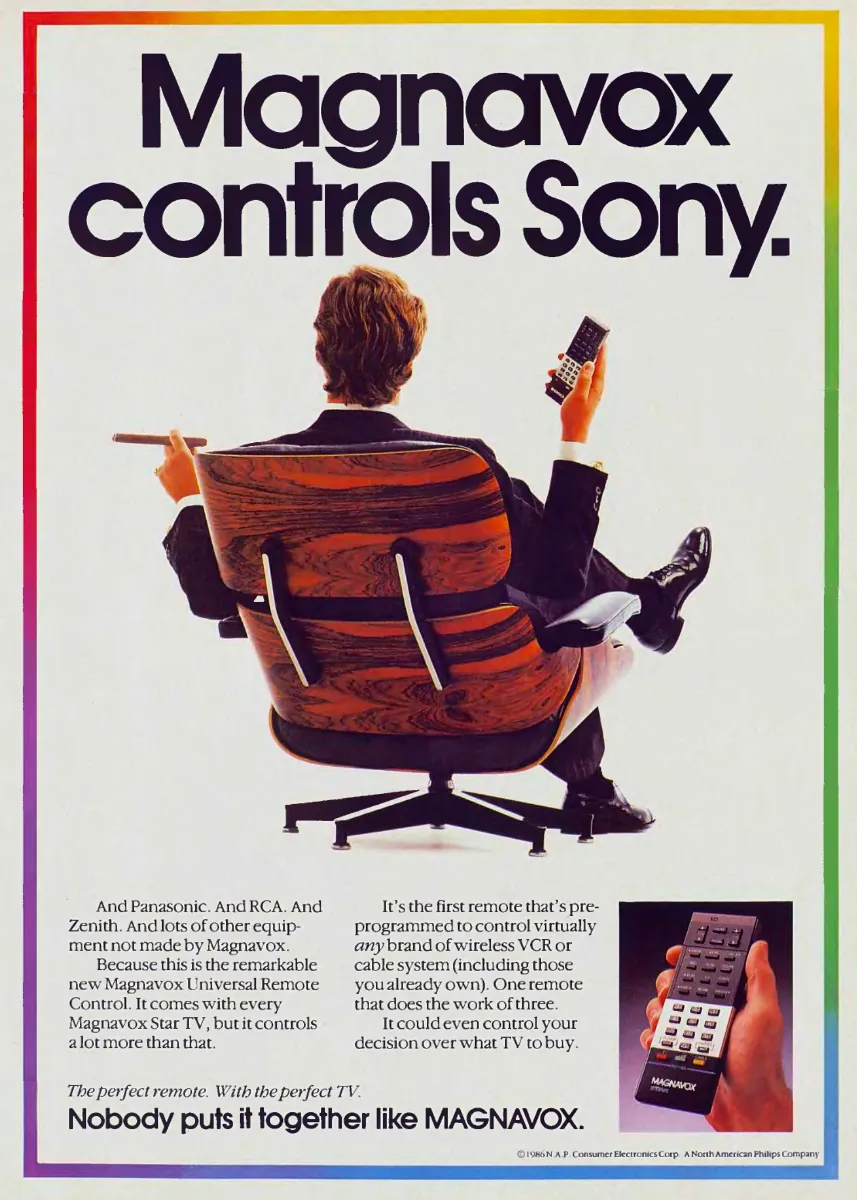
FROM THE PRINTED PAGEOriginal ad copy
OCR transcription from the archived page. Scanning and reading-order errors may remain.
Magnavox controls Sony. And Panasonic. And RCA. And Zenith. And lots of other equipment not made by Magnavox. Because this is the remarkable new Magnavox Universal Remote Control. It comes with every Magnavox Star TV, but it controls a lot more than that. It's the first remote that's pre-programmed to control virtually any brand of wireless VCR or cable system (including those you already own). One remote that does the work of three. It could even control your decision over what TV to buy. The perfect remote. With the perfect TV. Nobody puts it together like MAGNAVOX. MAGNAVOX © 1986 N.A.P. Consumer Electronics Corp. A North American Philips Company
Commentary
I first read this as a boast about corporate power. The enormous headline offers Magnavox as the boss of Sony, and the man beneath it seems appropriately installed: polished shoes, cigar, a richly figured wooden chair. His face is withheld. We are invited to borrow his position, not recognise his personality. Only the small object in his raised hand explains what “controls” means.
The joke turns out to be an unusually practical sales argument. This remote comes with a Magnavox television and operates other manufacturers’ equipment. The copy even mentions things the reader already owns. Rather than demanding a completely new living room, Magnavox offers to make the existing assortment obey. The accessory becomes the reason to choose the expensive principal product. Sony’s name gets the largest competitive billing, but Panasonic, RCA and Zenith extend the evidence below.
The closer I look, the more carefully the page divides aspiration from explanation. Above, the relaxed figure demonstrates command without effort. Below, a separate hand-held close-up lets the reader examine the remote. The colourful border encloses both fantasies: the prosperous television owner and the person trying to stop three controllers disappearing between cushions. There is no specification contest over the screen itself.
The ad’s definition of convenience is revealing. Its household already contains a television, a VCR and a cable system; progress means reducing the number of things required to operate them. A present-day reader juggling apps and device interfaces can recognise that burden even when the VCR has gone. The useful comparison is about coordination, not simply about old equipment becoming smaller.
For a new copywriter, “controls” shows how to build an entire page around one verb. The headline uses its suggestion of dominance, the body establishes its literal function, and the closing sentence turns it toward the buying decision. The repeated “And” makes a compatible-brand list sound like mounting evidence. Crucially, “virtually” qualifies “any brand”; removing that modest word would change the promise. A clever opening works best when the explanation earns it.
Magnavox’s brand history traces its origins to early loudspeaker development and 1917. The scan identifies a North American Philips company. The same brand history records Curtis International’s acquisition of global rights to Magnavox in January 2025; the current product range includes televisions, audio products, appliances and remotes.
The enduring proposition is compatibility as a reason to buy. The specific bundle of Star TV, wireless VCR control and cable-system commands belongs to its hardware moment. The larger design challenge—making several separately purchased products feel manageable—remains a persuasive place to start.