Back to the collection87 / 189
Consumer Goods 1989
Kodak
The genius is in the details.
FROM THE PRINTED PAGEOriginal ad copy
OCR transcription from the archived page. Scanning and reading-order errors may remain.
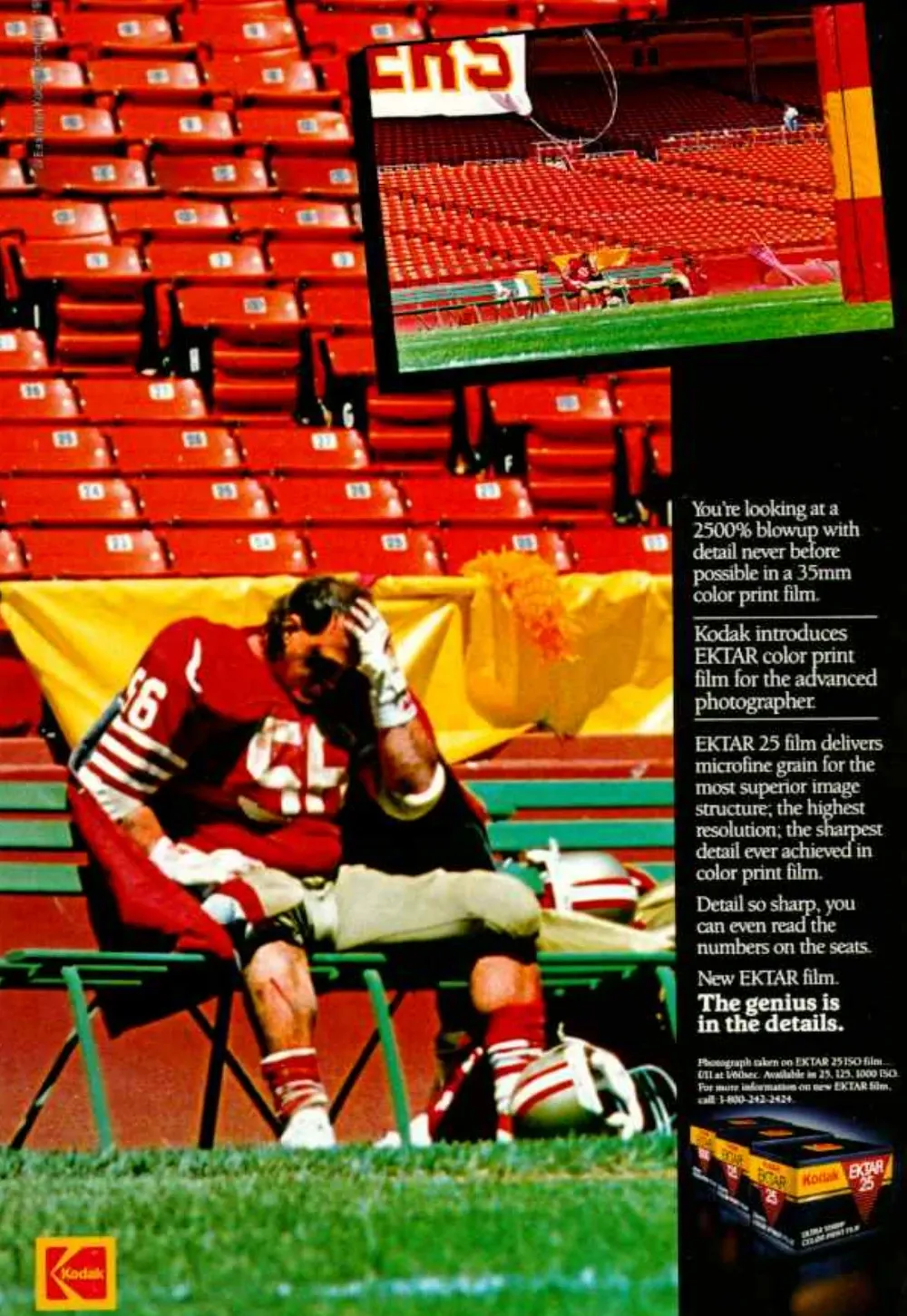
You're looking at a 2500% blowup with detail never before possible in a 35mm color print film. Kodak introduces EKTAR color print film for the advanced photographer. EKTAR 25 film delivers microfine grain for the most superior image structure, the highest resolution; the sharpest detail ever achieved in color print film. Detail so sharp, you can even read the numbers on the seats. New EKTAR film. The genius is in the details. Photograph taken on EKTAR 25/150 film. [Remaining demonstration and availability copy partly illegible.] For more information on new EKTAR film, call 1-800-342-2424. Kodak
Commentary
The football player is a decoy. He occupies most of the page, helmet off, head lowered on the sideline. My eye then finds the smaller inset high above him: a blown-up patch of stadium seating with tiny numbers still visible. Kodak makes a technical claim by inviting an inspection. The reader is meant to look past the obvious subject of the photograph and test what survives in its background.
The vertical black column explains the trick. It calls the inset a “2500% blowup,” then connects its detail to EKTAR 25’s microfine grain and high resolution. This is unusually direct product education for a color film ad. The pictured sports scene supplies color and drama, but the proof lives in the small printed seat numbers. Kodak addresses the “advanced photographer,” someone expected to care about the structure of the image after enlargement, not merely the moment captured. The film carton at the bottom makes the demonstration shoppable only after the reader has been asked to inspect it.
The page also records a different rhythm of photography. A film buyer had to choose a stock before making the image, then rely on processing and a print to see how much detail survived. Modern digital photographs are often checked and enlarged immediately on a screen. The underlying desire—to keep small information intact when an image is scrutinized—has not disappeared. The method of proving it has moved from a printed blowup to a zoom gesture.
For a young copywriter, the lesson is in the move from a large numerical claim to a tiny, verifiable object. “2500%” attracts attention, but “read the numbers on the seats” tells the reader exactly where to look. “The genius is in the details” could be generic on its own; placed after that visual instruction, “details” has a literal referent. The short blocks of white type on black also slow the reader into looking at the photograph between claims.
Kodak has long made photographic materials, and its current still-film catalog includes EKTAR 100. The EKTAR 25 advertised here is a historical film stock, distinct from the film now carrying the EKTAR name.
The enduring promise is image detail that survives enlargement. The claim of unprecedented 35mm color-print sharpness is an advertiser’s period claim, not a present technical benchmark. The creative method—show the audience exactly where a product’s performance can be inspected—remains useful.