Electronics 1978
JBL
JBL’s new L19: Now you don’t have to buy the station to own the speaker.
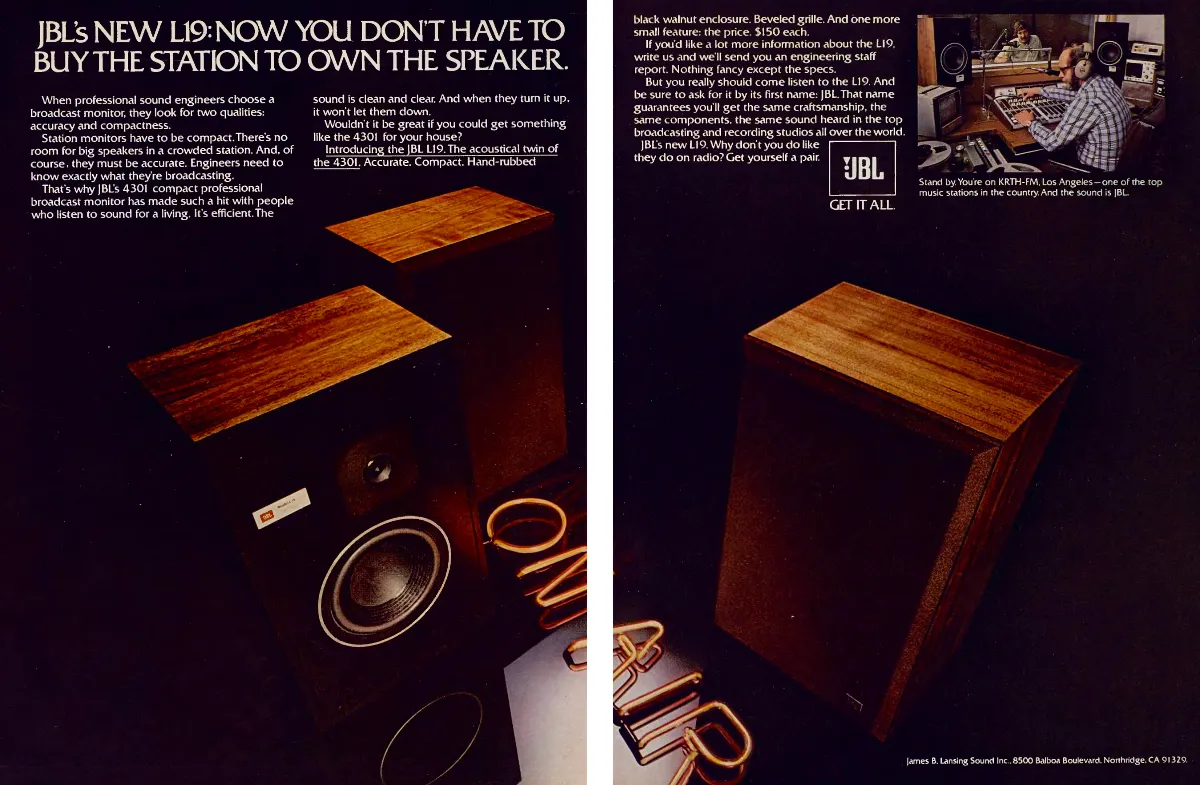
FROM THE PRINTED PAGEOriginal ad copy
OCR transcription from the archived page. Scanning and reading-order errors may remain.
JBL’s NEW L19: NOW YOU DON’T HAVE TO BUY THE STATION TO OWN THE SPEAKER. When professional sound engineers choose a broadcast monitor, they look for two qualities: accuracy and compactness. Station monitors have to be compact. There’s no room for big speakers in a crowded station. And, of course, they must be accurate. Engineers need to know exactly what they’re broadcasting. That’s why JBL’s 4301 compact professional broadcast monitor has made such a hit with people who listen to sound for a living. It’s efficient. The sound is clean and clear. And when they turn it up, it won’t let them down. Wouldn’t it be great if you could get something like the 4301 for your house? Introducing the JBL L19. The acoustical twin of the 4301. Accurate. Compact. Hand-rubbed black walnut enclosure. Beveled grille. And one more small feature: the price. $150 each. If you’d like a lot more information about the L19, write us and we’ll send you an engineering staff report. Nothing fancy except the specs. But you really should come listen to the L19. And be sure to ask for it by its first name: JBL. That name guarantees you’ll get the same craftsmanship, the same components, the same sound heard in the top broadcasting and recording studios all over the world. JBL’s new L19. Why don’t you do like they do on radio? Get yourself a pair. JBL GET IT ALL. Stand by. You’re on KRTH-FM, Los Angeles—one of the top music stations in the country. And the sound is JBL. James B. Lansing Sound Inc., 8500 Balboa Boulevard, Northridge, CA 91329.
Commentary
I followed the bright walnut tops across the dark spread before finding the smaller photograph of a radio studio. That inset is the credential. The large speakers could be attractive furniture on their own; the engineer, console, and KRTH-FM caption explain why these particular boxes should matter. JBL is bringing a professional tool home and keeping its workplace in view.
The headline makes ownership absurdly expensive before making it affordable. You no longer have to buy a station to own its speaker. The body narrows the claim carefully: the L19 is the “acoustical twin” of the 4301, with a hand-rubbed black walnut enclosure and beveled grille. Compactness is justified by crowded studios, accuracy by engineers needing to know what they broadcast. Those explanations turn professional constraints into household benefits. The $150 price is per speaker; the last invitation to get a pair therefore matters to the actual purchase calculation.
The engineering report offered by mail is another small credential. JBL imagines a buyer willing to request specifications, wait for them, and then listen at a dealer. Information is both a service and a test of seriousness. A contemporary product page can provide the report instantly, but it still faces the same argumentative task: explain why a working professional’s requirements should improve the customer’s own experience.
For a young copywriter, the headline’s extravagance is useful because it lands on a concrete relationship between two products. “Accurate. Compact.” makes the benefits sound settled; “Nothing fancy except the specs” lets the brand claim restraint while showing off expertise. “First name: JBL” then makes a technical purchase sociable. The practical lesson is to vary register without losing the chain of proof: joke, explain the shared engineering, invite an audition.
JBL traces its origins to James B. Lansing in 1946 and maintains both consumer and professional sound associations in its brand history. Its present range reaches beyond the passive home loudspeakers shown here.
Professional provenance still gives a consumer product a useful story when the connection is specific. The exact L19/4301 relationship, station caption, mailed report, and price are historical claims attached to this spread. The lasting proposition is access to working expertise in a form that fits the customer’s room and budget.