Automotive 1976
Fiat
For the price of an imitation sports car, you can own the real thing.
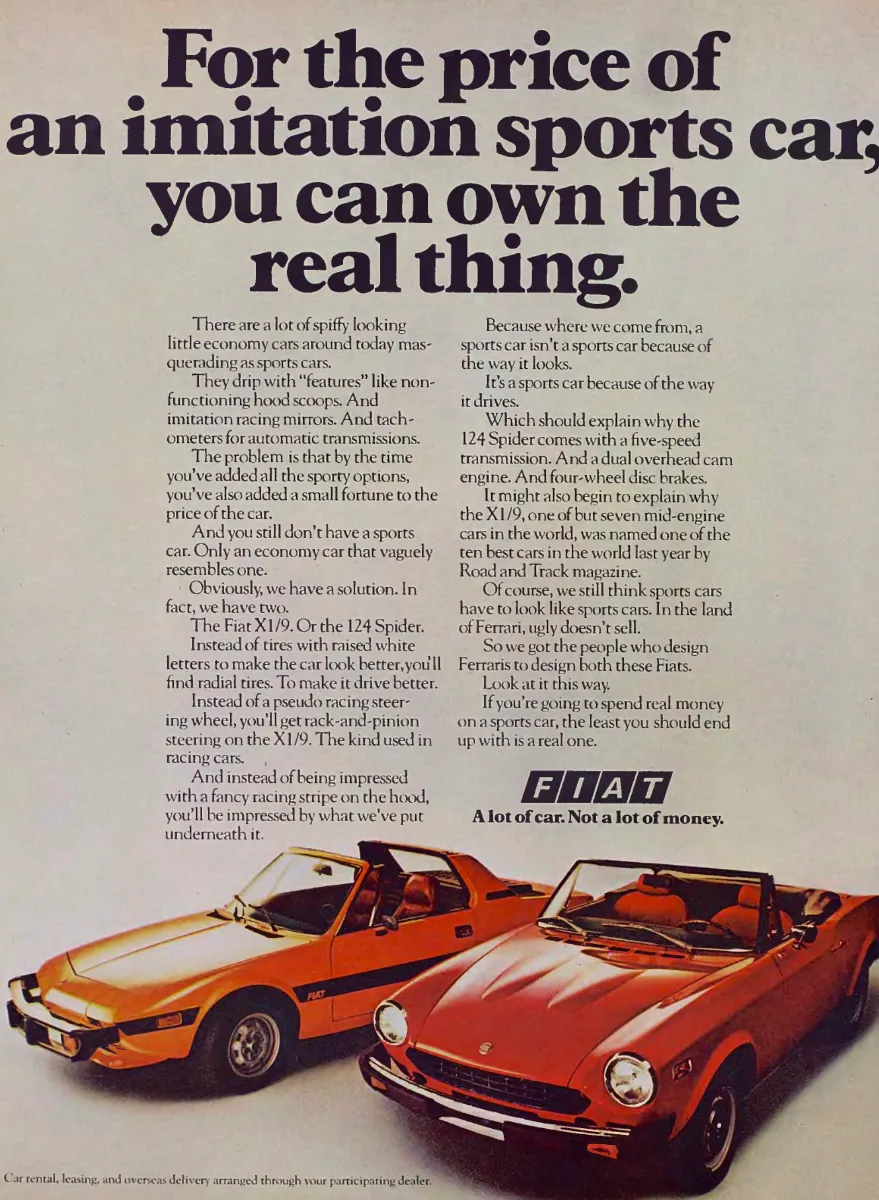
FROM THE PRINTED PAGEOriginal ad copy
OCR transcription from the archived page. Scanning and reading-order errors may remain.
For the price of an imitation sports car, you can own the real thing. There are a lot of spiffy looking little economy cars around today masquerading as sports cars. They drip with “features” like non-functioning hood scoops. And imitation racing mirrors. And tachometers for automatic transmissions. The problem is that by the time you’ve added all the sporty options, you’ve also added a small fortune to the price of the car. And you still don’t have a sports car. Only an economy car that vaguely resembles one. Obviously, we have a solution. In fact, we have two. The Fiat X1/9. Or the 124 Spider. Instead of tires with raised white letters to make the car look better, you’ll find radial tires. To make it drive better. Instead of a pseudo racing steering wheel, you’ll get rack-and-pinion steering on the X1/9. The kind used in racing cars. And instead of being impressed with a fancy racing stripe on the hood, you’ll be impressed by what we’ve put underneath it. Because where we come from, a sports car isn’t a sports car because of the way it looks. It’s a sports car because of the way it drives. Which should explain why the 124 Spider comes with a five-speed transmission. And a dual overhead cam engine. And four-wheel disc brakes. It might also begin to explain why the X1/9, one of but seven mid-engine cars in the world, was named one of the ten best cars in the world last year by Road and Track magazine. Of course, we still think sports cars have to look like sports cars. In the land of Ferrari, ugly doesn’t sell. So we got the people who design Ferraris to design both these Fiats. Look at it this way. If you’re going to spend real money on a sports car, the least you should end up with is a real one. FIAT A lot of car. Not a lot of money. Car rental, leasing, and overseas delivery arranged through your participating dealer.
Commentary
I looked for the price and found no figure. Fiat has put price in the headline, but the argument underneath concerns what the buyer should count as value. Decorative signs of speed are set against mechanisms associated with driving: radial tires, rack-and-pinion steering, a five-speed transmission and disc brakes.
The opening gives the rival car a costume. It is “masquerading,” dripping with quoted “features,” wearing imitation mirrors and a racing stripe. None of the competing manufacturers is named. The reader is asked to recognize a type of purchase: an ordinary product made more expensive by the visible tokens of a desirable category. Fiat then offers two ways out, the X1/9 and 124 Spider.
The photograph complicates the speech in a useful way. The cars themselves are brightly colored, open-topped and arranged for visual appetite. Fiat eventually admits that looks matter, invoking Ferrari and Italian design. My reading is that the concession protects the argument from its own severity. Buyers can want beauty; the ad insists they should also receive machinery that justifies it. Its seven-car count, magazine accolade and design comparison remain claims made by this historical advertisement.
The footnote offers rental, leasing and overseas delivery through a participating dealer. That small line widens the imagined transaction beyond an immediate showroom purchase. Today a buyer can encounter configurations, financing explanations and comparisons before speaking with a dealer; this page expects the dealer to arrange the next layer of detail. The persuasive task of explaining which options change experience and which mainly change appearance is still familiar.
For beginning copywriters, the repeated “Instead of” clauses do the teaching. Each takes a visible token and replaces it with a functional benefit, so the comparison follows the same pattern three times. “Real” then links the opening product definition to the reader’s “real money” at the close. Repetition works here because each return adds a concrete example rather than merely restating superiority.
Fiat was founded in Turin in 1899 and is now part of Stellantis. Its current brand profile emphasizes accessible urban mobility and shows products including the Grande Panda, Topolino and Strada, a different range from these two small sports cars.
The claim to deliver meaningful motoring for attainable money remains recognizable in Fiat’s positioning. The specific mechanical comparisons and sports-car offering belong to this ad. For a designer studying it, the lasting tension is productive: an attractive product still needs an argument about what the attraction buys.