Electronics 1976
JBL
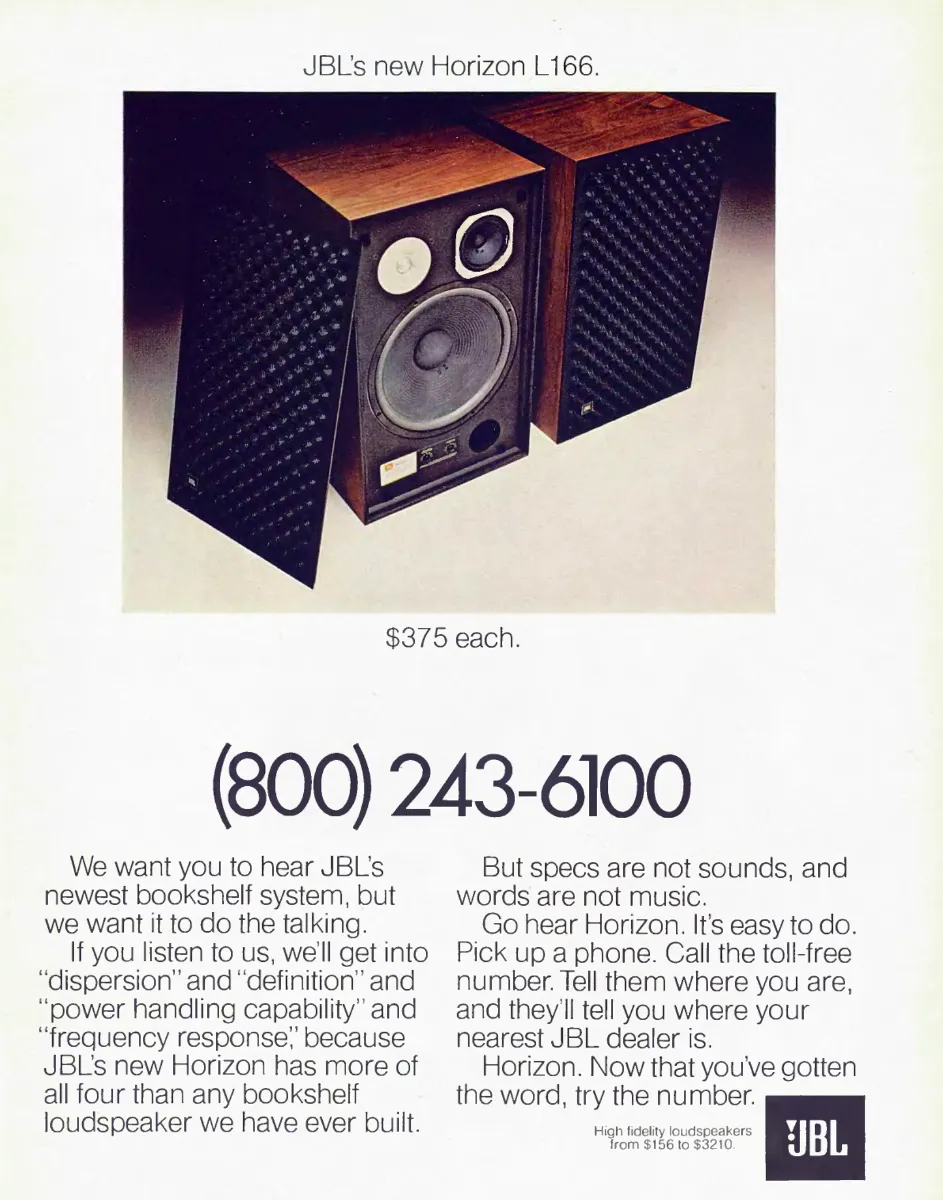
JBL's new Horizon L166.
FROM THE PRINTED PAGEOriginal ad copy
OCR transcription from the archived page. Scanning and reading-order errors may remain.
JBL's new Horizon L166. $375 each. (800) 243-6100 We want you to hear JBL's newest bookshelf system, but we want it to do the talking. If you listen to us, we'll get into “dispersion” and “definition” and “power handling capability” and “frequency response,” because JBL's new Horizon has more of all four than any bookshelf loudspeaker we have ever built. But specs are not sounds, and words are not music. Go hear Horizon. It's easy to do. Pick up a phone. Call the toll-free number. Tell them where you are, and they'll tell you where your nearest JBL dealer is. Horizon. Now that you've gotten the word, try the number. High fidelity loudspeakers from $156 to $3210. JBL
Commentary
The first thing I see is the speaker with its grille pulled aside. JBL shows the drivers, the wood cabinet, and the matching covered speaker next to it, as though it is willing to let the equipment be inspected. Then the page withholds the expected technical lecture. The model and $375 price are matter-of-fact; the largest type below the photograph is a telephone number. The ad is arranged as a small journey from looking, to calling, to listening.
JBL does have a specification story. It lists dispersion, definition, power handling, and frequency response, and claims this Horizon has more of each than any bookshelf model it had built. But the next line refuses to let those terms stand in for experience: “specs are not sounds, and words are not music.” That is a deft piece of buyer education. It gives technically minded readers a reason to take the product seriously while inviting everyone else to use their ears. The image also keeps the physical object in view; one can imagine hearing it only after seeing how it is made.
The enormous toll-free number is the ad’s practical center. A caller tells JBL where they live and gets directed to a dealer for a demonstration. Today a shopper could stream reviews or recordings of a loudspeaker, though those recordings would still be mediated by another playback system. The old arrangement makes a local showroom and a conversation part of evaluating sound.
For a young copywriter, the hinge is the matched sentence “specs are not sounds, and words are not music.” Its two halves use the same structure, moving from the engineer’s vocabulary to the listener’s reason for buying. “Now that you’ve gotten the word, try the number” then turns that argument into a simple next action. A copywriter can learn to name a product’s proof without mistaking the proof for the felt benefit.
JBL traces its loudspeaker business to James B. Lansing in 1946. The company still sells speakers for personal, home, and professional listening; its L166 manual describes the Horizon’s technical design.
The invitation to judge audio by listening remains sound. The phone-based dealer locator and the idea that a print ad must lead buyers to a local demonstration belong to another sales path. This page makes that path unusually visible by turning the contact number into a second headline.