Electronics 1994
NEC
You are an unfinished book.
FROM THE PRINTED PAGEOriginal ad copy
OCR transcription from the archived page. Scanning and reading-order errors may remain.
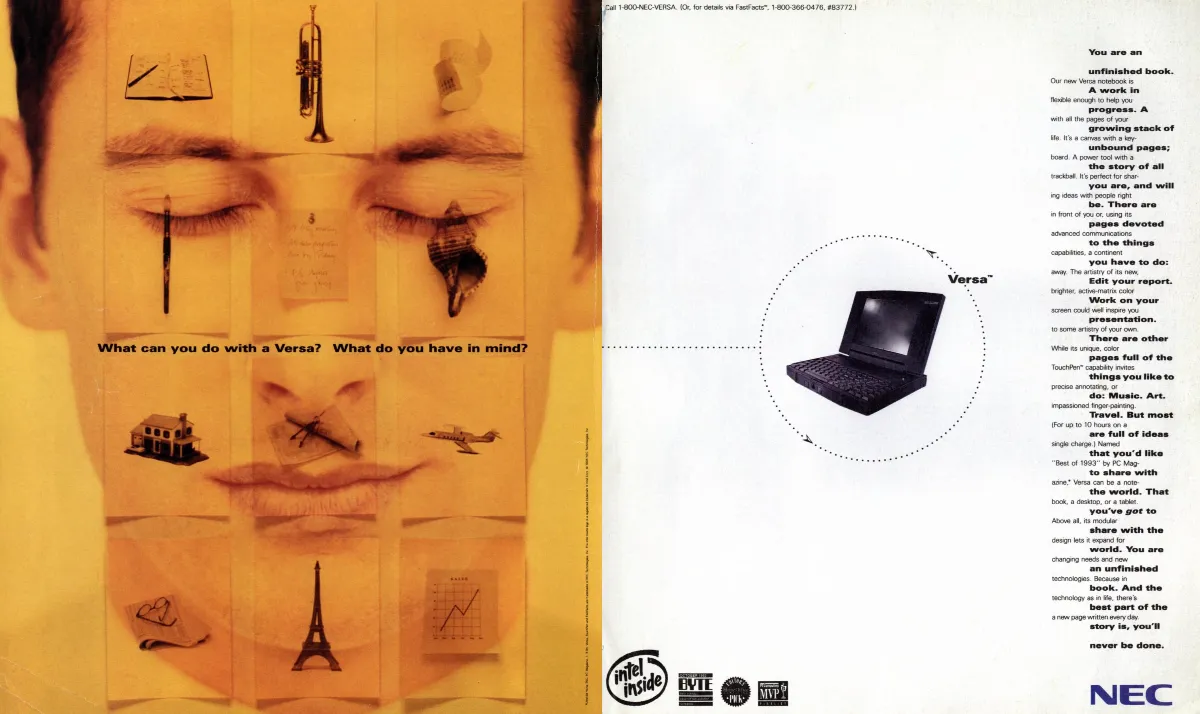
What can you do with a Versa? What do you have in mind? You are an unfinished book. A work in progress. A growing stack of unbound pages; the story of all you are, and will be. There are pages devoted to the things you have to do: Edit your report. Work on your presentation. There are other pages full of the things you like to do: Music. Art. Travel. But most are full of ideas that you'd like to share with the world. That you've got to share with the world. You are an unfinished book. And the best part of the story is, you'll never be done. Our new Versa notebook is flexible enough to help you with all the pages of your life. It's a canvas with a keyboard. A power tool with a trackball. It's perfect for sharing ideas with people right in front of you or, using its advanced communications capabilities, a continent away. The artistry of its new, brighter, active-matrix color screen could well inspire you to some artistry of your own. While its unique, color TouchPen™ capability invites precise annotating, or impassioned finger-painting. (For up to 10 hours on a single charge.) Named “Best of 1993” by PC Magazine,* Versa can be a notebook, a desktop, or a tablet. Above all, its modular design lets it expand for changing needs and new technologies. Because in technology as in life, there's a new page written every day. Call 1-800-NEC-VERSA. (Or, for details via FastFacts™, 1-800-366-0476, #83772.) Versa™ intel inside NEC
Commentary
I start on the left, where a closed-eyed face is divided into a small grid of possible lives: music, travel, a house, an airplane, a chart, a note. The question across the mouth asks what one can do with a Versa, then immediately asks what one has in mind. On the facing panel the actual notebook is small, suspended inside a dotted circle. The hardware is almost a footnote to the person it might accompany.
The far-right column is the real surprise. Two texts occupy the same narrow strip. Large bold words tell the reader, “You are an unfinished book,” while small type threads a product explanation between those declarations. One voice speaks of reports, music, art, travel, and ideas to share; the other names a trackball, active-matrix screen, TouchPen, communications, battery life, and modular expansion. This makes the page physically enact the sales argument: practical machinery is tucked into a larger personal story. The badge for PC Magazine’s “Best of 1993” is a claim printed on the page, not a claim this scan independently verifies.
The “continent away” line makes the communications feature sound expansive. In the same breath, the ad still offers a telephone number and FastFacts line for details. A contemporary reader may take immediate network access and product information for granted; here both are selling points that need explanation. The future-facing metaphor sits inside a more deliberate buying process.
For a beginning copywriter, the repeated “pages” do the structural work. Reports and presentations are pages one “has to” fill; music and travel are pages one “likes to” fill. The large words are broken across many short lines, forcing the eye down the column as if turning pages. Then “you’ll never be done” changes incompleteness from a defect into a reason to choose adaptable equipment. Repetition can persuade when each return adds a new meaning and the layout makes that rhythm visible.
NEC’s history places its first personal computer in 1979. The company remains a technology business, and its Japanese PC offering still includes business notebooks under the VersaPro name.
The durable promise is adaptability to work and interests that change over time. The trackball, pen input, modular expansion, and remote communications details are particular to the 1990s machine. The ad’s strongest move is giving those specifications a human reason to matter.