Automotive 1991
Harley-Davidson
At what point does a fender go from mudguard to a work of art?
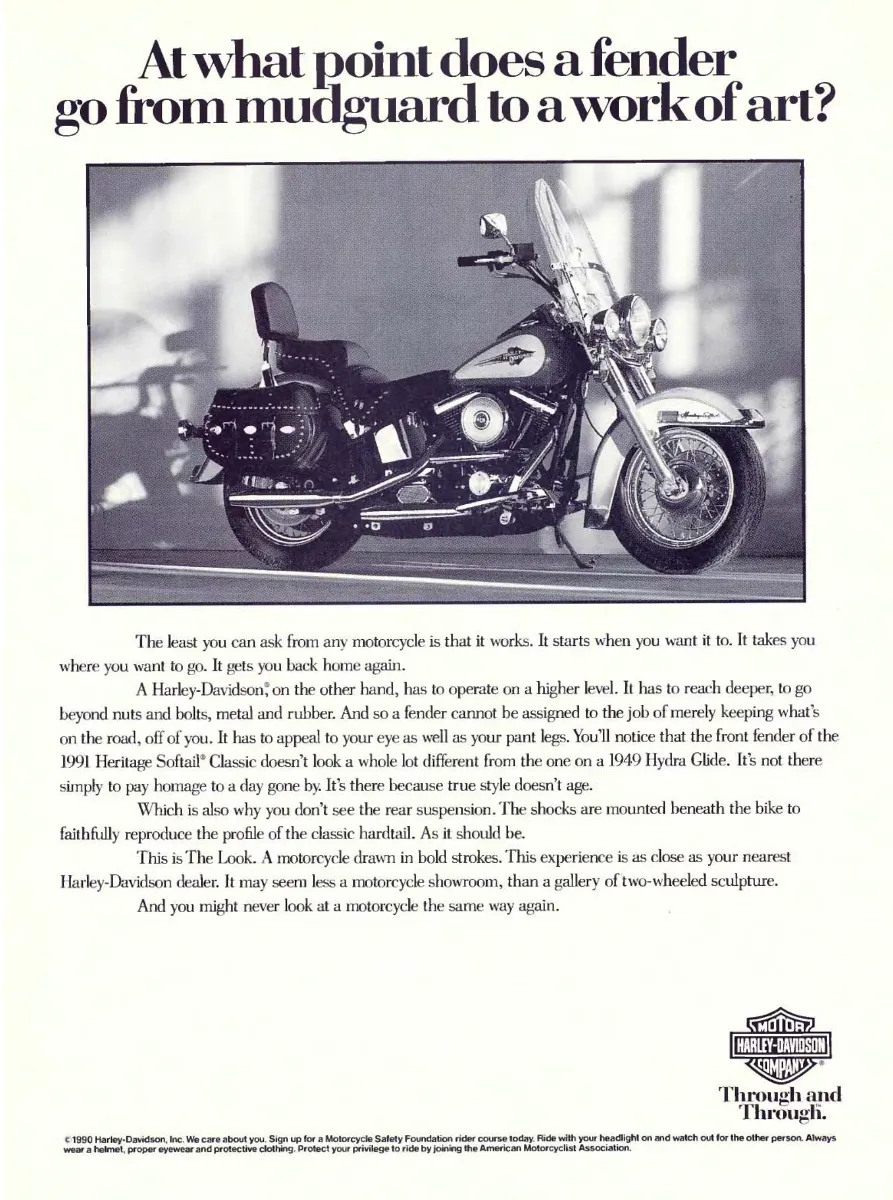
FROM THE PRINTED PAGEOriginal ad copy
OCR transcription from the archived page. Scanning and reading-order errors may remain.
At what point does a fender go from mudguard to a work of art? The least you can ask from any motorcycle is that it works. It starts when you want it to. It takes you where you want to go. It gets you back home again. A Harley-Davidson, on the other hand, has to operate on a higher level. It has to reach deeper, to go beyond nuts and bolts, metal and rubber. And so a fender cannot be assigned to the job of merely keeping what's on the road, off of you. It has to appeal to your eye as well as your pant legs. You'll notice that the front fender of the 1991 Heritage Softail® Classic doesn't look a whole lot different from the one on a 1949 Hydra Glide. It's not there simply to pay homage to a day gone by. It's there because true style doesn't age. Which is also why you don't see the rear suspension. The shocks are mounted beneath the bike to faithfully reproduce the profile of the classic hardtail. As it should be. This is The Look. A motorcycle drawn in bold strokes. This experience is as close as your nearest Harley-Davidson dealer. It may seem less a motorcycle showroom, than a gallery of two-wheeled sculpture. And you might never look at a motorcycle the same way again. MOTOR HARLEY-DAVIDSON COMPANY Through and Through. ©1990 Harley-Davidson, Inc. We care about you. Sign up for a Motorcycle Safety Foundation rider course today. Ride with your headlight on and watch out for the other person. Always wear a helmet, proper eyewear and protective clothing. Protect your privilege to ride by joining the American Motorcyclist Association.
Commentary
The question at the top makes me look for one particular part before I can take in the whole motorcycle. The front fender is large, curved, and brightly outlined against a plain studio background. Then the eye travels through windshield, whitewall tires, saddlebags, and the low line of the rear wheel. Harley-Davidson has made an argument about form by inviting us to inspect the form.
The first paragraph sets a deliberately modest baseline: a motorcycle should start, carry you, and return you home. The ad then raises the standard from transport to taste. Its most revealing detail is hidden rather than displayed. Rear shocks sit beneath the bike so it can retain the outline of an old hardtail. This is engineering in service of appearance, a modern comfort system made almost invisible to protect a historical silhouette. The comparison with the 1949 Hydra Glide supplies the claimed lineage. The scan proves the advertiser made that comparison; it cannot by itself prove that style never ages.
At the foot of the page, a safety message asks riders to wear a helmet and take a course. That practical voice sits below an invitation to see the dealer’s showroom as a sculpture gallery. I read the contrast as a useful reminder that the romance of riding still had to share a page with the responsibility of riding. The nearby dealer was also the place where the two-dimensional promise could be checked in person.
For a new copywriter, “mudguard” and “work of art” are doing more than supplying a clever opposition. One names a lowly job; the other changes the standard of judgment. The question format leaves a brief gap for the photograph to answer, and “The Look,” capitalized in the body, gives that answer a name. Let the image make the claim visible before the prose explains it.
Harley-Davidson continues to sell heritage-styled cruisers. Its current Heritage Classic page describes a motorcycle that combines vintage styling with LED lighting, traction control, and revised suspension; the company’s Softail explanation also describes the hidden-suspension principle.
The old argument still holds for a buyer who wants modern comfort without giving up an inherited outline. Today’s list of electronic and lighting features would complicate the 1991 page’s almost pure appeal to shape. The persistent design question is how much technology can disappear from sight while still improving the ride.