Consumer Goods 1976
Jack Daniel's
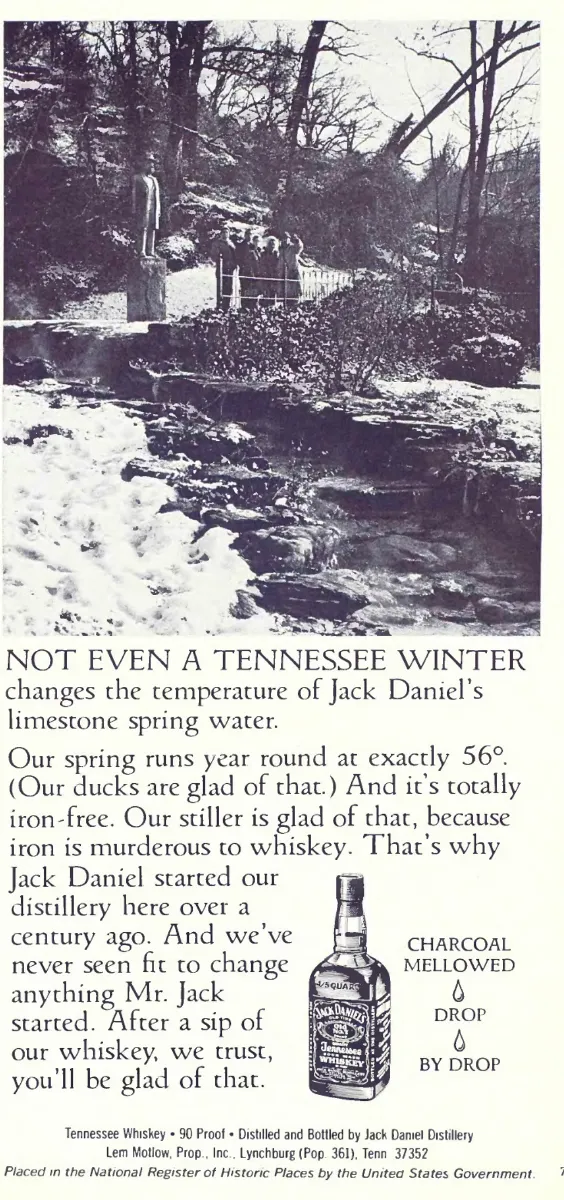
Not even a Tennessee winter changes the temperature of Jack Daniel's limestone spring water.
FROM THE PRINTED PAGEOriginal ad copy
OCR transcription from the archived page. Scanning and reading-order errors may remain.
NOT EVEN A TENNESSEE WINTER changes the temperature of Jack Daniel’s limestone spring water. Our spring runs year round at exactly 56°. (Our ducks are glad of that.) And it’s totally iron-free. Our stiller is glad of that, because iron is murderous to whiskey. That’s why Jack Daniel started our distillery here over a century ago. And we’ve never seen fit to change anything Mr. Jack started. After a sip of our whiskey, we trust, you’ll be glad of that. CHARCOAL MELLOWED DROP BY DROP Tennessee Whiskey • 90 Proof • Distilled and Bottled by Jack Daniel Distillery Lem Motlow, Prop., Inc., Lynchburg (Pop. 361), Tenn 37352 Placed in the National Register of Historic Places by the United States Government.
Commentary
I first looked for the whiskey and found a winter landscape. Snow has settled around a stream; bare branches fill the sky; a statue and a little fenced gathering give the place the air of a local landmark. The bottle, when it finally appears, is small enough to sit beside the closing sentences. Jack Daniel’s is asking me to inspect the address before considering the drink.
The headline makes the photograph into a test. Winter can change the scenery, but the water supposedly holds at precisely 56 degrees. That number is followed by a second production detail, the absence of iron. The ducks approve of one; the stiller approves of the other. A technical explanation has acquired two residents. The brand’s own account of Cave Spring Hollow still describes the water’s steady temperature and its usefulness in production. That supports the importance of the location, although the photograph itself cannot establish either temperature or mineral content.
What interests me is the change of scale. A whole landscape becomes an ingredient, then an ingredient becomes a reason to trust a person’s judgment a century later. The sentence about never changing anything Mr. Jack started is much broader than the evidence. I read it as a declaration of loyalty, not a literal inventory of an unaltered factory. Even the population in the footer makes the company seem locally accountable: this is a place small enough for somebody to know the stiller.
For a new copywriter, follow the repeated landing on “glad of that.” First ducks, then a worker, finally the reader: the phrase carries the benefit from nature through production to consumption. “Murderous” supplies one sharp, memorable word inside otherwise neighbourly speech. The lesson is to give technical facts a conversational rhythm while keeping their actual causal role visible.
The distillery was registered in 1866 and acquired by Brown-Forman in 1956, according to its company background. Brown-Forman’s current portfolio includes Old No. 7, Gentleman Jack, single-barrel whiskeys and flavoured expressions.
That expanding range makes the old insistence on changing nothing especially revealing. The enduring proposition is continuity of place and method; an entirely static business is harder to claim. The snowy spring can still anchor that story, even when the products drawing on it have multiplied.