Electronics 1969
Benjamin
When nations work together…
FROM THE PRINTED PAGEOriginal ad copy
OCR transcription from the archived page. Scanning and reading-order errors may remain.
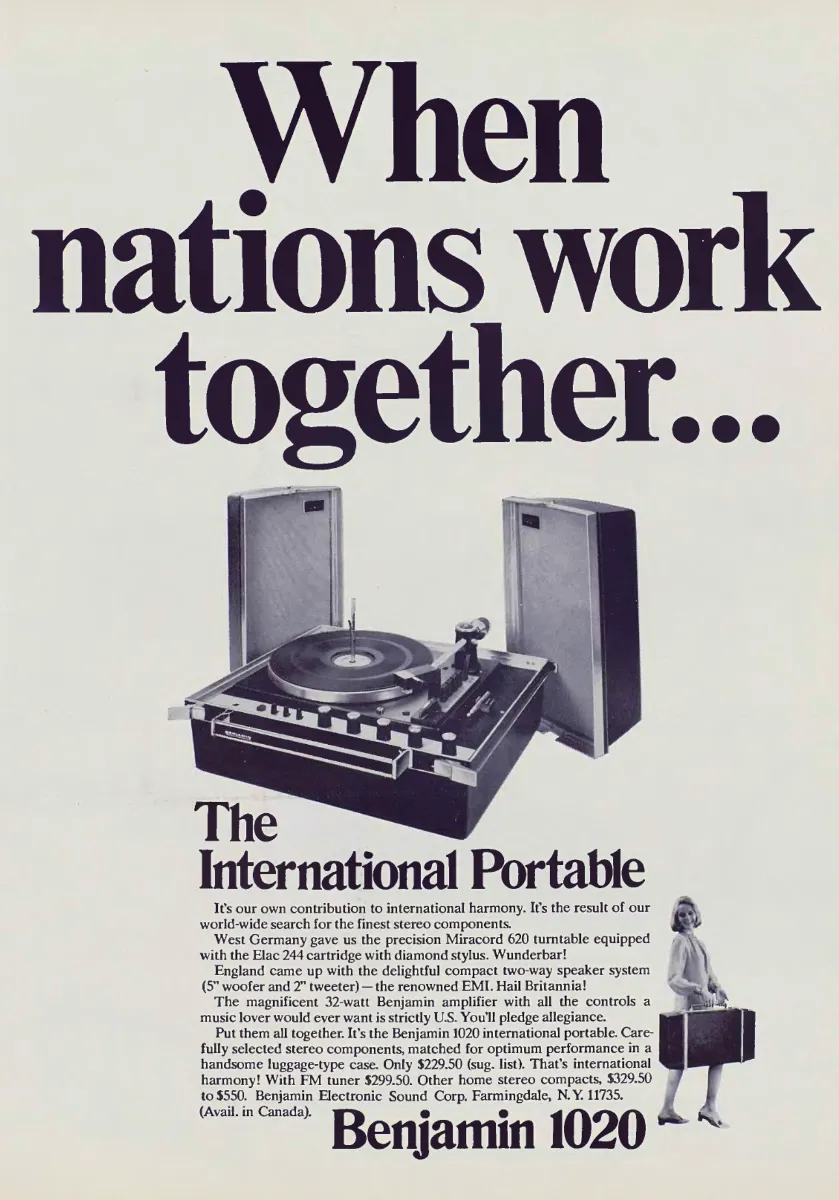
When nations work together... The International Portable It’s our own contribution to international harmony. It’s the result of our world-wide search for the finest stereo components. West Germany gave us the precision Miracord 620 turntable equipped with the Elac 244 cartridge with diamond stylus. Wunderbar! England came up with the delightful compact two-way speaker system (5” woofer and 2” tweeter)—the renowned EMI. Hail Britannia! The magnificent 32-watt Benjamin amplifier with all the controls a music lover would ever want is strictly U.S. You’ll pledge allegiance. Put them all together. It’s the Benjamin 1020 international portable. Carefully selected stereo components, matched for optimum performance in a handsome luggage-type case. Only $229.50 (sug. list). That’s international harmony! With FM tuner $299.50. Other home stereo compacts, $329.50 to $550. Benjamin Electronic Sound Corp. Farmingdale, N.Y. 11735. (Avail. in Canada). Benjamin 1020
Commentary
The headline takes up so much space that I initially expect a statement about diplomacy. Then the eye reaches a turntable and two speakers. That reduction in scale is the joke: international cooperation has produced something that can be carried by its handle. The little photograph of a woman holding the closed case provides the final measurement. The grand announcement ends as luggage.
I follow the component list to see what “international” actually buys. West Germany supplies the Miracord 620 and Elac cartridge; England supplies the EMI speaker system; the American contribution is Benjamin’s 32-watt amplifier. Countries lend reputations, but model numbers, driver sizes and a diamond stylus keep the argument attached to equipment. Benjamin’s role is selection and matching. The buyer is offered the prestige of separate components without having to assemble the system personally.
The open product photograph makes those separate parts visible, while the smaller closed-case image promises that they can travel together. At $229.50 suggested list, with a $299.50 FM option, the portable also has a defined place below the more expensive home compacts named at the end. The page is selling a particular combination of competence, convenience and price, not merely an agreeable sentiment about nations.
The case gives “portable” a physical meaning that a modern listener might overlook. Here, taking music along means moving a record-playing system and its speakers, then setting them up somewhere else. The ad promises transportability, not music playing while someone walks. Compared with a phone and headphones, that distinction reveals how much equipment once accompanied the wish to choose the soundtrack in another room or another home.
For young copywriters, “harmony” is the working word: it connects cooperation among countries with the sound of the assembled stereo. The national sign-offs give three specification paragraphs a repeatable rhythm, with “Wunderbar!” followed by “Hail Britannia!” and a pledge of allegiance. They are deliberately broad cultural shorthand. The useful lesson is that a governing idea should organize the details as well as attract attention; here every component gets a role in the same small diplomatic comedy.
Benjamin Electronic Sound Corp. marketed audio equipment from Farmingdale, New York. A 1971 announcement in Billboard documents its Concord division and parent Instrument Systems Corporation. I could not verify an active present-day Benjamin audio business. Component supplier ELAC still offers speakers and Miracord turntables, but that is a separate company’s continuity.
The enduring proposition is a carefully matched system whose parts justify confidence. The country labels and suitcase format belong to this particular offer; the broader task remains familiar: make the benefit of combining components easier to understand than the work of choosing them.