Automotive 1976
BMW
Introducing the successor to the car that started a cult.
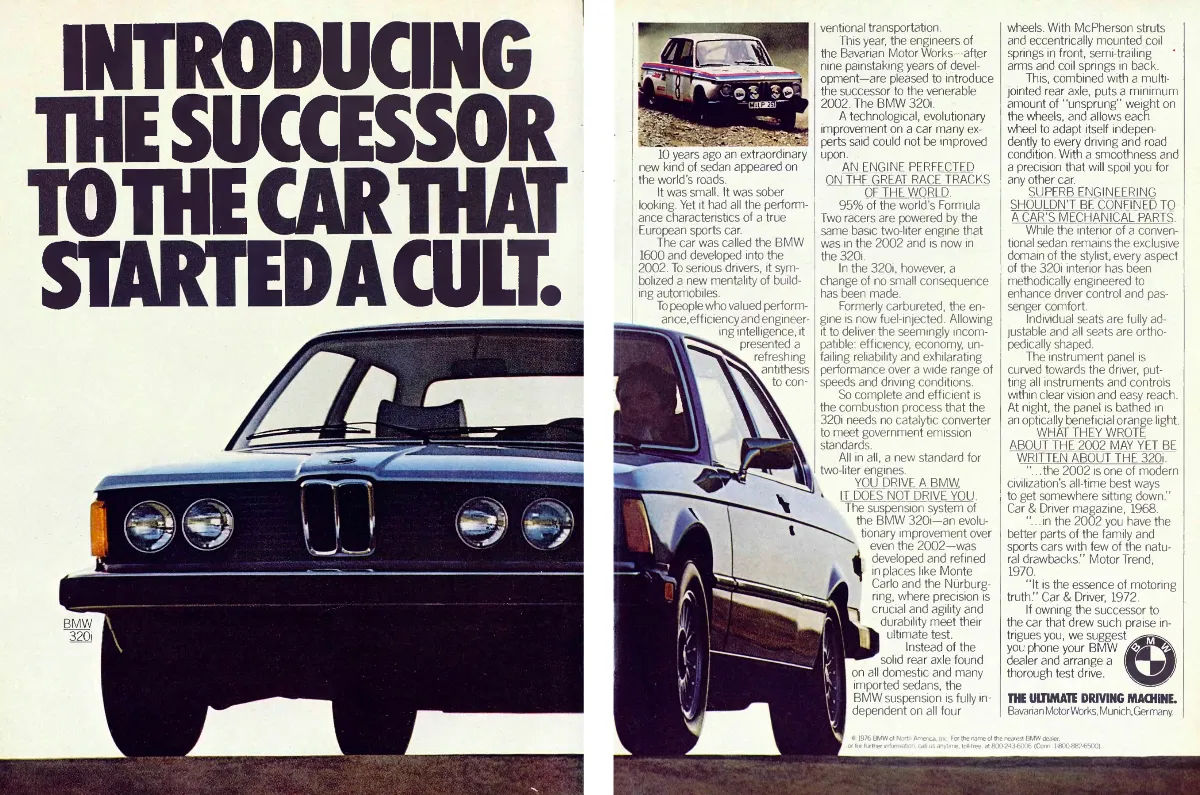
FROM THE PRINTED PAGEOriginal ad copy
OCR transcription from the archived page. Scanning and reading-order errors may remain.
INTRODUCING THE SUCCESSOR TO THE CAR THAT STARTED A CULT. BMW 320i 10 years ago an extraordinary new kind of sedan appeared on the world’s roads. It was small. It was sober looking. Yet it had all the performance characteristics of a true European sports car. The car was called the BMW 1600 and developed into the 2002. To serious drivers, it symbolized a new mentality of building automobiles. To people who valued performance, efficiency and engineering intelligence, it presented a refreshing antithesis to conventional transportation. This year, the engineers of the Bavarian Motor Works—after nine painstaking years of development—are pleased to introduce the successor to the venerable 2002. The BMW 320i. A technological, evolutionary improvement on a car many experts said could not be improved upon. AN ENGINE PERFECTED ON THE GREAT RACE TRACKS OF THE WORLD. 95% of the world’s Formula Two racers are powered by the same basic two-liter engine that was in the 2002 and is now in the 320i. In the 320i, however, a change of no small consequence has been made. Formerly carbureted, the engine is now fuel-injected. Allowing it to deliver the seemingly incompatible: efficiency, economy, unfailing reliability and exhilarating performance over a wide range of speeds and driving conditions. So complete and efficient is the combustion process that the 320i needs no catalytic converter to meet government emission standards. All in all, a new standard for two-liter engines. YOU DRIVE A BMW. IT DOES NOT DRIVE YOU. The suspension system of the BMW 320i—an evolutionary improvement over even the 2002—was developed and refined in places like Monte Carlo and the Nürburgring, where precision is crucial and agility and durability meet their ultimate test. Instead of the solid rear axle found on all domestic and many imported sedans, the BMW suspension is fully independent on all four wheels. With McPherson struts and eccentrically mounted coil springs in front, semi-trailing arms and coil springs in back. This, combined with a multi-jointed rear axle, puts a minimum amount of “unsprung” weight on the wheels, and allows each wheel to adapt itself independently to every driving and road condition. With a smoothness and a precision that will spoil you for any other car. SUPERB ENGINEERING SHOULDN’T BE CONFINED TO A CAR’S MECHANICAL PARTS. While the interior of a conventional sedan remains the exclusive domain of the stylist, every aspect of the 320i interior has been methodically engineered to enhance driver control and passenger comfort. Individual seats are fully adjustable and all seats are orthopedically shaped. The instrument panel is curved towards the driver, putting all instruments and controls within clear vision and easy reach. At night, the panel is bathed in an optically beneficial orange light. WHAT THEY WROTE ABOUT THE 2002 MAY YET BE WRITTEN ABOUT THE 320i. “…the 2002 is one of modern civilization’s all-time best ways to get somewhere sitting down.” Car & Driver magazine, 1968. “…in the 2002 you have the better parts of the family and sports cars with few of the natural drawbacks.” Motor Trend, 1970. “It is the essence of motoring truth.” Car & Driver, 1972. If owning the successor to the car that drew such praise intrigues you, we suggest you phone your BMW dealer and arrange a thorough test drive. THE ULTIMATE DRIVING MACHINE. Bavarian Motor Works, Munich, Germany. © 1976 BMW of North America, Inc. For the name of the nearest BMW dealer, or for further information, call us anytime, toll-free, at 800-243-6006 (Conn. 1-800-882-6500).
Commentary
I started with the enormous word “cult,” then noticed how little the car resembles an object of theatrical devotion. Its blue body is square and sober; the photograph gives the headlights and bumper almost architectural weight. The devotees are being recruited through restraint. BMW’s pitch is that an ordinary-looking sedan can distinguish the person who understands what lies underneath.
There is a succession problem here. Praise for the 2002 could make replacing it sound like a mistake. The ad deals with that by giving the predecessor a biography, introducing a racing photograph, and moving through engine, suspension and cockpit evidence. Only then does it reproduce the old reviews. The careful heading says those words “may yet” be written about the 320i: borrowed prestige, with the transfer still grammatically pending. BMW’s historical record dates the first 3 Series presentation to July 1975 and identifies its driver-oriented cockpit as a defining feature. The supplied 1976 ad belongs to that transition, rather than establishing the model’s launch date.
The most persuasive detail for me is the orange instrument lighting. After racing circuits and suspension terminology, it brings engineering down to something the buyer will see at night. The spread lets the car interrupt the columns, but the text keeps returning to the person inside it. Its intended reader is prepared to spend time with an explanation and then telephone a dealer for a “thorough” test drive. The sales encounter is the next stage of an education already begun on paper.
For young copywriters, “You drive a BMW. It does not drive you” demonstrates how reversing subject and object can turn a mechanical claim into a claim about agency. The short pair also gives the reader a rest between dense technical passages. “Successor” does another job: it makes change sound like inheritance. Both devices work because the following copy supplies tangible reasons to believe them.
BMW continues to sell the 3 Series sedan, now with contemporary powertrain and control technologies. The original E21 sits in the company’s archive as the first generation of that continuing model family.
Driver involvement remains a recognisable promise. The 1976 emissions argument and its sweeping axle comparison belong to this historical advertisement, not to a current buying guide. What survives is the method: make technical refinement legible as something a person can feel, reach and control.