Electronics 1992
Sun Microsystems
Show me one with better ideas, and you’ll get my order.
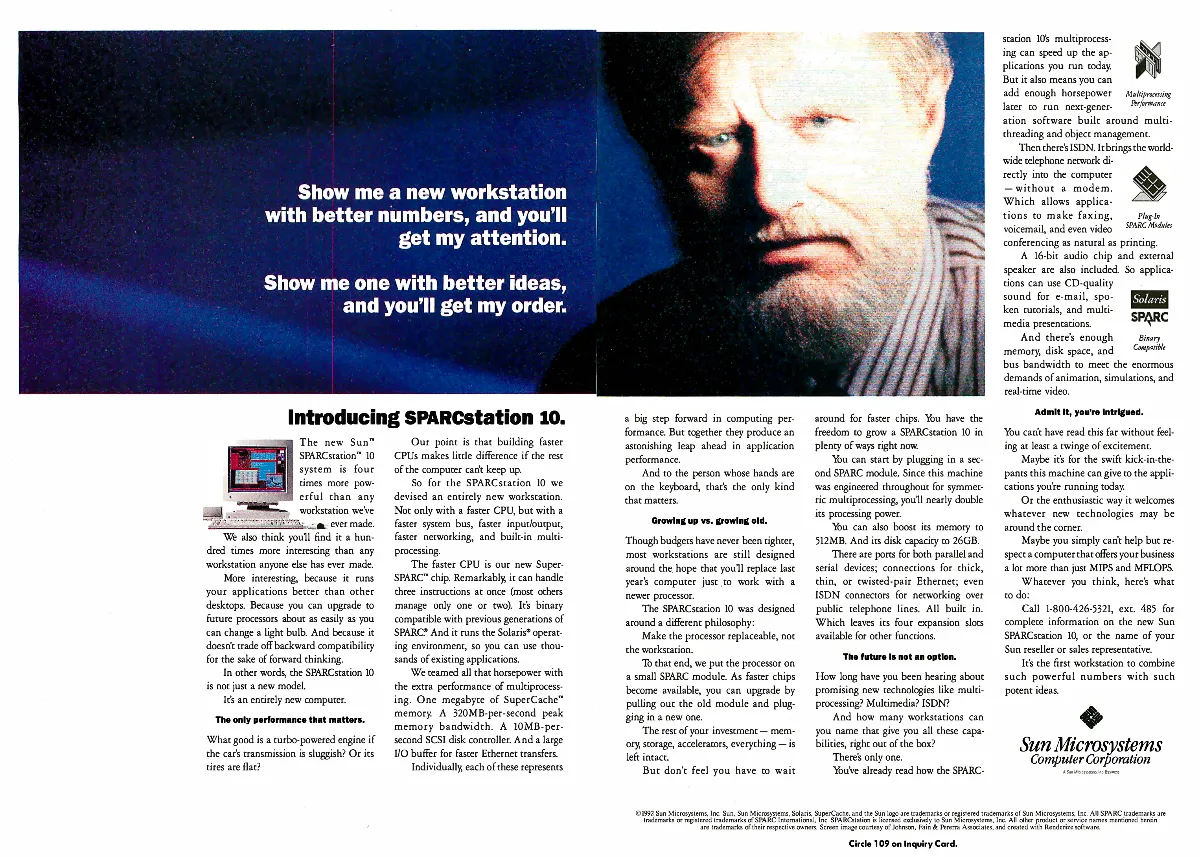
FROM THE PRINTED PAGEOriginal ad copy
OCR transcription from the archived page. Scanning and reading-order errors may remain.
Show me a new workstation with better numbers, and you'll get my attention. Show me one with better ideas, and you'll get my order. Introducing SPARCstation 10. The new Sun™ SPARCstation™ 10 system is four times more powerful than any workstation we've ever made. We also think you'll find it a hundred times more interesting than any workstation anyone else has ever made. More interesting, because it runs your applications better than other desktops. Because you can upgrade to future processors about as easily as you can change a light bulb. And because it doesn't trade off backward compatibility for the sake of forward thinking. In other words, the SPARCstation 10 is not just a new model. It's an entirely new computer. The only performance that matters. What good is a turbo-powered engine if the car's transmission is sluggish? Or its tires are flat? Our point is that building faster CPUs makes little difference if the rest of the computer can't keep up. So for the SPARCstation 10 we devised an entirely new workstation. Not only with a faster CPU, but with a faster system bus, faster input/output, faster networking, and built-in multiprocessing. The faster CPU is our new SuperSPARC™ chip. Remarkably, it can handle three instructions at once (most others manage only one or two). It's binary compatible with previous generations of SPARC.® And it runs the Solaris® operating environment, so you can use thousands of existing applications. We teamed all that horsepower with the extra performance of multiprocessing. One megabyte of SuperCache™ memory. A 320MB-per-second peak memory bandwidth. A 10MB-per-second SCSI disk controller. And a large I/O buffer for faster Ethernet transfers. Individually, each of these represents a big step forward in computing performance. But together they produce an astonishing leap ahead in application performance. And to the person whose hands are on the keyboard, that's the only kind that matters. Growing up vs. growing old. Though budgets have never been tighter, most workstations are still designed around the hope that you'll replace last year's computer just to work with a newer processor. The SPARCstation 10 was designed around a different philosophy: Make the processor replaceable, not the workstation. To that end, we put the processor on a small SPARC module. As faster chips become available, you can upgrade by pulling out the old module and plugging in a new one. The rest of your investment—memory, storage, accelerators, everything—is left intact. But don't feel you have to wait around for faster chips. You have the freedom to grow a SPARCstation 10 in plenty of ways right now. You can start by plugging in a second SPARC module. Since this machine was engineered throughout for symmetric multiprocessing, you'll nearly double its processing power. You can also boost its memory to 512MB. And its disk capacity to 26GB. There are ports for both parallel and serial devices; connections for thick, thin, or twisted-pair Ethernet; even ISDN connectors for networking over public telephone lines. All built in. Which leaves its four expansion slots available for other functions. The future is not an option. How long have you been hearing about promising new technologies like multiprocessing? Multimedia? ISDN? And how many workstations can you name that give you all these capabilities, right out of the box? There's only one. You've already read how the SPARCstation 10's multiprocessing can speed up the applications you run today. But it also means you can add enough horsepower later to run next-generation software built around multithreading and object management. Then there's ISDN. It brings the worldwide telephone network directly into the computer—without a modem. Which allows applications to make faxing, voicemail, and even video conferencing as natural as printing. A 16-bit audio chip and external speaker are also included. So applications can use CD-quality sound for e-mail, spoken tutorials, and multimedia presentations. And there's enough memory, disk space, and bus bandwidth to meet the enormous demands of animation, simulations, and real-time video. Multiprocessing Performance Plug-In SPARC Modules Solaris SPARC Binary Compatible Admit it, you're intrigued. You can't have read this far without feeling at least a twinge of excitement. Maybe it's for the swift kick-in-the-pants this machine can give to the applications you're running today. Or the enthusiastic way it welcomes whatever new technologies may be around the corner. Maybe you simply can't help but respect a computer that offers your business a lot more than just MIPS and MFLOPS. Whatever you think, here's what to do: Call 1-800-426-5321, ext. 485 for complete information on the new Sun SPARCstation 10, or the name of your Sun reseller or sales representative. It's the first workstation to combine such powerful numbers with such potent ideas. Sun Microsystems Computer Corporation A Sun Microsystems, Inc. Business ©1992 Sun Microsystems, Inc. Sun, Sun Microsystems, Solaris, SuperCache, and the Sun logo are trademarks or registered trademarks of Sun Microsystems, Inc. All SPARC trademarks are trademarks or registered trademarks of SPARC International, Inc. SPARCstation is licensed exclusively to Sun Microsystems, Inc. All other product or service names mentioned herein are trademarks of their respective owners. Screen image courtesy of Johnson, Fain & Pereira Associates, and created with Renderize software. Circle 109 on Inquiry Card.
Commentary
I first noticed how little room Sun gives the actual workstation. A face occupies the spread’s blue upper half; the computer is a small specimen below. The implied buyer has already seen enough machines. What he wants is a reason to replace one. Sun lets him set the terms: numbers earn attention, ideas earn an order.
Following the columns, I found the economic argument inside the engineering. A processor on a removable SPARC module means the buyer can retain memory, storage and accelerators. The heading about growing up and growing old turns replacement anxiety into a design problem. Then come the particulars: a second module, 512MB of memory, 26GB of storage, several Ethernet connections and ISDN. These are the advertiser’s specifications and promises, not measurements established by this archive. Their density gives a technically literate reader something to audit after the portrait has secured a pause.
The most revealing promise may be that faxing, voicemail and video conferencing will become as natural as printing. I read this as an invitation to a connected working day that still requires explanation. Today those activities can share a pocket device; here the telephone network, audio chip and external speaker must be introduced individually. The copy sells their integration as a future worth buying into while reassuring the buyer that existing applications survive the journey.
For a beginning copywriter, the two uses of “Show me” are a useful lesson in controlled repetition. Identical openings make “attention” and “order” register as different commercial outcomes. “Growing up vs. growing old” repeats that structure at a smaller scale, making upgradeability sound like continued usefulness. The technique works because the detailed module explanation pays off the verbal promise; the clever phrase is attached to a purchasing concern.
Sun was founded in 1982 as a workstation company, as the Computer History Museum records. Oracle acquired Sun in 2010, and Solaris remains in Oracle’s operating-system portfolio.
Protecting an investment while gaining capability remains a persuasive business promise. The plug-in processor and ISDN belong to this particular workstation; the larger question—how much must I throw away to move forward?—still gives the ad its force.