Electronics 1970
Honeywell Pentax
You made Honeywell Pentax a classic.
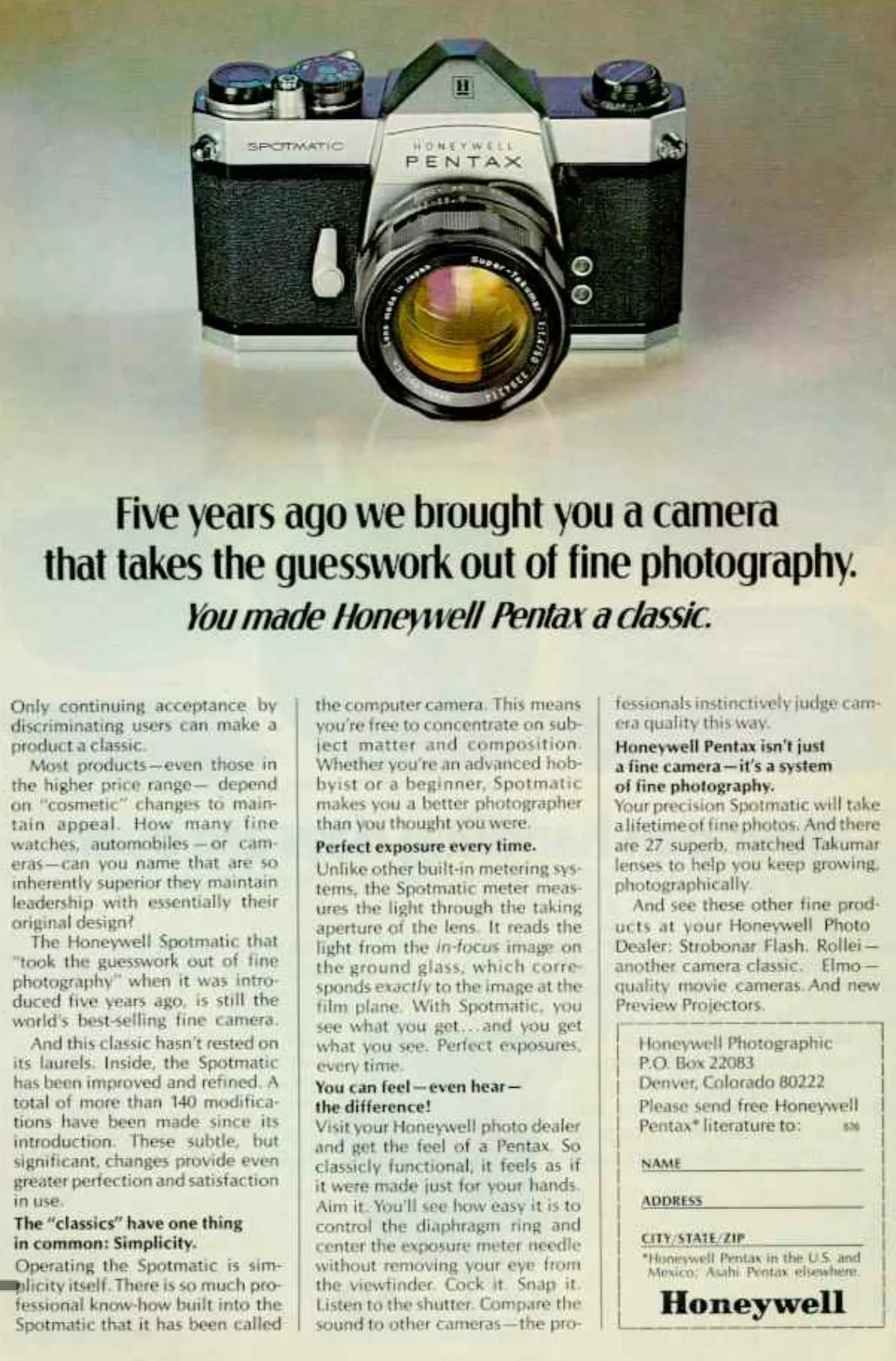
FROM THE PRINTED PAGEOriginal ad copy
OCR transcription from the archived page. Scanning and reading-order errors may remain.
SPOTMATIC HONEYWELL PENTAX Five years ago we brought you a camera that takes the guesswork out of fine photography. You made Honeywell Pentax a classic. Only continuing acceptance by discriminating users can make a product a classic. Most products—even those in the higher price range—depend on “cosmetic” changes to maintain appeal. How many fine watches, automobiles—or cameras—can you name that are so inherently superior they maintain leadership with essentially their original design? The Honeywell Spotmatic that “took the guesswork out of fine photography” when it was introduced five years ago, is still the world's best-selling fine camera. And this classic hasn't rested on its laurels. Inside, the Spotmatic has been improved and refined. A total of more than 140 modifications have been made since its introduction. These subtle, but significant, changes provide even greater perfection and satisfaction in use. The “classics” have one thing in common: Simplicity. Operating the Spotmatic is simplicity itself. There is so much professional know-how built into the Spotmatic that it has been called the computer camera. This means you're free to concentrate on subject matter and composition. Whether you're an advanced hobbyist or a beginner, Spotmatic makes you a better photographer than you thought you were. Perfect exposure every time. Unlike other built-in metering systems, the Spotmatic meter measures the light through the taking aperture of the lens. It reads the light from the in-focus image on the ground glass, which corresponds exactly to the image at the film plane. With Spotmatic, you see what you get...and you get what you see. Perfect exposures, every time. You can feel—even hear—the difference! Visit your Honeywell photo dealer and get the feel of a Pentax. So classicly functional, it feels as if it were made just for your hands. Aim it. You'll see how easy it is to control the diaphragm ring and center the exposure meter needle without removing your eye from the viewfinder. Cock it. Snap it. Listen to the shutter. Compare the sound to other cameras—the professionals instinctively judge camera quality this way. Honeywell Pentax isn't just a fine camera—it's a system of fine photography. Your precision Spotmatic will take a lifetime of fine photos. And there are 27 superb, matched Takumar lenses to help you keep growing photographically. And see these other fine products at your Honeywell Photo Dealer: Strobonar Flash. Rollei—another camera classic. Elmo—quality movie cameras. And new Preview Projectors. Honeywell Photographic P.O. Box 22083 Denver, Colorado 80222 Please send free Honeywell Pentax* literature to: NAME ADDRESS CITY/STATE/ZIP *Honeywell Pentax in the U.S. and Mexico. Asahi Pentax elsewhere. Honeywell
Commentary
The camera is isolated at the top, lens aimed straight at us. Below it, the headline says the public made the Honeywell Pentax a “classic.” I find a small tension in that claim: a classic sounds finished, but the body copy insists the Spotmatic has undergone more than 140 internal modifications. The advertisement wants the trust earned by an unchanged exterior and the reassurance of continuing improvement inside it.
It spends considerable space teaching the buyer how the through-the-lens meter works. The meter reads light from the image on the ground glass, the copy says, so the photographer can judge exposure without removing an eye from the viewfinder. The claim of “perfect exposure every time” is the advertiser’s, while the camera and lens pictured show the physical system being sold. A separate section asks the reader to visit a dealer, turn the diaphragm ring, cock the camera, hear the shutter and compare it with others. The printed page can explain the mechanism; touch and sound must be supplied in person.
The mail-in coupon and list of 27 matched Takumar lenses reveal two different ways to extend the sale. A reader can request literature before committing, then imagine growing into a larger photographic system afterward. Today product research often begins with online comparisons and video demonstrations, but the ad’s advice to handle a camera still makes sense. The feel of a control ring remains hard to reduce to a specification.
For a new copywriter, the paired claim “You made … a classic” flatters existing buyers and lets their continued acceptance serve as social proof. “Perfect exposure every time” is a bold benefit heading; the long paragraph that follows supplies a mechanism. Short commands—“Aim it,” “Cock it,” “Snap it”—then change the pace and turn an explanation into a rehearsal. Use each register for the job it can do.
Pentax’s official history records the Spotmatic’s 1964 launch and the brand’s later continuation within Ricoh Imaging. Honeywell’s history now concerns a diversified technology company; this ad records its period as the U.S. photographic marketer of the camera.
The appeal of intuitive controls and a system that can grow with the user persists. The claim that a film SLR’s exposure meter makes photography nearly effortless, and the coupon as the route to more information, belong to the world in which this page circulated.