Automotive 1970
Chevrolet
A few smaller cars cost less. That's what they're worth.
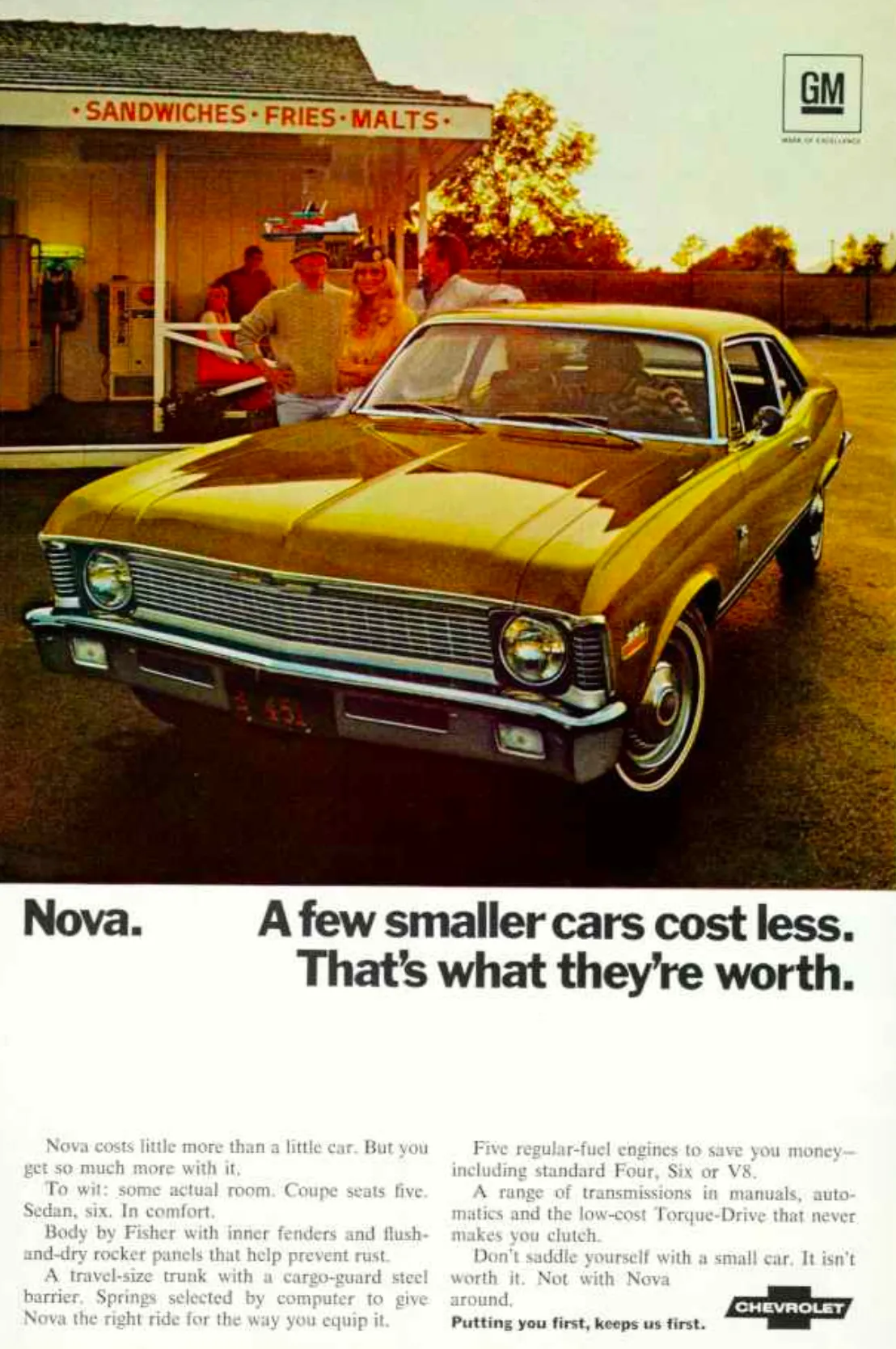
FROM THE PRINTED PAGEOriginal ad copy
OCR transcription from the archived page. Scanning and reading-order errors may remain.
SANDWICHES · FRIES · MALTS GM MARK OF EXCELLENCE Nova. A few smaller cars cost less. That's what they're worth. Nova costs little more than a little car. But you get so much more with it. To wit: some actual room. Coupe seats five. Sedan, six. In comfort. Body by Fisher with inner fenders and flush-and-dry rocker panels that help prevent rust. A travel-size trunk with a cargo-guard steel barrier. Springs selected by computer to give Nova the right ride for the way you equip it. Five regular-fuel engines to save you money—including standard Four, Six or V8. A range of transmissions in manuals, automatics and the low-cost Torque-Drive that never makes you clutch. Don't saddle yourself with a small car. It isn't worth it. Not with Nova around. Putting you first, keeps us first. CHEVROLET
Commentary
The Nova sits outside a roadside stand advertising sandwiches, fries and malts. People gather behind the gold car, but the car occupies nearly the whole foreground. Nothing in the scene is lavish: this is ordinary travel and ordinary eating. Then the blunt headline turns the scene into a comparison. A few smaller cars may have a lower sticker price, Chevrolet concedes, but it argues that their low cost measures what they lack.
The body copy names that missing value in practical units. A coupe seats five, a sedan six; both have a trunk and a choice of engines and transmissions. Rust prevention appears alongside ride tuning and a Torque-Drive that “never makes you clutch.” The ad offers a long menu of combinations while keeping the photograph of one car simple. It does not name a rival. “Smaller cars” is broad enough to let the reader supply whichever model is currently under consideration.
The line about regular fuel shows how economy is being framed. Savings matter, but the ad says a buyer should calculate them across comfort, capacity, fuel, and equipment rather than initial price alone. Today’s small cars can be sold as efficient and well equipped in their own right, so the automatic equation between size and worth no longer follows. The useful advertising question remains: what does a buyer gain for the extra cost?
For a new copywriter, the headline’s apparent concession is the pivot. “A few smaller cars cost less” grants a fact the audience may know; “That’s what they’re worth” flips it into a judgment. “To wit: some actual room” brings the argument down from attitude to proof. The short seat counts then give the cheeky opening something measurable. A comparison is stronger when the body supplies the terms on which it should be judged.
Chevrolet’s history traces the marque to 1911. The 1970 Nova appears in GM’s heritage archive; Chevrolet continues to sell cars, SUVs and trucks, though this Nova is a historical model.
The page’s value argument survives whenever buyers weigh price against usable space and equipment. Its dismissal of smaller cars, and its casual promotion of a V8 among the economical choices, marks a different set of assumptions about what a sensible family car should be.