Automotive 1965
Honda
You meet the nicest people on a Honda
FROM THE PRINTED PAGEOriginal ad copy
OCR transcription from the archived page. Scanning and reading-order errors may remain.
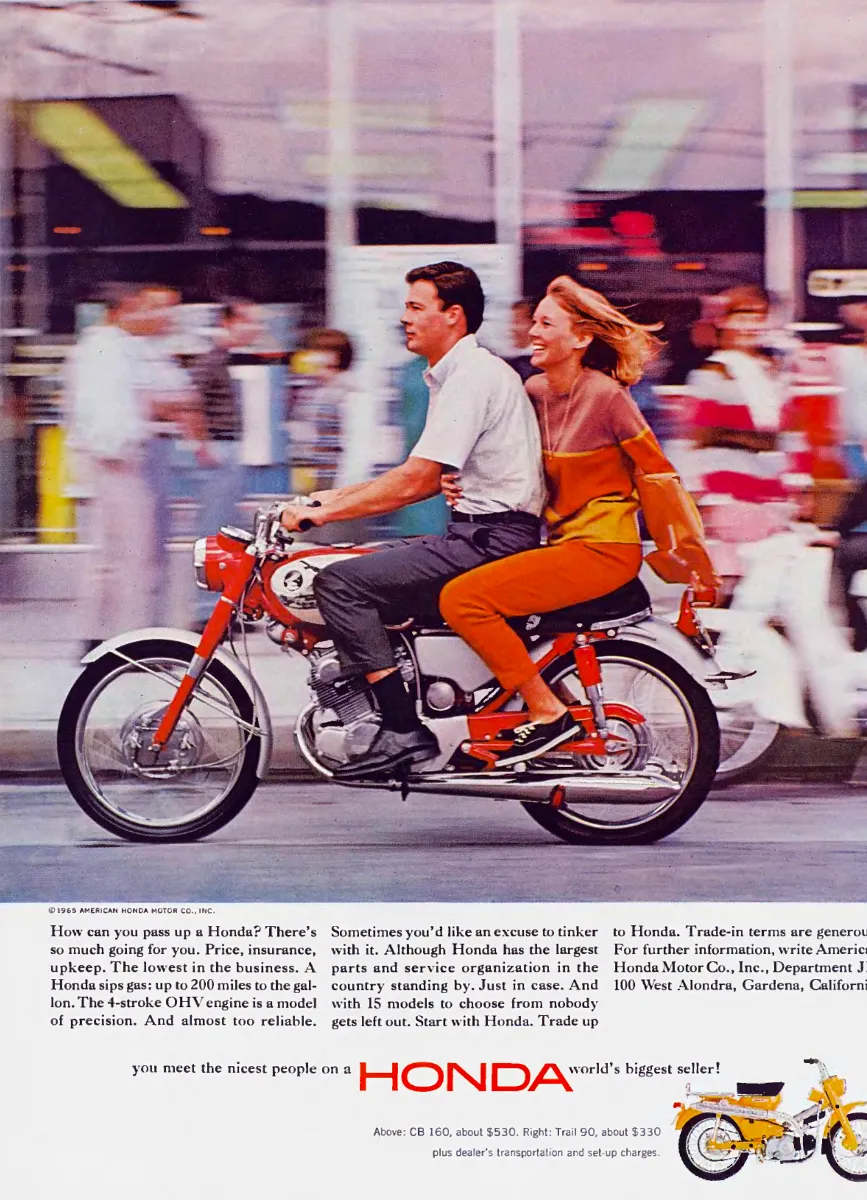
© 1965 AMERICAN HONDA MOTOR CO., INC. How can you pass up a Honda? There’s so much going for you. Price, insurance, upkeep. The lowest in the business. A Honda sips gas: up to 200 miles to the gallon. The 4-stroke OHV engine is a model of precision. And almost too reliable. Sometimes you’d like an excuse to tinker with it. Although Honda has the largest parts and service organization in the country standing by. Just in case. And with 15 models to choose from nobody gets left out. Start with Honda. Trade up to Honda. Trade-in terms are generou[illegible] For further information, write Americ[illegible] Honda Motor Co., Inc., Department J[illegible] 100 West Alondra, Gardena, Californi[illegible] you meet the nicest people on a HONDA world’s biggest seller! Above: CB 160, about $530. Right: Trail 90, about $330 plus dealer’s transportation and set-up charges.
Commentary
The shopfronts blur, but the couple stays distinct. I read the picture as a small escape inside an ordinary shopping street: no race circuit, no remote mountain, no dramatic machinery close-up. The passenger’s orange clothing is almost as conspicuous as the red motorcycle. Honda is selling the pleasure of being seen together, and the passing pedestrians keep that pleasure inside everyday public life.
The copy below is more cautious than the picture. Price, insurance, maintenance and fuel consumption all receive attention. Reliability is exaggerated into a comic disappointment: the owner might welcome an excuse to tinker. The service network then stands by “just in case.” These are successive answers to the anxieties of someone who likes the photograph but has never been certain a motorcycle belongs in their life.
The small yellow Trail 90 widens that invitation. The caption identifies the main machine as a CB 160 at about $530 and the smaller one at about $330, with transportation and setup charges extra. The broad mileage and engine statements sit in the general copy; I would not silently turn them into verified CB 160 specifications. The scan also cuts off the right-hand response address, so the transcription marks those losses.
The riders’ ordinary clothes and uncovered heads make the ease look effortless. That is a visible choice in this image, not evidence of everybody’s riding practice. Set beside the detailed cost reassurance, the omission shows where this particular pitch locates resistance: in expense, maintenance and social belonging. Its carefree styling should be read as a historical construction of leisure.
For a new copywriter, “sips” compresses fuel economy into a familiar human action. “Almost too reliable” lets a drawback-shaped sentence communicate a benefit. The short fragments then keep reassurance conversational, while the repeated Honda in the trade-up invitation imagines a continuing customer relationship. The useful lesson is to identify the buyer’s objection before choosing the joke that answers it.
Honda’s history of its American operation records its 1959 entry and the broader campaign’s attempt to make motorcycling approachable. Honda remains a motorcycle manufacturer with a current range spanning touring, sport, scooters and smaller everyday machines.
Accessible enjoyment still connects those products to this page. The period prices, fifteen-model claim and mailed enquiry do not describe today’s offer. The enduring creative move is the pairing of social welcome with practical reassurance: first picture yourself riding, then find reasons the idea might be manageable.