Consumer Goods 1969
Gillette
The Gillette Techmatic Razor. For very special occasions.
FROM THE PRINTED PAGEOriginal ad copy
OCR transcription from the archived page. Scanning and reading-order errors may remain.
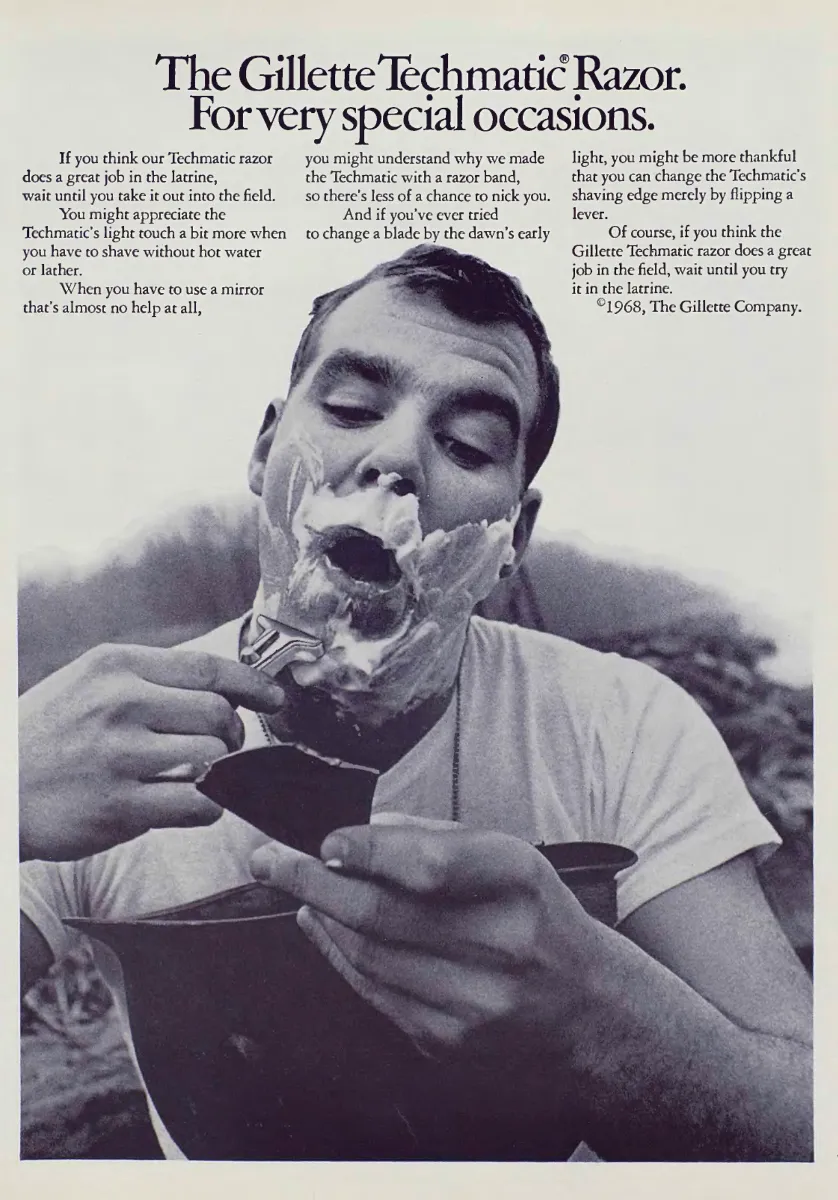
The Gillette Techmatic® Razor. For very special occasions. If you think our Techmatic razor does a great job in the latrine, wait until you take it out into the field. You might appreciate the Techmatic’s light touch a bit more when you have to shave without hot water or lather. When you have to use a mirror that’s almost no help at all, you might understand why we made the Techmatic with a razor band, so there’s less of a chance to nick you. And if you’ve ever tried to change a blade by the dawn’s early light, you might be more thankful that you can change the Techmatic’s shaving edge merely by flipping a lever. Of course, if you think the Gillette Techmatic razor does a great job in the field, wait until you try it in the latrine. ©1968, The Gillette Company.
Commentary
“Special occasions” initially sends me looking for a wedding suit. Instead I find a white undershirt, a helmet, a small mirror and a man making the necessary face for shaving his chin. The photograph occupies most of the page. It gives the joke enough human inconvenience to keep the headline from sounding like a slogan pasted onto a product demonstration.
The military vocabulary arrives immediately: latrine, field, dawn. No unit or location is identified, so the scene does not establish a particular deployment. What it does establish is the intended problem. The reader may lack the usual bathroom equipment and still need to shave. Each paragraph removes another convenience before introducing a compensating feature: a light touch, a band rather than a loose blade, an edge advanced with a lever. The claims are tied to circumstances rather than presented as an abstract engineering inventory.
The photograph and text are not identical demonstrations. The man visibly has lather; the copy asks him to imagine going without it. That distinction matters. This is an argument about preparedness under worse conditions, not photographic proof that the razor can deliver every claimed benefit. Gillette’s own product history describes the Techmatic’s continuous, spooled band and its reduction of direct blade handling, which supports the mechanical basis of the lever story.
The small mirror is also a reminder that convenience depends on surroundings. In a bathroom, replacing an edge can be a minor chore; outside, with poor visibility, handling a separate blade becomes a different proposition. Today’s grooming shelves contain many more specialized options, but the ad’s useful question survives: which ordinary task becomes difficult when the expected infrastructure disappears?
For young copywriters, the last sentence is worth comparing with the first. “Latrine” and “field” exchange places, turning the same promise back on itself. The understated “you might” lets the reader arrive at appreciation rather than ordering them to admire the product. Even “dawn’s early light” makes familiar ceremonial language serve an awkward practical task. The lesson is to make wordplay clarify the use case.
Gillette’s account traces its replaceable-blade innovation to the beginning of the twentieth century and lists the Techmatic in 1965. Today it is a P&G grooming brand selling razors, replacement cartridges and other grooming products.
Reducing effort and anxiety around a sharp edge remains a useful promise. The continuous-band mechanism is the period-specific answer here, while the military setting gives “special” its ironic meaning. Neither needs to be mistaken for a present-day product recommendation to understand the persuasion.