Electronics 1965
Voigtländer
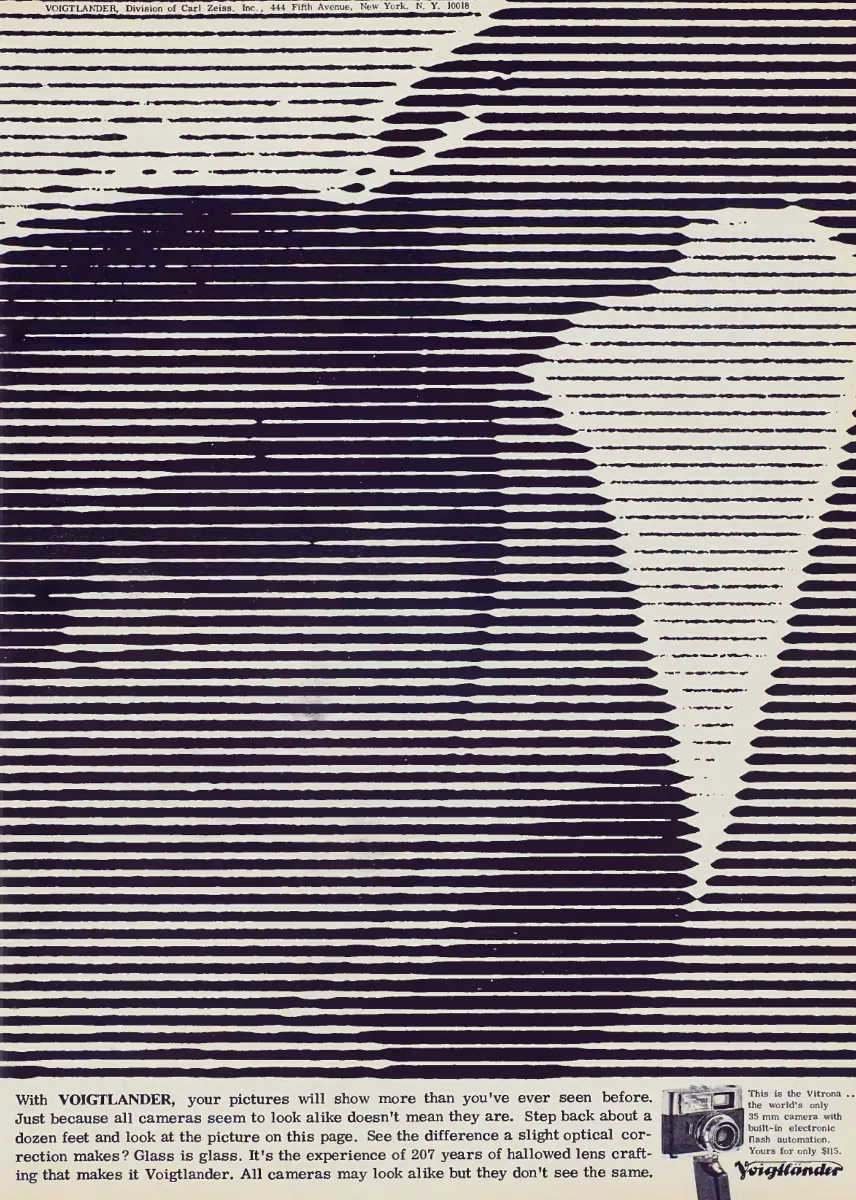
With VOIGTLANDER, your pictures will show more than you’ve ever seen before.
FROM THE PRINTED PAGEOriginal ad copy
OCR transcription from the archived page. Scanning and reading-order errors may remain.
VOIGTLANDER, Division of Carl Zeiss, Inc., 444 Fifth Avenue, New York, N. Y. 10018 With VOIGTLANDER, your pictures will show more than you’ve ever seen before. Just because all cameras seem to look alike doesn’t mean they are. Step back about a dozen feet and look at the picture on this page. See the difference a slight optical correction makes? Glass is glass. It’s the experience of 207 years of hallowed lens crafting that makes it Voigtlander. All cameras may look alike but they don’t see the same. This is the Vitrona . . . the world’s only 35 mm camera with built-in electronic flash automation. Yours for only $115. Voigtländer
Commentary
At first I see a page that seems almost to refuse photography: dark horizontal bands, irregular openings, very little merchandise. The instruction at the bottom changes my task. I am supposed to move away. As the pattern becomes less insistently a collection of individual lines, the face becomes easier to recognize. The reader’s own act of looking supplies the reveal.
That is an ingenious substitution for a lens demonstration, but it is still a substitution. Viewing a printed pattern from farther away does not establish the Vitrona’s optical performance. The page makes a narrower experience available: apparent sameness can conceal a difference in what one sees. It then invites the reader to transfer that experience to cameras whose bodies might look interchangeable.
The tiny product photograph matters because it refuses to compete with the experiment. The camera gets the bottom-right corner, a $115 price and a claim about built-in electronic flash automation. Meanwhile, the main paragraph invokes generations of lens crafting. Two routes to confidence coexist: inherited optical skill and a specific convenience feature.
On a screen the experiment becomes less controlled. Page size and viewing distance vary, and a thumbnail can reveal what the full printed page initially disguises. The ad assumes a physical reader who can stand up and step back roughly twelve feet. That bodily instruction is part of the creative idea, not incidental delivery information.
For new copywriters, “Glass is glass” is the productive interruption. After promising a difference, the advertiser briefly concedes sameness at the material level, then locates value in accumulated skill. The imperative to step back also gives the audience a job with an observable result. A demonstration can make the next sentence feel earned, provided we distinguish the experience demonstrated from the broader product claim it supports.
Voigtländer’s current brand site dates its heritage to 1756. Today its catalog centers on photographic lenses, including a Micro Four Thirds range, rather than the Vitrona camera shown in this scan.
The continuing need is to explain why optical choices matter when products look similar. The historical answer combines a printed illusion, inherited craftsmanship and flash automation. A present-day lens pitch can retain the invitation to look closely, but must provide evidence appropriate to current cameras and viewing conditions.