Automotive 1981
Subaru
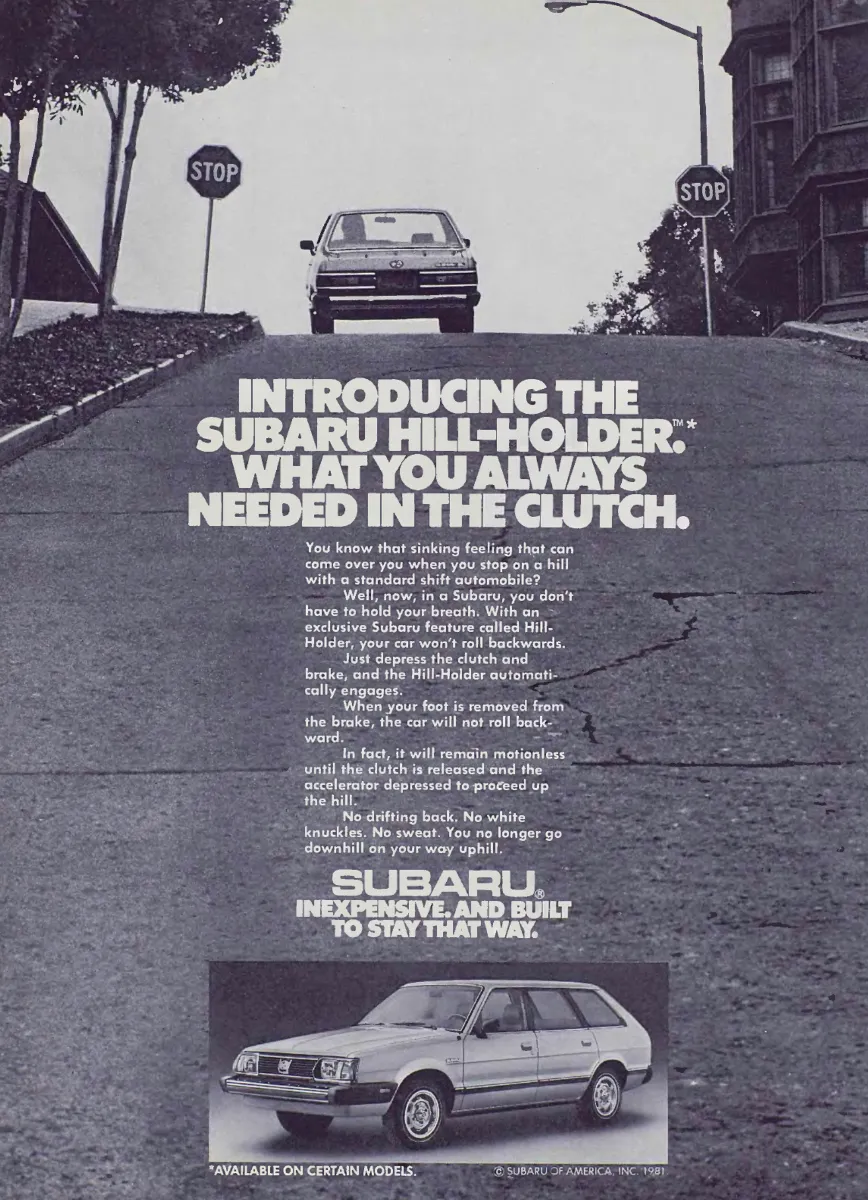
Introducing the Subaru Hill-Holder. What you always needed in the clutch.
FROM THE PRINTED PAGEOriginal ad copy
OCR transcription from the archived page. Scanning and reading-order errors may remain.
STOP STOP INTRODUCING THE SUBARU HILL-HOLDER™.* WHAT YOU ALWAYS NEEDED IN THE CLUTCH. You know that sinking feeling that can come over you when you stop on a hill with a standard shift automobile? Well, now, in a Subaru, you don't have to hold your breath. With an exclusive Subaru feature called Hill-Holder, your car won't roll backwards. Just depress the clutch and brake, and the Hill-Holder automatically engages. When your foot is removed from the brake, the car will not roll backward. In fact, it will remain motionless until the clutch is released and the accelerator depressed to proceed up the hill. No drifting back. No white knuckles. No sweat. You no longer go downhill on your way uphill. SUBARU® INEXPENSIVE. AND BUILT TO STAY THAT WAY. *AVAILABLE ON CERTAIN MODELS. © SUBARU OF AMERICA, INC. 1981
Commentary
I read the street before the headline. The car is waiting at the top, two stop signs make the halt unavoidable, and the road seems to descend toward the reader. The photograph supplies the exact situation in which an otherwise competent driver might become acutely aware of having only two feet. Subaru does not need to show the driver sweating; the slope has already made the suggestion.
The headline’s “clutch” identifies both a mechanical part and a moment of pressure. Below it, the copy names the “sinking feeling” before introducing Hill-Holder. What follows is almost a miniature driving lesson: press clutch and brake, remove the foot from the brake, then release the clutch and accelerate. The feature becomes legible through the sequence of human actions it changes. There is no diagram of the mechanism, because the promised result is enough to explain the value.
I noticed how little space is devoted to the vehicle’s other merits. A separate picture at the foot restores the wagon’s ordinary shape after the dramatic view from below, but the selling argument remains unusually disciplined. This is one small moment made easier. Even the brand line about staying inexpensive sits beneath a story about composure, rather than a list of purchase prices or operating costs. The footnote limiting availability to certain models belongs with the promise.
For a driver accustomed to an automatic transmission, the choreography described here may need explanation before the anxiety makes sense. The page assumes clutch control is a familiar everyday skill and that losing confidence in it is a recognizable inconvenience. I read it as a reminder that convenience is historically specific: a feature can be valuable because it removes a task another driver has never had to learn.
For new copywriters, the closing rhythm deserves attention. “No drifting back. No white knuckles. No sweat.” moves from vehicle behaviour to a visible bodily response and finally a casual expression of relief. “Downhill” and “uphill” then make the direction of travel carry an emotional meaning. The lesson is to name the practical problem precisely before using wordplay to make the release memorable.
Subaru Corporation’s history includes the establishment of Fuji Heavy Industries in 1953 and the change to the Subaru name in 2017. The company’s current vehicle presentation continues to emphasize engineering, traction and confidence across cars and SUVs.
The exact Hill-Holder operation and model qualification are historical specifications. The underlying position still makes sense: thoughtful engineering earns attention when it answers an ordinary person’s small fear. Subaru makes its technology matter by showing the moment in which a driver would be glad it exists.