Electronics 1984
Hasselblad
Of course Hasselblads are expensive. Look at the materials we use.
FROM THE PRINTED PAGEOriginal ad copy
OCR transcription from the archived page. Scanning and reading-order errors may remain.
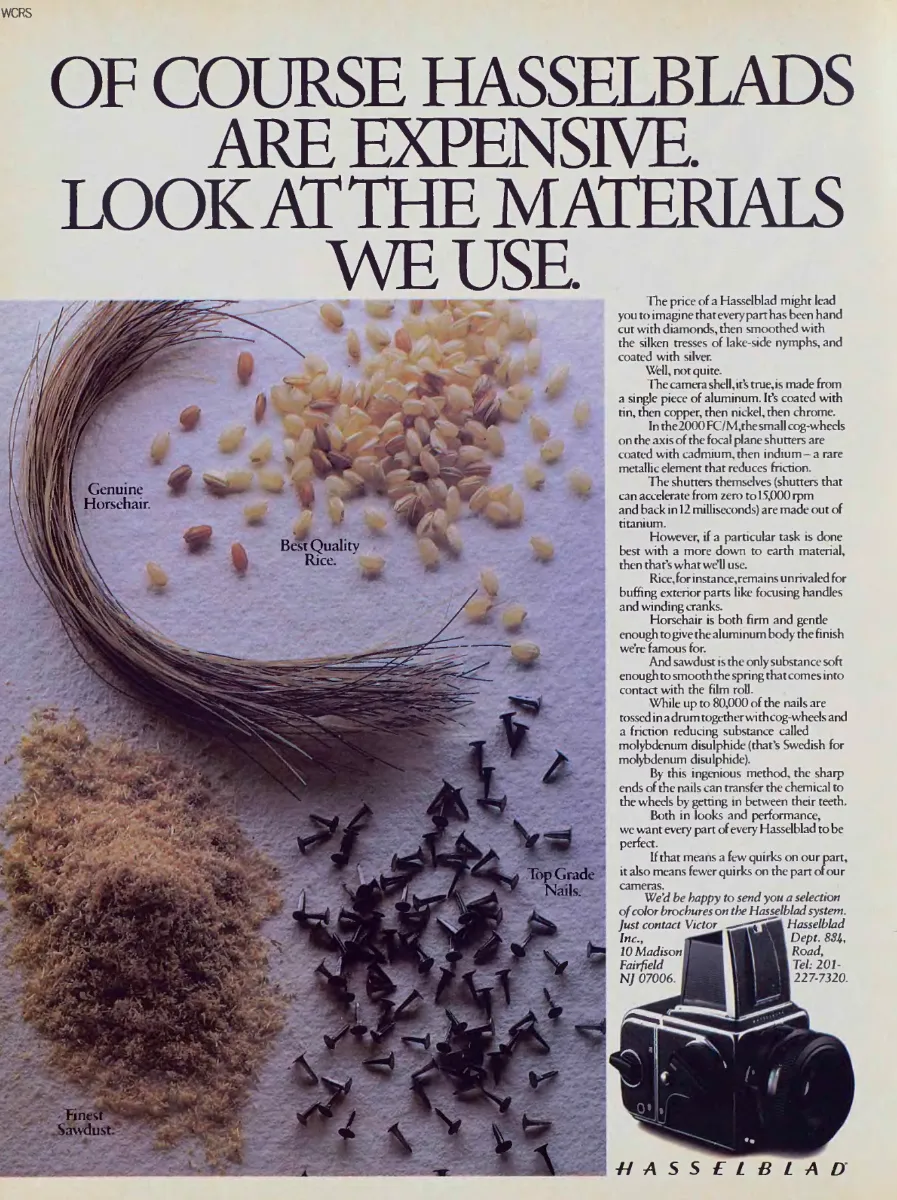
WCRS OF COURSE HASSELBLADS ARE EXPENSIVE. LOOK AT THE MATERIALS WE USE. Genuine Horsehair. Best Quality Rice. Top Grade Nails. Finest Sawdust. The price of a Hasselblad might lead you to imagine that every part has been hand cut with diamonds, then smoothed with the silken tresses of lake-side nymphs, and coated with silver. Well, not quite. The camera shell, it's true, is made from a single piece of aluminum. It's coated with tin, then copper, then nickel, then chrome. In the 2000FC/M, the small cog-wheels on the axis of the focal plane shutters are coated with cadmium, then indium—a rare metallic element that reduces friction. The shutters themselves (shutters that can accelerate from zero to 15,000 rpm and back in 12 milliseconds) are made out of titanium. However, if a particular task is done best with a more down to earth material, then that's what we'll use. Rice, for instance, remains unrivaled for buffing exterior parts like focusing handles and winding cranks. Horsehair is both firm and gentle enough to give the aluminum body the finish we're famous for. And sawdust is the only substance soft enough to smooth the spring that comes into contact with the film roll. While up to 80,000 of the nails are tossed in a drum together with cog-wheels and a friction reducing substance called molybdenum disulphide (that's Swedish for molybdenum disulphide). By this ingenious method, the sharp ends of the nails can transfer the chemical to the wheels by getting in between their teeth. Both in looks and performance, we want every part of every Hasselblad to be perfect. If that means a few quirks on our part, it also means fewer quirks on the part of our cameras. We'd be happy to send you a selection of color brochures on the Hasselblad system. Just contact Victor Hasselblad Inc., 10 Madison Road, Fairfield NJ 07006. Dept. 884. Tel: 201-227-7320. HASSELBLAD
Commentary
The headline agrees with an objection before a buyer can voice it: Hasselblads are expensive. Then the photograph delivers a joke. Rice, horsehair, sawdust and nails occupy most of the page, with the camera tucked into the lower corner. Each humble pile has a caption that sounds like a luxury specification: “Best Quality Rice,” “Top Grade Nails.” I read on to find out why a costly precision camera needs what looks like the contents of a workshop floor.
The body moves between exotic and ordinary materials. It lists layers of metal on the shell, indium on shutter gears and titanium in the shutter, then explains the less glamorous rice used for buffing, horsehair for finishing and sawdust for smoothing a spring. Nails, it says, carry a friction-reducing chemical between gear teeth during tumbling. These are the advertiser’s process claims; the scan itself shows the objects and the argument made from them. The important reversal is that expense is defended by using whatever material performs the task, however cheap it looks.
The last step is almost social. A mailing address, department number and phone number offer colour brochures to anyone curious about the system. A prospective buyer had to request a catalogue to study the range in detail. The ad therefore does two jobs at once: it teaches the reader how to interpret price, then invites a longer sales conversation.
For a young copywriter, “Of course” is the key move. It concedes the audience’s likely thought and disarms it with the imperative “Look.” The photograph then contradicts the expected image of expense before the text explains the contradiction. The deadpan “that’s Swedish for molybdenum disulphide” keeps a dense technical passage human. Humour works here because each odd material has a stated job.
Hasselblad’s camera history traces its modular medium-format system, and its current releases show that it still makes medium-format cameras and lenses. The manufacturing details in this 1984 ad belong to a particular film-era product.
The enduring idea is that care can be proven with small, surprising choices. A present-day buyer may research a digital camera online rather than request a brochure, but the question behind the headline remains: what exactly does the price buy?