Electronics 1980
Atari
The Atari personal computers. You should know why so many people are buying them.
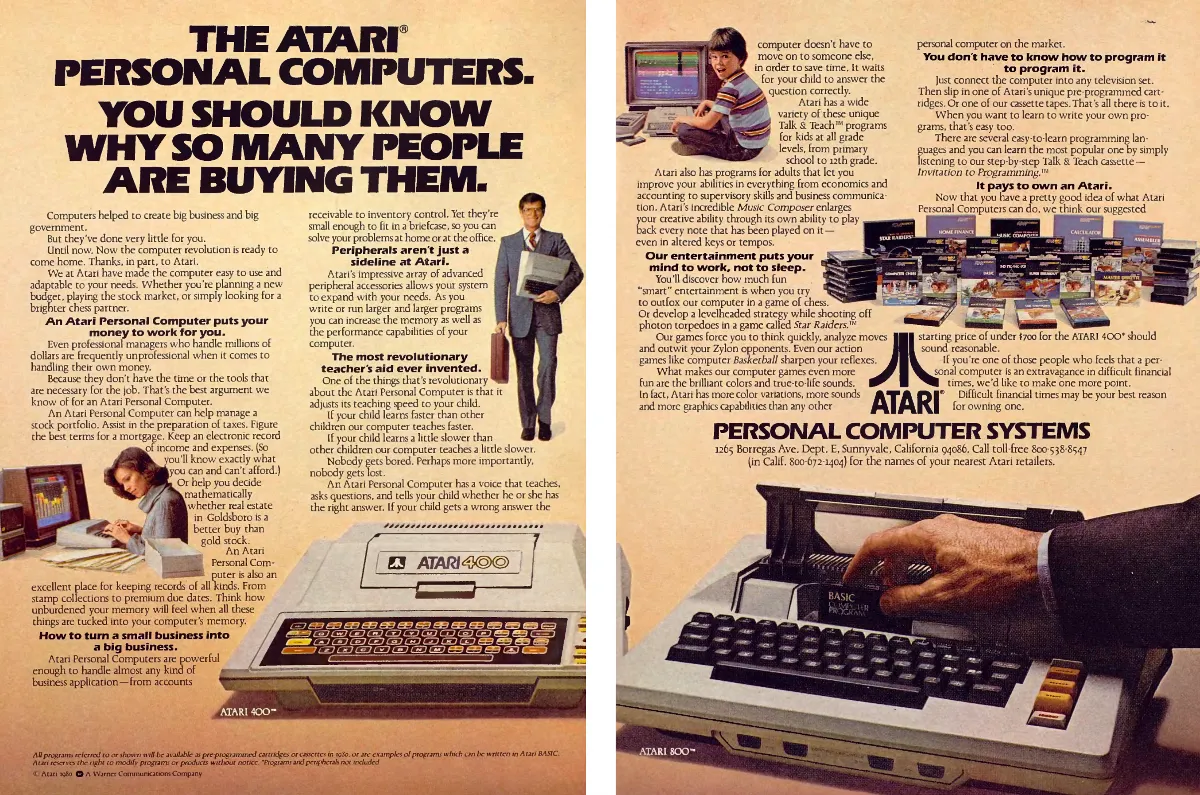
FROM THE PRINTED PAGEOriginal ad copy
OCR transcription from the archived page. Scanning and reading-order errors may remain.
THE ATARI® PERSONAL COMPUTERS. YOU SHOULD KNOW WHY SO MANY PEOPLE ARE BUYING THEM. Computers helped to create big business and big government. But they've done very little for you. Until now. Now the computer revolution is ready to come home. Thanks, in part, to Atari. We at Atari have made the computer easy to use and adaptable to your needs. Whether you're planning a new budget, playing the stock market, or simply looking for a brighter chess partner. An Atari Personal Computer puts your money to work for you. Even professional managers who handle millions of dollars are frequently unprofessional when it comes to handling their own money. Because they don't have the time or the tools that are necessary for the job. That's the best argument we know of for an Atari Personal Computer. An Atari Personal Computer can help manage a stock portfolio. Assist in the preparation of taxes. Figure the best terms for a mortgage. Keep an electronic record of income and expenses. (So you'll know exactly what you can and can't afford.) Or help you decide mathematically whether real estate in Goldsboro is a better buy than gold stock. An Atari Personal Computer is also an excellent place for keeping records of all kinds. From stamp collections to premium due dates. Think how unburdened your memory will feel when all these things are tucked into your computer's memory. How to turn a small business into a big business. Atari Personal Computers are powerful enough to handle almost any kind of business application—from accounts receivable to inventory control. Yet they're small enough to fit in a briefcase, so you can solve your problems at home or at the office. Peripherals aren't just a sideline at Atari. Atari's impressive array of advanced peripheral accessories allows your system to expand with your needs. As you write or run larger and larger programs you can increase the memory as well as the performance capabilities of your computer. The most revolutionary teacher's aid ever invented. One of the things that's revolutionary about the Atari Personal Computer is that it adjusts its teaching speed to your child. If your child learns faster than other children our computer teaches faster. If your child learns a little slower than other children our computer teaches a little slower. Nobody gets bored. Perhaps more importantly, nobody gets lost. An Atari Personal Computer has a voice that teaches, asks questions, and tells your child whether he or she has the right answer. If your child gets a wrong answer the computer doesn't have to move on to someone else, in order to save time. It waits for your child to answer the question correctly. Atari has a wide variety of these unique Talk & Teach™ programs for kids at all grade levels, from primary school to 12th grade. Atari also has programs for adults that let you improve your abilities in everything from economics and accounting to supervisory skills and business communication. Atari's Incredible Music Composer enlarges your creative ability through its own ability to play back every note that has been played on it—even in altered keys or tempos. Our entertainment puts your mind to work, not to sleep. You'll discover how much fun “smart” entertainment is when you try to outfox our computer in a game of chess. Or develop a levelheaded strategy while shooting off photon torpedoes in a game called Star Raiders.™ Our games force you to think quickly, analyze moves and outwit your Zylon opponents. Even our action games like computer Basketball sharpen your reflexes. What makes our computer games even more fun are the brilliant colors and true-to-life sounds. In fact, Atari has more color variations, more sounds and more graphics capabilities than any other personal computer on the market. You don't have to know how to program it to program it. Just connect the computer into any television set. Then slip in one of Atari's unique pre-programmed cartridges. Or one of our cassette tapes. That's all there is to it. When you want to learn to write your own programs, that's easy too. There are several easy-to-learn programming languages and you can learn the most popular one by simply listening to our step-by-step Talk & Teach cassette—Invitation to Programming.™ It pays to own an Atari. Now that you have a pretty good idea of what Atari Personal Computers can do, we think our suggested starting price of under $700 for the ATARI 400® should sound reasonable. If you're one of those people who feels that a personal computer is an extravagance in difficult financial times, we'd like to make one more point. Difficult financial times may be your best reason for owning one. ATARI® PERSONAL COMPUTER SYSTEMS 1265 Borregas Ave. Dept. E, Sunnyvale, California 94086. Call toll-free 800-538-8547 (in Calif. 800-672-1404) for the names of your nearest Atari retailers. All programs referred to or shown will be available as pre-programmed cartridges or cassettes in 1980, or are examples of programs which can be written in Atari BASIC. Atari reserves the right to modify programs or products without notice. Programs and peripherals not included. © Atari 1980. A Warner Communications Company.
Commentary
The headline makes an appeal to social proof—“so many people are buying them”—but the spread spends most of its space trying to justify the crowd. I move from household accounts to a small business, from a child at a television set to games and programming lessons. Two computer models anchor the bottom edge, while software boxes occupy the upper right. There is no single imagined owner. Atari is trying to make the machine useful to every member of a household.
The densest argument concerns time. The computer can remember premium dates, help calculate a mortgage, manage inventory and wait patiently for a child to answer a question. Even entertainment is said to sharpen thought rather than let the mind sleep. Those are advertiser claims, and the ad offers no independent evidence for the educational or cognitive benefits. Its more concrete proof is the ecosystem: cartridges, cassettes, peripherals, BASIC, an Atari 400 starting below $700, and a toll-free number for locating a retailer. The page reads like a miniature catalogue because a new product category needed a lot of explanation.
The address and phone numbers mark a different information path. Readers who wanted to see one could call for the name of a nearby seller. Today the product, programs, prices and reviews would be visible online within minutes. The print spread had to carry enough detail to keep a buyer’s curiosity alive until that next contact.
For a young copywriter, the repeated subheads are the lesson. “Puts your money to work,” “turn a small business into a big business,” and “puts your mind to work” give a sprawling feature list one energetic verb. The paradox “You don’t have to know how to program it to program it” reframes a likely fear as an invitation. It succeeds as copy because cartridges and a teaching cassette appear immediately below as concrete explanations.
Atari’s history places its home-computing period alongside its game business; its current company description focuses on games, hardware and licensing. The corporate identity has changed through several owners since this spread appeared.
The idea of one device serving finance, learning, work and play survived far beyond the Atari 400. The cassette lessons, retailer hotline and under-$700 threshold describe a particular buying journey; the underlying need was for someone to show how a computer could enter ordinary life.