Electronics 1991
Magnavox
Very Smart.
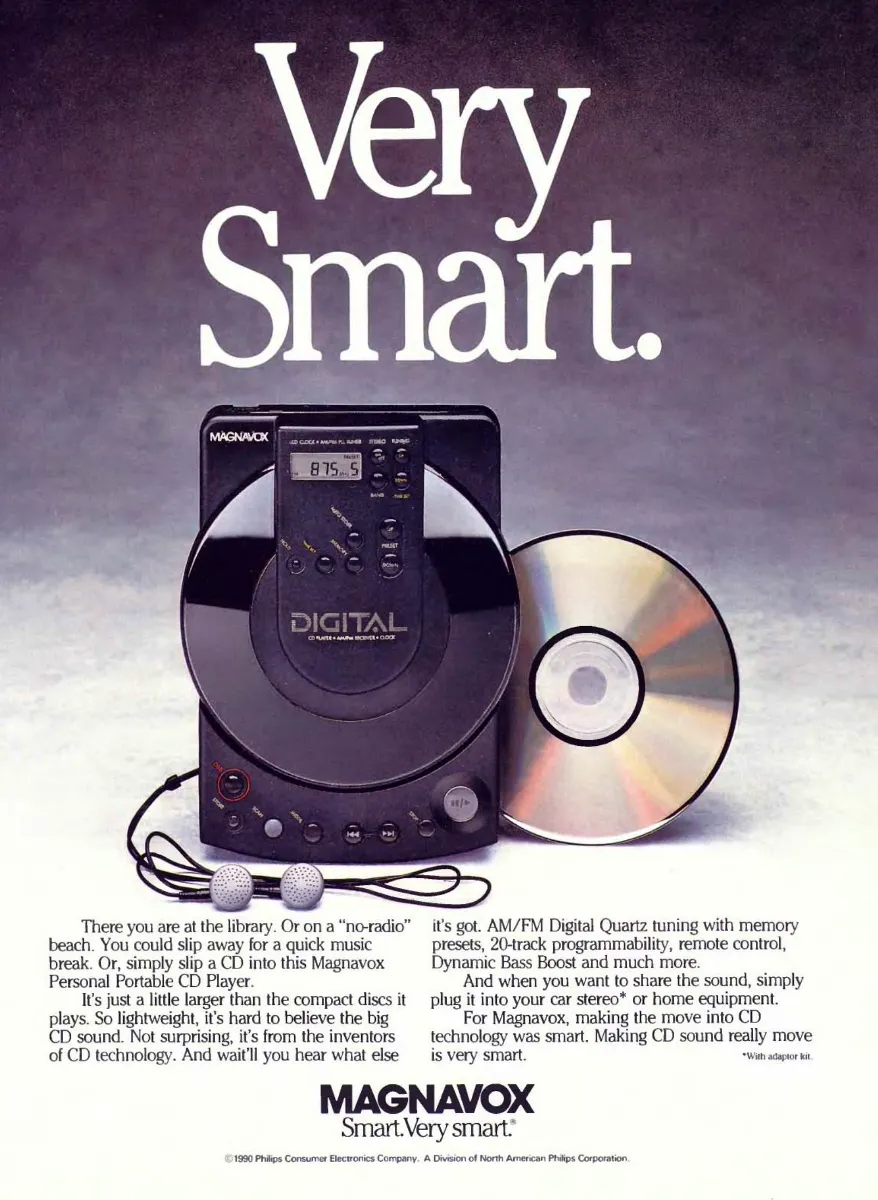
FROM THE PRINTED PAGEOriginal ad copy
OCR transcription from the archived page. Scanning and reading-order errors may remain.
Very Smart. MAGNAVOX DIGITAL There you are at the library. Or on a “no-radio” beach. You could slip away for a quick music break. Or, simply slip a CD into this Magnavox Personal Portable CD Player. It's just a little larger than the compact discs it plays. So lightweight, it's hard to believe the big CD sound. Not surprising, it's from the inventors of CD technology. And wait'll you hear what else it's got. AM/FM Digital Quartz tuning with memory presets, 20-track programmability, remote control, Dynamic Bass Boost and much more. And when you want to share the sound, simply plug it into your car stereo* or home equipment. For Magnavox, making the move into CD technology was smart. Making CD sound really move is very smart. *With adaptor kit. MAGNAVOX Smart. Very smart.® ©1990 Philips Consumer Electronics Company. A Division of North American Philips Corporation.
Commentary
The first thing I notice is the scale of the words. “Very Smart.” occupies nearly the entire upper third; the compact disc and player sit beneath it as proof of what that intelligence has made portable. A disc beside the unit supplies a built-in ruler. The headphones at the bottom promise private listening, while the product photograph shows enough controls to make the device feel capable rather than merely small.
The copy locates its listener in a library or on a “no-radio” beach. Those places explain the need before the specification list begins: music should travel where a receiver cannot help. The argument grows from a solitary break to more uses. AM/FM tuning, memory presets, programmed tracks, remote control, and bass boost make the device sound like several audio products in one. The car-stereo and home-equipment connection expands it again, though the little asterisk admits that sharing it in a car needs an adaptor kit. I read that footnote as the practical limit inside a broad mobility promise.
The word “portable” once needed this much demonstration. Today music can be carried without carrying a dedicated player or a disc, but the ad’s list reveals the earlier work of portability: packing a library, radio, remote, and connector into one object. That change makes the disc in the photograph more than decoration. It records the physical medium on which the whole offer depends.
For a young copywriter, follow the movement from “Smart” to “Very smart.” The first claim is given away to the company’s entry into CD technology; the second is reserved for making the sound move. The short, giant headline creates confidence, while ordinary scenes and a precise feature list earn the adjective below. The colloquial “wait’ll” also keeps the engineering from sounding like a manual.
Magnavox traces its brand to 1917. The scan identifies its 1990 advertiser as Philips Consumer Electronics; Philips records that it developed the compact disc jointly with Sony. Philips now describes itself as a health-technology company, while Magnavox remains a consumer-electronics brand.
The customer need survives: easy access to chosen sound in different places. The claim that this requires a slightly oversized disc player, a wired headphone set, and an optional car adaptor belongs to the device’s era. The ad is most useful now as a lesson in showing a new technology through the ordinary places it lets someone inhabit.