Automotive 1972
Toyota
Each one offers styling, economy and something the other three can't.
FROM THE PRINTED PAGEOriginal ad copy
OCR transcription from the archived page. Scanning and reading-order errors may remain.
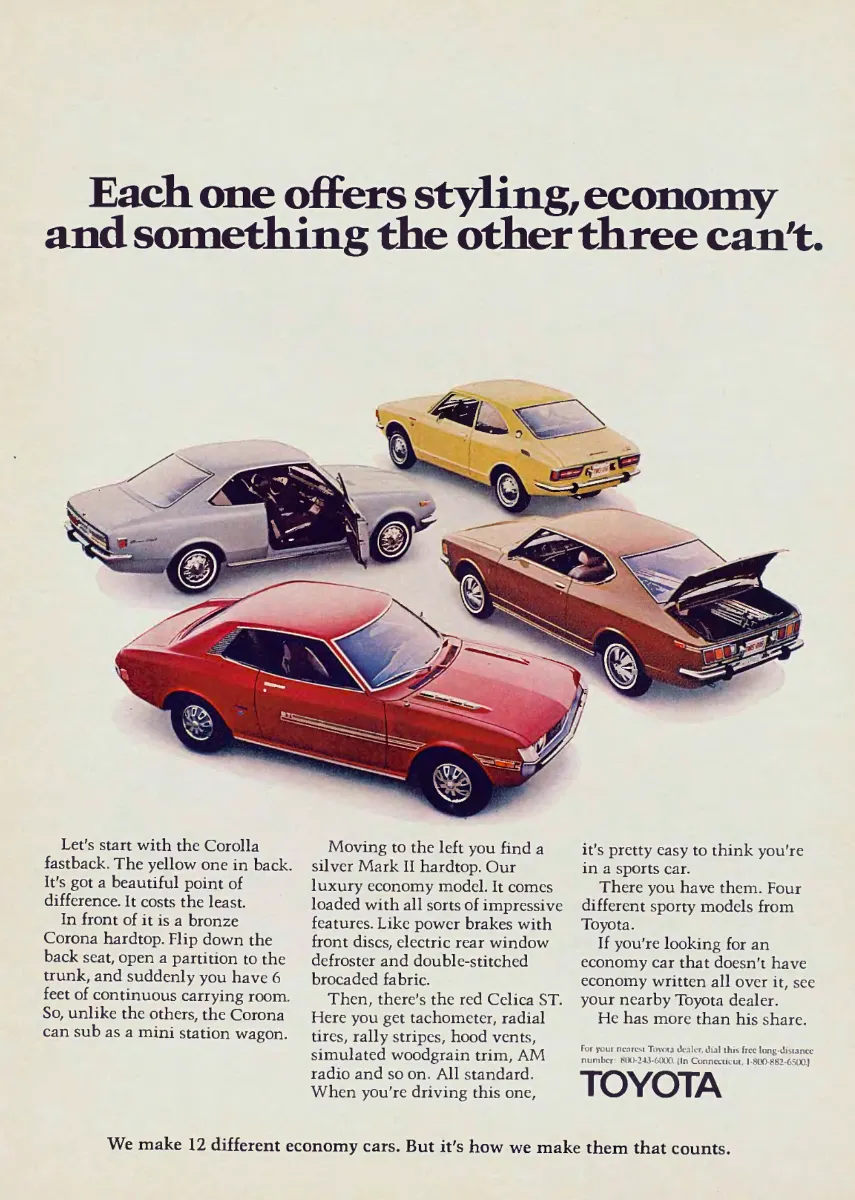
Each one offers styling, economy and something the other three can't. Let's start with the Corolla fastback. The yellow one in back. It's got a beautiful point of difference. It costs the least. In front of it is a bronze Corona hardtop. Flip down the back seat, open a partition to the trunk, and suddenly you have 6 feet of continuous carrying room. So, unlike the others, the Corona can sub as a mini station wagon. Moving to the left you find a silver Mark II hardtop. Our luxury economy model. It comes loaded with all sorts of impressive features. Like power brakes with front discs, electric rear window defroster and double-stitched brocaded fabric. Then, there's the red Celica ST. Here you get tachometer, radial tires, rally stripes, hood vents, simulated woodgrain trim, AM radio and so on. All standard. When you're driving this one, it's pretty easy to think you're in a sports car. There you have them. Four different sporty models from Toyota. If you're looking for an economy car that doesn't have economy written all over it, see your nearby Toyota dealer. He has more than his share. For your nearest Toyota dealer, dial this free long-distance number: 800-243-6000. (In Connecticut, 1-800-882-6500.) TOYOTA We make 12 different economy cars. But it's how we make them that counts.
Commentary
I tried matching the colours to the names before reading the specifications. Toyota makes that easy: yellow at the back, bronze in front of it, silver to the left, red nearest the reader. The four cars sit on an almost empty ground, their diagonal arrangement giving the page the clarity of a display table. An open door and raised trunk lid turn two of the objects into demonstrations.
The apparent comparison with “the other three” turns out to be entirely within Toyota’s range. That is the clever boundary of the exercise. Once the reader accepts the question, the decision is which Toyota best fits, rather than whether Toyota belongs on the list. Corolla gets the lowest price; Corona gets carrying room; Mark II gets luxury equipment; Celica gets sporting cues. Each has a reason to remain in the picture.
The six feet of continuous carrying room is the most concrete proof. The reader is told how to create it, in order: fold the seat, open the partition. By comparison, the Celica’s promise is candidly about feeling as though one is in a sports car. This distinction between utility and self-image keeps the range from collapsing into four versions of the same sales sentence.
For a young copywriter, “The yellow one in back” is a useful lesson in coordination between words and pictures. It sounds conversational because it performs the simple task of pointing. “A beautiful point of difference. It costs the least” then turns expected styling language into a price joke. The lesson is to make navigation effortless before asking readers to absorb distinctions.
Toyota records its incorporation in 1937. Its current mobility programme includes vehicles alongside battery, hybrid and hydrogen technologies. The four-car page shows an earlier version of that range-making problem: how to keep several propositions recognisable under one name.
The dealer-location telephone number and long-distance reassurance date the route from page to showroom. An online catalogue can now let readers sort and compare for themselves. The underlying editorial job remains the same: give each choice a clear purpose without making economy sound like a punishment.