Consumer Goods 1969
Jack Daniel’s
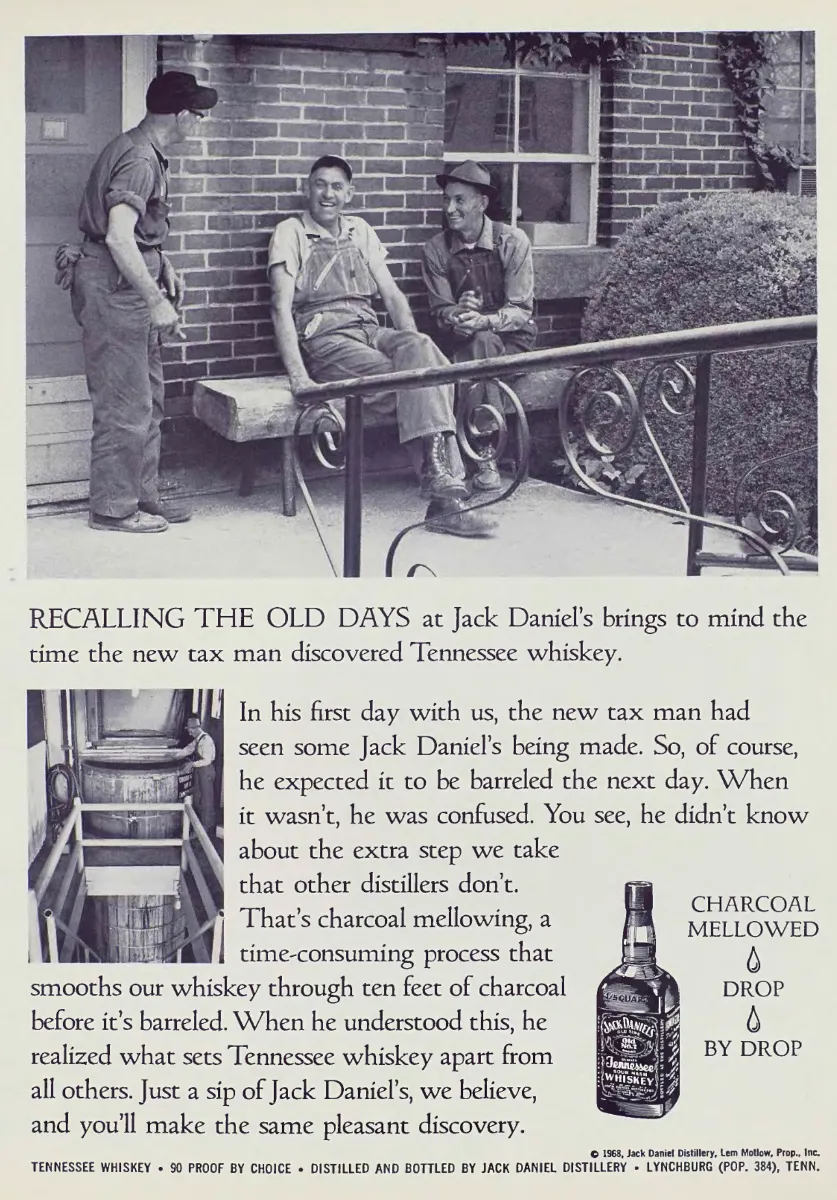
Recalling the old days at Jack Daniel’s brings to mind the time the new tax man discovered Tennessee whiskey.
FROM THE PRINTED PAGEOriginal ad copy
OCR transcription from the archived page. Scanning and reading-order errors may remain.
RECALLING THE OLD DAYS at Jack Daniel’s brings to mind the time the new tax man discovered Tennessee whiskey. In his first day with us, the new tax man had seen some Jack Daniel’s being made. So, of course, he expected it to be barreled the next day. When it wasn’t, he was confused. You see, he didn’t know about the extra step we take that other distillers don’t. That’s charcoal mellowing, a time-consuming process that smooths our whiskey through ten feet of charcoal before it’s barreled. When he understood this, he realized what sets Tennessee whiskey apart from all others. Just a sip of Jack Daniel’s, we believe, and you’ll make the same pleasant discovery. CHARCOAL MELLOWED DROP BY DROP JACK DANIEL’S Old No. 7 BRAND Tennessee SOUR MASH WHISKEY [illegible] © 1968, Jack Daniel Distillery, Lem Motlow, Prop., Inc. TENNESSEE WHISKEY • 90 PROOF BY CHOICE • DISTILLED AND BOTTLED BY JACK DANIEL DISTILLERY • LYNCHBURG (POP. 384), TENN.
Commentary
I start with the man standing beside the bench, trying to work out which of these three men is the tax man. The page never tells me. That uncertainty is useful: the photograph establishes conversation and familiarity without needing to illustrate every sentence literally. Work clothes, brickwork and the curling iron railing provide the setting in which a story might have been told more than once.
The plot is a delay. A newcomer expects whiskey to reach the barrel the next day, and its failure to appear becomes evidence of extra care. The tax man’s occupational identity lends the misunderstanding a little authority: even someone whose work concerns the business has something to learn. But he is unnamed, and this is the advertiser’s anecdote, not an independently documented inspection. His discovery supplies a comfortable role for the reader, who can learn alongside him without being called ignorant.
The small photograph of the tall vessel moves the argument from recollection toward equipment. “Ten feet” makes the additional process measurable; the separated drops beside the bottle make slowness visible. Jack Daniel’s still describes charcoal mellowing before barreling. That supports the process explanation, but does not independently prove the story or the ad’s broad claim about what other distillers do.
I am struck by the reversal of the usual convenience promise. Here an extra operation and a longer wait justify desire. The population figure in the footer further makes a commercial product feel attached to a small, knowable place. A modern reader can investigate the production process online; the printed page instead lets the social scene and one physical measurement carry much of the reassurance.
For a beginning copywriter, “You see” is the hinge. It shifts from anecdote into explanation without announcing a technical lecture. The paired discoveries at the beginning and end then turn a tax man’s lesson into the reader’s proposed tasting experience. “We believe” softens that invitation. The practical lesson is to let a story’s unanswered question create demand for the product fact you need to explain.
Brown-Forman’s current brand account dates the Lynchburg distillery to 1866 and describes a present range including Old No. 7, Gentleman Jack, Single Barrel and flavored products. Charcoal mellowing remains central to its description of Tennessee whiskey.
The continuity is the conversion of an additional production step into a reason to care. The small-town scene and single bottle compress a business that now offers a much wider range. The historical 90-proof line belongs to this advertisement; the durable idea is the explanation of why the maker takes extra time.