Electronics 1979
Maxell
Why the tape company with the most liberal return policy has the fewest returns.
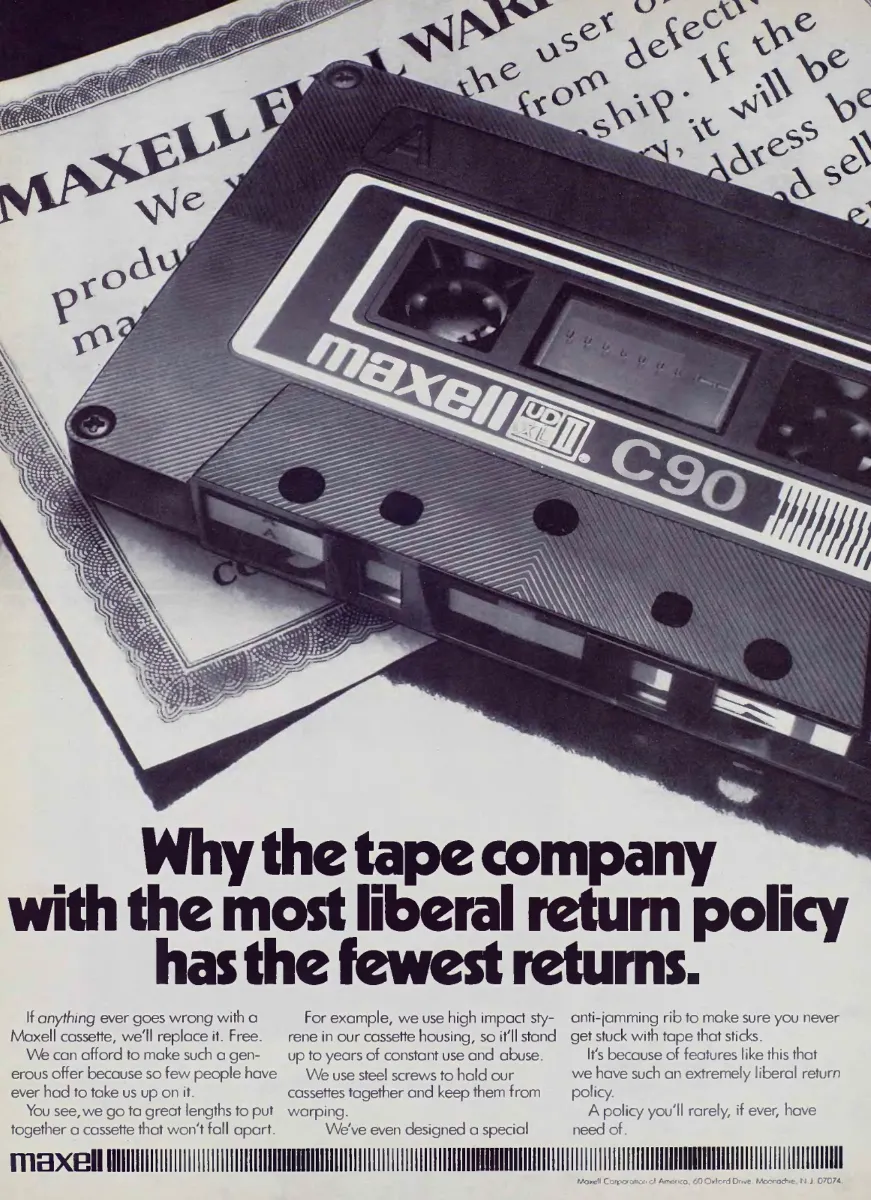
FROM THE PRINTED PAGEOriginal ad copy
OCR transcription from the archived page. Scanning and reading-order errors may remain.
MAXELL WARRANTY maxell UD C90 Why the tape company with the most liberal return policy has the fewest returns. If anything ever goes wrong with a Maxell cassette, we'll replace it. Free. We can afford to make such a generous offer because so few people have ever had to take us up on it. You see, we go to great lengths to put together a cassette that won't fall apart. For example, we use high impact styrene in our cassette housing, so it'll stand up to years of constant use and abuse. We use steel screws to hold our cassettes together and keep them from warping. We've even designed a special anti-jamming rib to make sure you never get stuck with tape that sticks. It's because of features like this that we have such an extremely liberal return policy. A policy you'll rarely, if ever, have need of. maxell Maxell Corporation of America, 60 Oxford Drive, Moonachie, N.J. 07074.
Commentary
The cassette is placed diagonally across a document headed “MAXELL WARRANTY.” At first it looks like proof that the company will take responsibility if the product fails. Then the headline makes a more aggressive claim: Maxell supposedly has the most liberal return policy and the fewest returns. The large tape covers much of the certificate, almost as if the object itself is the more important guarantee. The scan provides no comparative return data; that superlative is the advertiser’s assertion.
The body copy turns a potentially anxious topic into a lesson in construction. It says the housing uses high impact styrene, the halves are held with steel screws, and a special rib prevents jams. These details matter because cassette failure was physical. A cracked shell, warped case, or tangled tape could interrupt listening and possibly damage a recording. The ad does not promise better music so much as fewer unpleasant encounters with the mechanism carrying it. Its logic is circular in a productive way: the company can promise replacement because the product supposedly makes replacement unnecessary.
The warranty sheet also shows a different kind of consumer reassurance. A physical tape could be mailed back or exchanged, and a postal address appears in the footer. For a buyer of streamed music, the quality problems are more likely to involve access, connection, rights, or files. The underlying need is still dependable access to something one chose to keep, but the point of failure has moved away from screws and plastic.
For a new copywriter, the headline delays its explanation. “Most liberal” and “fewest” look contradictory until the body supplies the product story. The curt “Free.” gives the promise a satisfying stop; “rarely, if ever” then turns the guarantee into confidence rather than an invitation to use it. A surprising claim can earn attention, but its supporting details must answer the surprise in terms the buyer can picture.
Maxell describes magnetic tape manufacturing as part of its technical inheritance. The company now lists batteries, industrial adhesive tapes, and other materials among its products, far beyond the consumer C90 shown here.
The old ad’s promise of reliability still makes sense wherever a medium holds something valued. Its steel screws, anti-jamming rib, and mail-addressed warranty belong to the cassette’s physical life. The durable design principle is to make a guarantee credible by showing how the product was built to avoid invoking it.