Electronics 1970
General Dynamics
Here's a little idea worth about $1 billion a year.
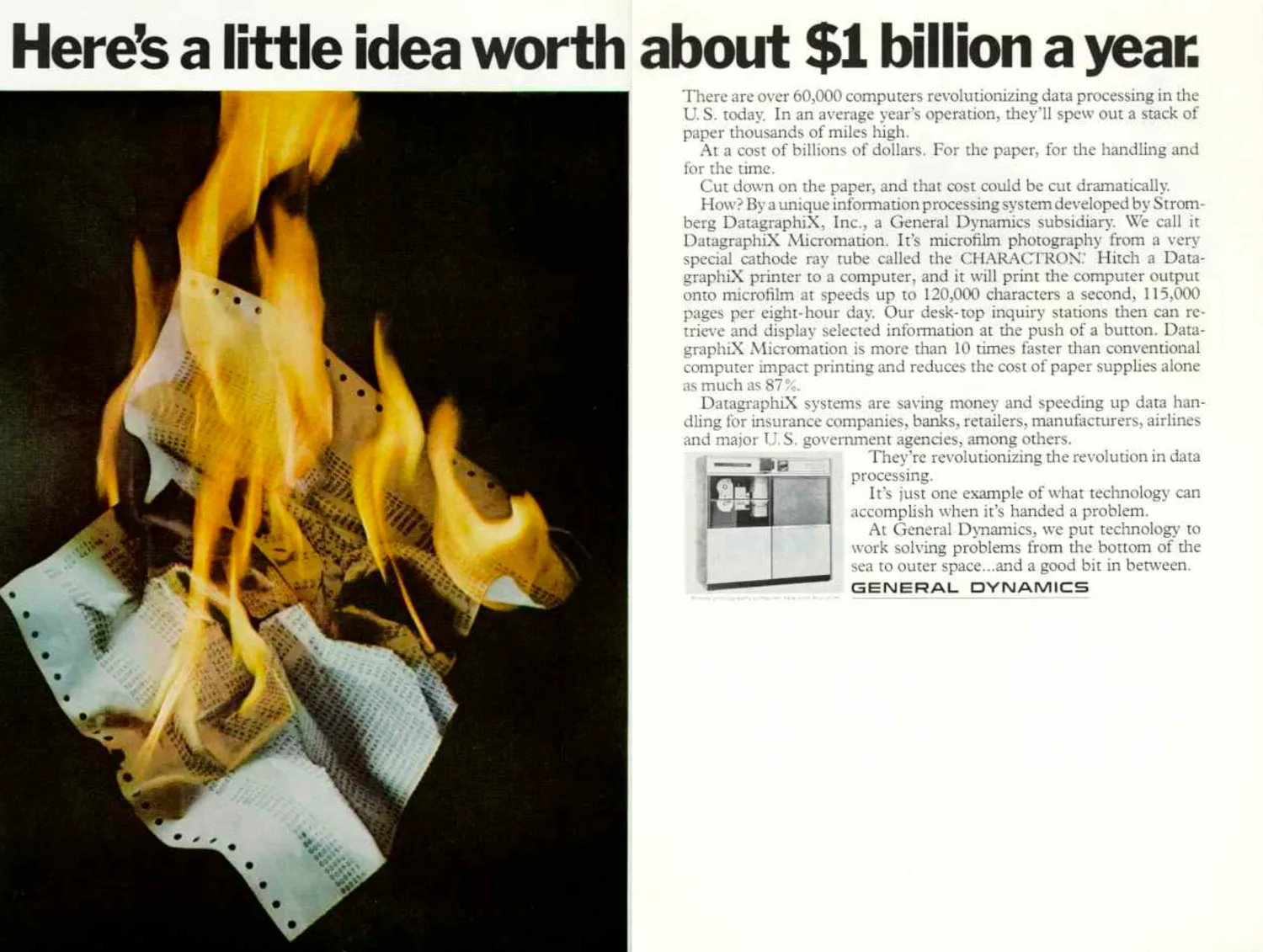
FROM THE PRINTED PAGEOriginal ad copy
OCR transcription from the archived page. Scanning and reading-order errors may remain.
Here's a little idea worth about $1 billion a year. There are over 60,000 computers revolutionizing data processing in the U.S. today. In an average year's operation, they'll spew out a stack of paper thousands of miles high. At a cost of billions of dollars. For the paper, for the handling and for the time. Cut down on the paper, and that cost could be cut dramatically. How? By a unique information processing system developed by Stromberg DatagraphiX, Inc., a General Dynamics subsidiary. We call it DatagraphiX Micromation. It's microfilm photography from a very special cathode ray tube called the CHARACTRON. Hitch a DatagraphiX printer to a computer, and it will print the computer output onto microfilm at speeds up to 120,000 characters a second, 115,000 pages per eight-hour day. Our desk-top inquiry stations then can retrieve and display selected information at the push of a button. DatagraphiX Micromation is more than 10 times faster than conventional computer impact printing and reduces the cost of paper supplies alone as much as 87%. DatagraphiX systems are saving money and speeding up data handling for insurance companies, banks, retailers, manufacturers, airlines and major U.S. government agencies, among others. They're revolutionizing the revolution in data processing. It's just one example of what technology can accomplish when it's handed a problem. At General Dynamics, we put technology to work solving problems from the bottom of the sea to outer space...and a good bit in between. GENERAL DYNAMICS
Commentary
The left page is a brisk visual argument: computer printout burns against black. The right page requires patient reading. I find the split revealing. The fire dramatizes waste, yet the sales claim is not that anyone should literally destroy records. General Dynamics wants computer users to stop making so much paper in the first place. “A little idea” in the headline is deliberately out of scale with the projected billion-dollar saving.
The text first describes the problem in volume, imagining an annual stack of output thousands of miles high. It then specifies the proposed route around it: DatagraphiX Micromation records computer output on microfilm using a cathode-ray tube called CHARACTRON, while desktop inquiry stations retrieve selected information. The ad lists speeds of 120,000 characters a second and 115,000 pages per eight-hour day, and says paper supplies alone can cost as much as 87 percent less. These are the advertiser’s performance claims; the page does not show their measurement. The tiny machine photograph beside the prose lends the dense account a physical object.
What changed most is the destination of the information. This is a paper-reduction ad, but its answer is microfilm, a medium that still needs a dedicated reader and a managed archive. Today a business might describe a similar aim in terms of searchable digital records, cloud storage or workflow software. The old page reminds us that moving away from paper happened in stages, and each stage sold its own version of instant access.
For a new copywriter, “revolutionizing the revolution” is a compact way to borrow the prestige of computing while claiming to improve its consequences. The opening’s “little” and “$1 billion” create a scale collision; the burning paper makes that collision legible at a glance. Then the long, number-heavy explanation serves the technically minded buyer. A striking metaphor can invite attention, but this page shows why a costly business purchase still needs a mechanism and figures underneath.
General Dynamics dates its incorporation to 1952. It later sold its Data Systems Division, and today describes itself as an aerospace and defense company spanning aerospace, marine, combat and technology businesses.
The promise of reducing information-handling cost remains familiar. Microfilm and CHARACTRON are no longer the ordinary route to it; the ad’s more durable idea is to show the financial burden created by a celebrated technology, then sell a second technology as its repair.