Automotive 1970
Lincoln
Its looks tell you it's different. Its ride tells you how different.
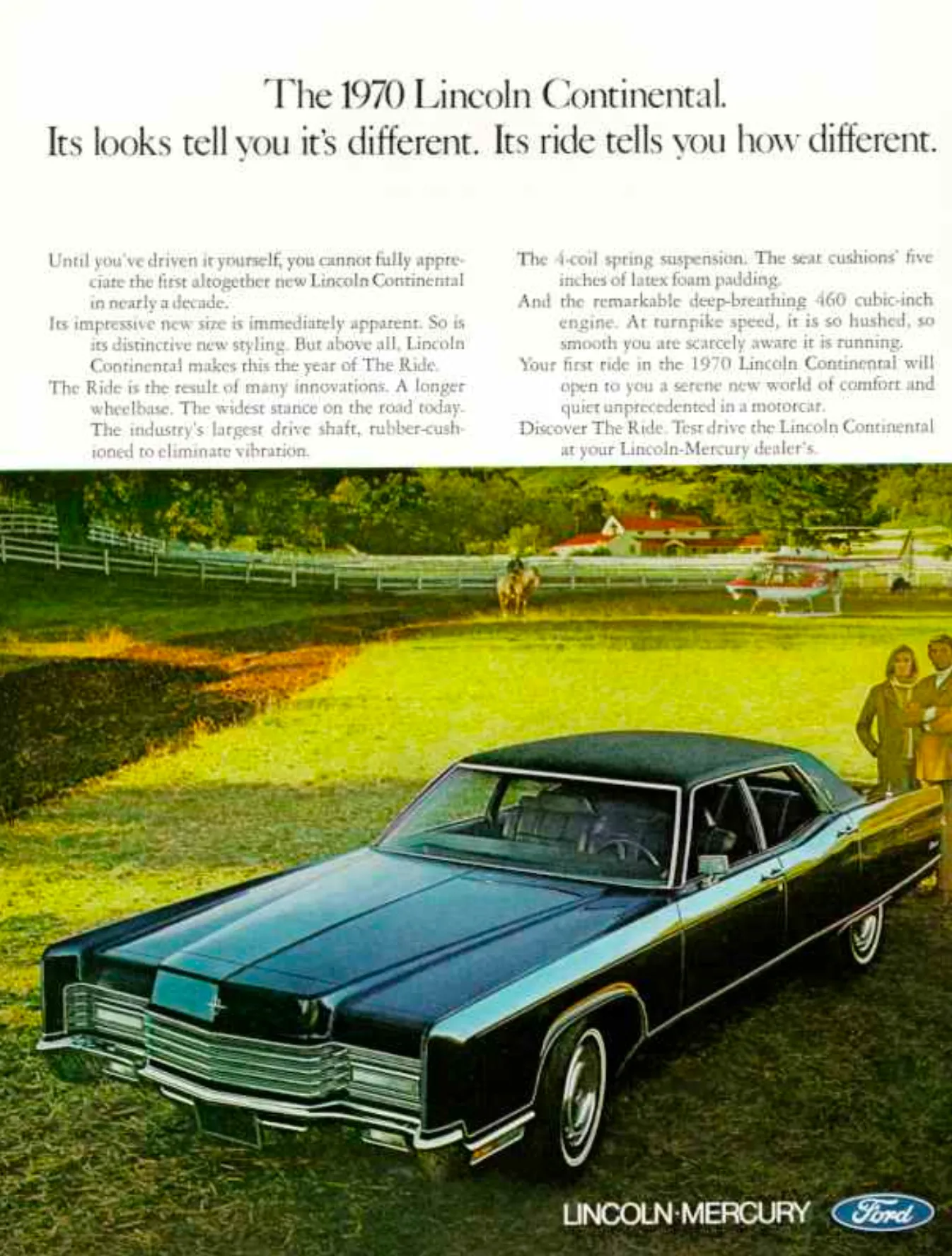
FROM THE PRINTED PAGEOriginal ad copy
OCR transcription from the archived page. Scanning and reading-order errors may remain.
The 1970 Lincoln Continental. Its looks tell you it's different. Its ride tells you how different. Until you've driven it yourself, you cannot fully appreciate the first altogether new Lincoln Continental in nearly a decade. Its impressive new size is immediately apparent. So is its distinctive new styling. But above all, Lincoln Continental makes this the year of The Ride. The Ride is the result of many innovations. A longer wheelbase. The widest stance on the road today. The industry's largest drive shaft, rubber-cushioned to eliminate vibration. The 4-coil spring suspension. The seat cushions' five inches of latex foam padding. And the remarkable deep-breathing 460 cubic-inch engine. At turnpike speed, it is so hushed, so smooth you are scarcely aware it is running. Your first ride in the 1970 Lincoln Continental will open to you a serene new world of comfort and quiet unprecedented in a motorcar. Discover The Ride. Test drive the Lincoln Continental at your Lincoln-Mercury dealer's. LINCOLN-MERCURY Ford
Commentary
The car takes up nearly all the lower half of the page, but the setting is worth a second look. A white fence, broad lawn and distant house frame the Continental as a visitor to an estate; a pair of people stand at the edge, small enough to make the car’s length emphatic. The headline says the appearance is only the introduction. To find the real difference, we must ride in it. That is a shrewd move for a print ad, which can display a shape but cannot reproduce the quiet it sells.
The copy tries to bridge that sensory gap with hardware: a longer wheelbase, wide stance, rubber-cushioned drive shaft, four-coil suspension, five inches of latex foam in the seats, and a 460-cubic-inch engine. Those details lead toward one desired feeling, “The Ride,” capitalized as though it were a named feature. The claim that the engine is scarcely noticeable at turnpike speed is the most vivid test offered. The reader is finally directed to a dealer because the page’s evidence can only prepare an experience, not deliver it.
The estate and the scale of the automobile suggest a version of luxury measured in physical amplitude: length, padding, distance from vibration and noise. Much contemporary luxury advertising also promises calm, though the technical means and the vehicle shapes have changed. The ad makes a useful period record of the large sedan as a private quiet room on a public road.
For a young copywriter, the paired sentences of the headline are doing the ordering. “Looks” is immediately available to the eye; “ride” is withheld. Repeating “different” makes the second sentence answer the first without naming a competitor. The capitalized “The Ride” then gives a broad sensation a memorable label, while the component list underneath keeps that label from floating free of evidence.
Lincoln’s official history places the Continental among the brand’s defining cars. Lincoln remains Ford’s luxury marque, although the Continental is no longer in its lineup.
Ride comfort and quiet remain persuasive luxury promises. The particular demonstration here—a very large sedan on an estate, its 460-cubic-inch engine presented as a source of serenity—belongs to a different automotive moment.