Back to the collection256 / 281
Consumer Goods 1976
Jose Cuervo
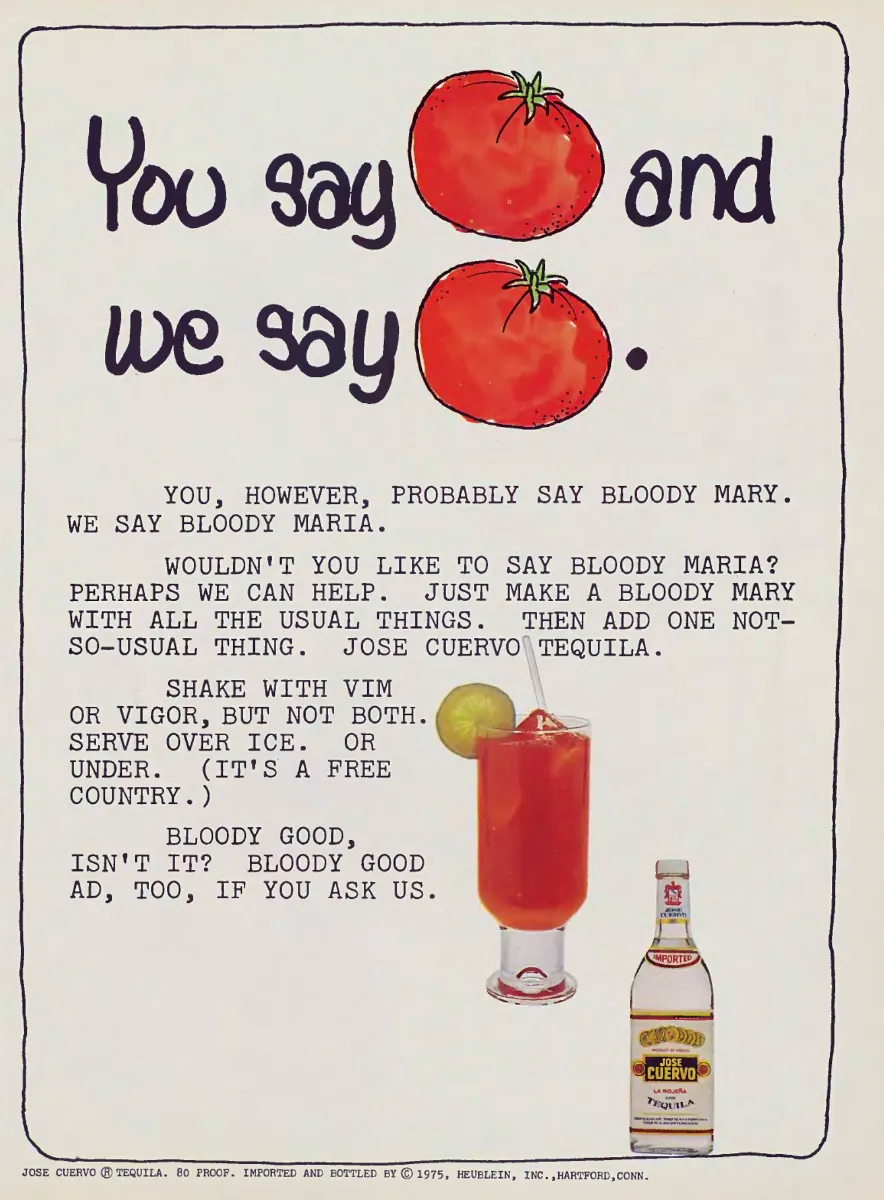
You say [tomato] and we say [tomato].
FROM THE PRINTED PAGEOriginal ad copy
OCR transcription from the archived page. Scanning and reading-order errors may remain.
You say [tomato] and we say [tomato]. YOU, HOWEVER, PROBABLY SAY BLOODY MARY. WE SAY BLOODY MARIA. WOULDN’T YOU LIKE TO SAY BLOODY MARIA? PERHAPS WE CAN HELP. JUST MAKE A BLOODY MARY WITH ALL THE USUAL THINGS. THEN ADD ONE NOT- SO-USUAL THING. JOSE CUERVO TEQUILA. SHAKE WITH VIM OR VIGOR, BUT NOT BOTH. SERVE OVER ICE. OR UNDER. (IT’S A FREE COUNTRY.) BLOODY GOOD, ISN’T IT? BLOODY GOOD AD, TOO, IF YOU ASK US. IMPORTED JOSE CUERVO LA ROJEÑA TEQUILA JOSE CUERVO ® TEQUILA. 80 PROOF. IMPORTED AND BOTTLED BY © 1975, HEUBLEIN, INC., HARTFORD, CONN.
Commentary
I tried reading the tomatoes aloud. The two drawings are almost the same; the difference the headline asks us to supply exists in speech. Jose Cuervo turns a familiar disagreement about pronunciation into a way of introducing another name for a familiar-looking drink. The reader has to finish the opening before the advertiser explains the substitution.
The body copy then moves from Mary to Maria. This is a small linguistic change standing in for a change of spirit, with tequila positioned as the ingredient that gives an established drink a different identity. The photograph makes the experiment look manageable: a tall red cocktail, a citrus wheel, a straw and a bottle. The ad assumes its audience already knows the usual Bloody Mary ingredients and uses that knowledge to lower the effort of trying something adjacent.
The recipe soon abandons precision. Vim or vigor, over or under ice: instructions become opportunities for the writer to interrupt himself. The claim to have made a good advertisement finally breaks the frame altogether. I read that self-congratulation as part of the informal performance, reinforced by the uneven border and loose lettering. The page behaves like an amusing suggestion passed across a table, despite its carefully placed bottle.
One historical detail belongs in the record without forcing a new ad date: the supplied filename identifies 1976, while the footer carries a 1975 copyright. A copyright year can precede a particular appearance. The transcription preserves that earlier printed year; it does not replace the user’s provenance with an inferred publication date.
For young copywriters, the important device is economical substitution. “Mary” becomes “Maria,” and “usual” becomes “not-so-usual,” giving the product a role in both sentence and recipe. “Vim or vigor” adds comic fussiness to a simple action. The practical lesson is to build your wordplay around the behavior you want readers to consider, so remembering the joke also helps them remember the product’s proposed use.
Casa Cuervo’s history records the family’s eighteenth-century agave business and its 1795 authorization to produce and sell the spirit. Jose Cuervo remains a tequila brand; its current product information describes agave cultivation, production and the continuing operation of La Rojeña.
Making an unfamiliar choice approachable through a familiar recipe remains useful. The page’s casual instructions and Heublein importer credit belong to this execution. Its durable idea is that a product can enter an established ritual through one memorable alteration, without asking the customer to learn an entirely new occasion.