Automotive 1972
Fiat
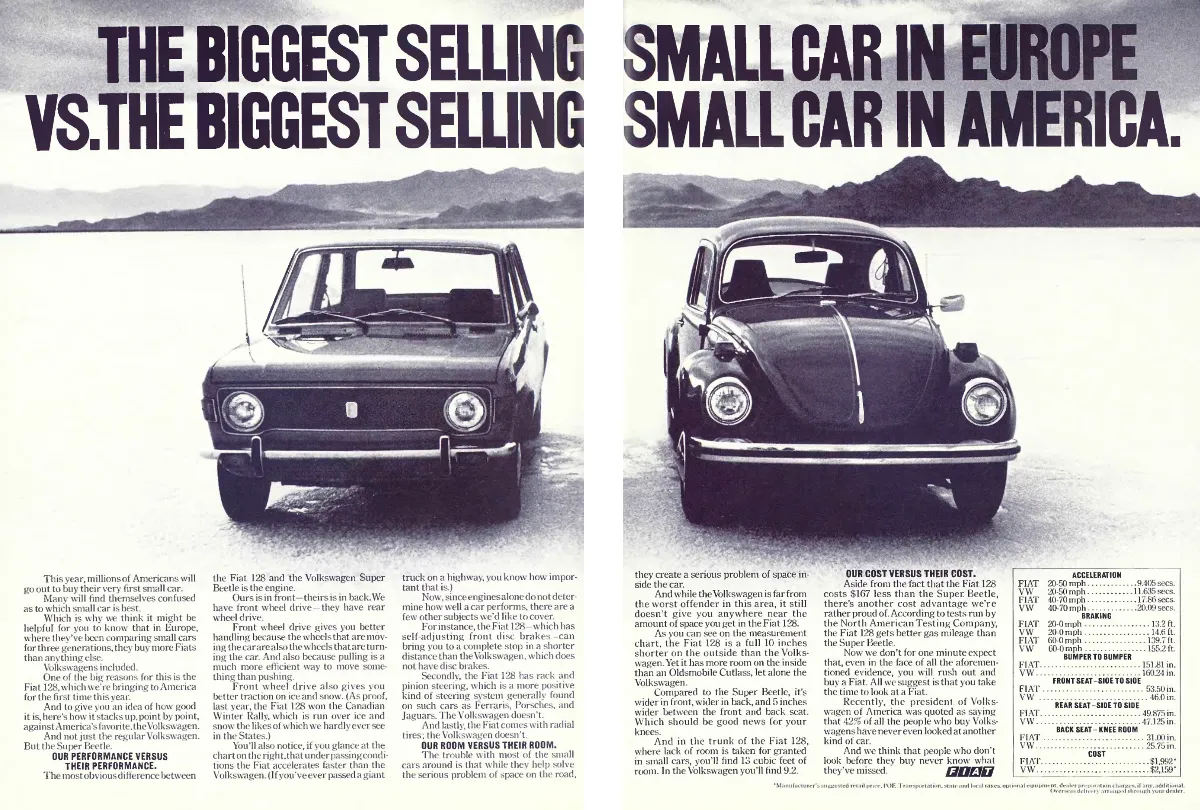
The biggest selling small car in Europe vs. the biggest selling small car in America.
FROM THE PRINTED PAGEOriginal ad copy
OCR transcription from the archived page. Scanning and reading-order errors may remain.
THE BIGGEST SELLING SMALL CAR IN EUROPE VS. THE BIGGEST SELLING SMALL CAR IN AMERICA. This year, millions of Americans will go out to buy their very first small car. Many will find themselves confused as to which small car is best. Which is why we think it might be helpful for you to know that in Europe, where they've been comparing small cars for three generations, they buy more Fiats than anything else. Volkswagens included. One of the big reasons for this is the Fiat 128, which we're bringing to America for the first time this year. And to give you an idea of how good it is, here's how it stacks up, point by point, against America's favorite, the Volkswagen. And not just the regular Volkswagen. But the Super Beetle. OUR PERFORMANCE VERSUS THEIR PERFORMANCE. The most obvious difference between the Fiat 128 and the Volkswagen Super Beetle is the engine. Ours is in front—theirs is in back. We have front wheel drive—they have rear wheel drive. Front wheel drive gives you better handling because the wheels that are moving the car are also the wheels that are turning the car. And also because pulling is a much more efficient way to move something than pushing. Front wheel drive also gives you better traction on ice and snow. (As proof, last year, the Fiat 128 won the Canadian Winter Rally, which is run over ice and snow the likes of which we hardly ever see in the States.) You'll also notice, if you glance at the chart on the right, that under passing conditions the Fiat accelerates faster than the Volkswagen. (If you've ever passed a giant truck on a highway, you know how important that is.) Now, since engines alone do not determine how well a car performs, there are a few other subjects we'd like to cover. For instance, the Fiat 128—which has self-adjusting front disc brakes—can bring you to a complete stop in a shorter distance than the Volkswagen, which does not have disc brakes. Secondly, the Fiat 128 has rack and pinion steering, which is a more positive kind of steering system generally found on such cars as Ferraris, Porsches, and Jaguars. The Volkswagen doesn't. And lastly, the Fiat comes with radial tires; the Volkswagen doesn't. OUR ROOM VERSUS THEIR ROOM. The trouble with most of the small cars around is that while they help solve the serious problem of space on the road, they create a serious problem of space inside the car. And while the Volkswagen is far from the worst offender in this area, it still doesn't give you anywhere near the amount of space you get in the Fiat 128. As you can see on the measurement chart, the Fiat 128 is a full 10 inches shorter on the outside than the Volkswagen. Yet it has more room on the inside than an Oldsmobile Cutlass, let alone the Volkswagen. Compared to the Super Beetle, it's wider in front, wider in back, and 5 inches wider between the front and back seat. Which should be good news for your knees. And in the trunk of the Fiat 128, where lack of room is taken for granted in small cars, you'll find 13 cubic feet of room. In the Volkswagen you'll find 9.2. OUR COST VERSUS THEIR COST. Aside from the fact that the Fiat 128 costs $167 less than the Super Beetle, there's another cost advantage we're rather proud of. According to tests run by the North American Testing Company, the Fiat 128 gets better gas mileage than the Super Beetle. Now we don't for one minute expect that, even in the face of all the aforementioned evidence, you will rush out and buy a Fiat. All we suggest is that you take the time to look at a Fiat. Recently, the president of Volkswagen of America was quoted as saying that 42% of all the people who buy Volkswagens have never even looked at another kind of car. And we think that people who don't look before they buy never know what they've missed. FIAT ACCELERATION FIAT 20-50 mph: 9.405 secs. VW 20-50 mph: 11.635 secs. FIAT 40-70 mph: 17.86 secs. VW 40-70 mph: 20.09 secs. BRAKING FIAT 20-0 mph: 13.2 ft. VW 20-0 mph: 14.6 ft. FIAT 60-0 mph: 139.7 ft. VW 60-0 mph: 155.2 ft. BUMPER TO BUMPER FIAT: 151.81 in. VW: 160.24 in. FRONT SEAT—SIDE TO SIDE FIAT: 53.50 in. VW: 46.0 in. REAR SEAT—SIDE TO SIDE FIAT: 49.875 in. VW: 47.125 in. BACK SEAT—KNEE ROOM FIAT: 31.00 in. VW: 25.75 in. COST FIAT: $1,992* VW: $2,159* *Manufacturer's suggested retail price. P.O.E. Transportation, state and local taxes, optional equipment, dealer preparation charges, if any, additional. Overseas delivery arranged through your dealer.
Commentary
I began with the gap between the cars. The white gutter divides a boxy Fiat from a rounded Volkswagen, but the level horizon and matching frontal views make them look like exhibits arranged for inspection. Fiat has given its rival almost half the spread. That is a large concession of space until the headline turns it into borrowed recognition: the American favourite becomes the ruler against which the unfamiliar car can be measured.
The case proceeds through performance, room and cost. Engine position becomes an explanation of handling; passing a truck supplies a human reason to care about acceleration; knee room makes packaging tangible. The table lends the argument the appearance of an independent shopping exercise, although the advertiser has selected the measurements. There is even a useful imperfection: the prose calls the Fiat a full ten inches shorter, while the printed lengths differ by 8.43 inches. I read this as advocacy with numbers, not a neutral road test.
The final request is surprisingly small: look at a Fiat. The quoted claim that 42 percent of Volkswagen buyers have not considered another car identifies the obstacle as habit. Today a comparison can begin with several browser tabs; here the printed spread must supply the comparison and persuade the reader to undertake the next physical visit. Its density is part of that job.
For a new copywriter, notice how “ours” and “theirs” turn specifications into a recurring contest. “Volkswagens included” is a short sentence placed after a much larger claim about European taste; its delayed arrival makes the opponent unmistakable. The practical lesson is to organise detail around a small number of repeated questions. A reader can skim the section headings and still recover the argument.
Stellantis traces Fiat to Turin in 1899 and presents the continuing brand around accessible mobility, Italian identity and everyday use. That gives this older American introduction a useful context: smallness was being offered as accumulated expertise.
The enduring proposition is efficient use of money and space. The particular winner, test figures and price gap belong to this historical comparison; what survives is the need to make an unfamiliar option easy to evaluate against the product already in someone’s mind.