Electronics 1976
Panasonic
From the mountains to the prairies to the oceans far from home
FROM THE PRINTED PAGEOriginal ad copy
OCR transcription from the archived page. Scanning and reading-order errors may remain.
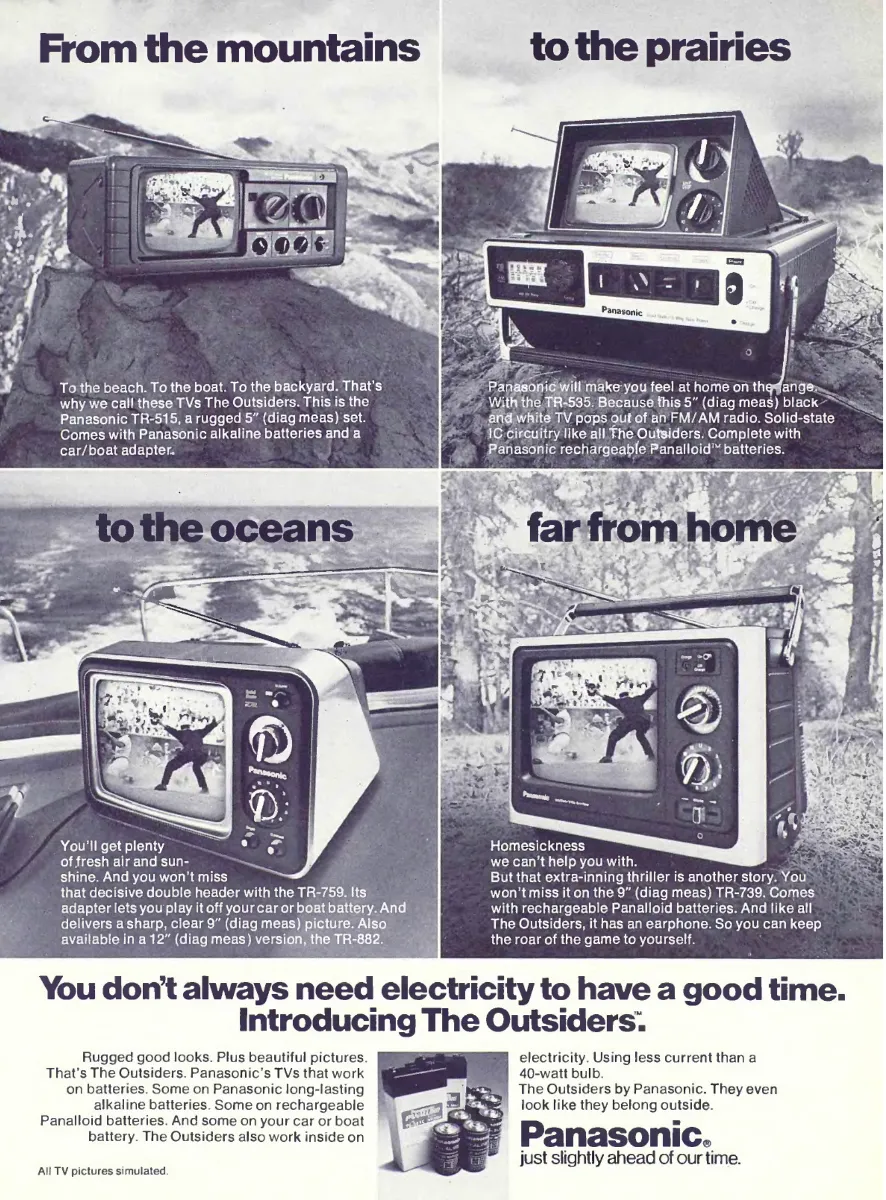
From the mountains To the beach. To the boat. To the backyard. That’s why we call these TVs The Outsiders. This is the Panasonic TR-515, a rugged 5” (diag meas) set. Comes with Panasonic alkaline batteries and a car/boat adapter. to the prairies Panasonic will make you feel at home on the range. With the TR-535. Because this 5” (diag meas) black and white TV pops out of an FM/AM radio. Solid-state IC circuitry like all The Outsiders. Complete with Panasonic rechargeable Panalloid™ batteries. to the oceans You’ll get plenty of fresh air and sunshine. And you won’t miss that decisive double header with the TR-759. Its adapter lets you play it off your car or boat battery. And delivers a sharp, clear 9” (diag meas) picture. Also available in a 12” (diag meas) version, the TR-882. far from home Homesickness we can’t help you with. But that extra-inning thriller is another story. You won’t miss it on the 9” (diag meas) TR-739. Comes with rechargeable Panalloid batteries. And like all The Outsiders, it has an earphone. So you can keep the roar of the game to yourself. You don’t always need electricity to have a good time. Introducing The Outsiders™. Rugged good looks. Plus beautiful pictures. That’s The Outsiders. Panasonic’s TVs that work on batteries. Some on Panasonic long-lasting alkaline batteries. Some on rechargeable Panalloid batteries. And some on your car or boat battery. The Outsiders also work inside on electricity. Using less current than a 40-watt bulb. The Outsiders by Panasonic. They even look like they belong outside. Panasonic® just slightly ahead of our time. All TV pictures simulated.
Commentary
I followed the four landscapes expecting an invitation to leave the living room behind. Instead, every television carries the game into the scenery. Mountains, prairie, water and woods supply variety; the baseball pictures supply continuity. Panasonic’s freedom is the ability to change location without surrendering the event being watched.
The grid doubles as a small catalogue. Each landscape shelters a distinct explanation: a rugged five-inch set with batteries and adapter; a television that lifts out of a radio; a larger screen using a car or boat battery; another with rechargeable batteries and an earphone. Those are different practical arrangements, gathered under the social identity of “The Outsiders.” I find the little battery photograph at the bottom especially useful. After the landscape tour, it shows the unglamorous provision that makes the promised independence possible.
There is an instructive imprecision in “You don’t always need electricity.” The copy immediately explains that these are battery-powered televisions; the intended contrast is with a household power connection. The persuasive shorthand is obvious, but so is the importance of the clarification. Likewise, the simulated pictures show the desired experience rather than demonstrating reception in any of these settings. Nothing on the page establishes that every remote location will receive a usable signal.
The extra-inning thriller supplies the ad’s clock. Leisure can move outdoors, but the broadcast still determines when the viewer must be present. Compared with on-demand viewing, that is a different kind of freedom: carry the appointment with you. Live sport preserves some of that urgency today. The earphone adds an unexpectedly considerate qualification, allowing one person’s attachment to the game without making the entire landscape listen.
For young copywriters, notice how the repeated “to” turns four product panels into a journey. The short “To the beach. To the boat. To the backyard” brings grand geography down to attainable weekend distances. “The Outsiders” then gives the range a name easier to retain than its model numbers. The useful technique is to establish a memorable organising idea, then let each panel answer a different practical question.
Panasonic was founded by Konosuke Matsushita in 1918, initially making electrical fittings, as its consumer history explains. Its current consumer business spans home appliances, personal care and audiovisual products.
The need to bring entertainment along remains familiar. The separate TV sets, screen-size hierarchy and battery arrangements shown here locate the solution in an earlier hardware world. Panasonic’s lasting insight is that portability sells the preservation of a valued experience, not simply the removal of a cable.