Electronics 1984
Pioneer
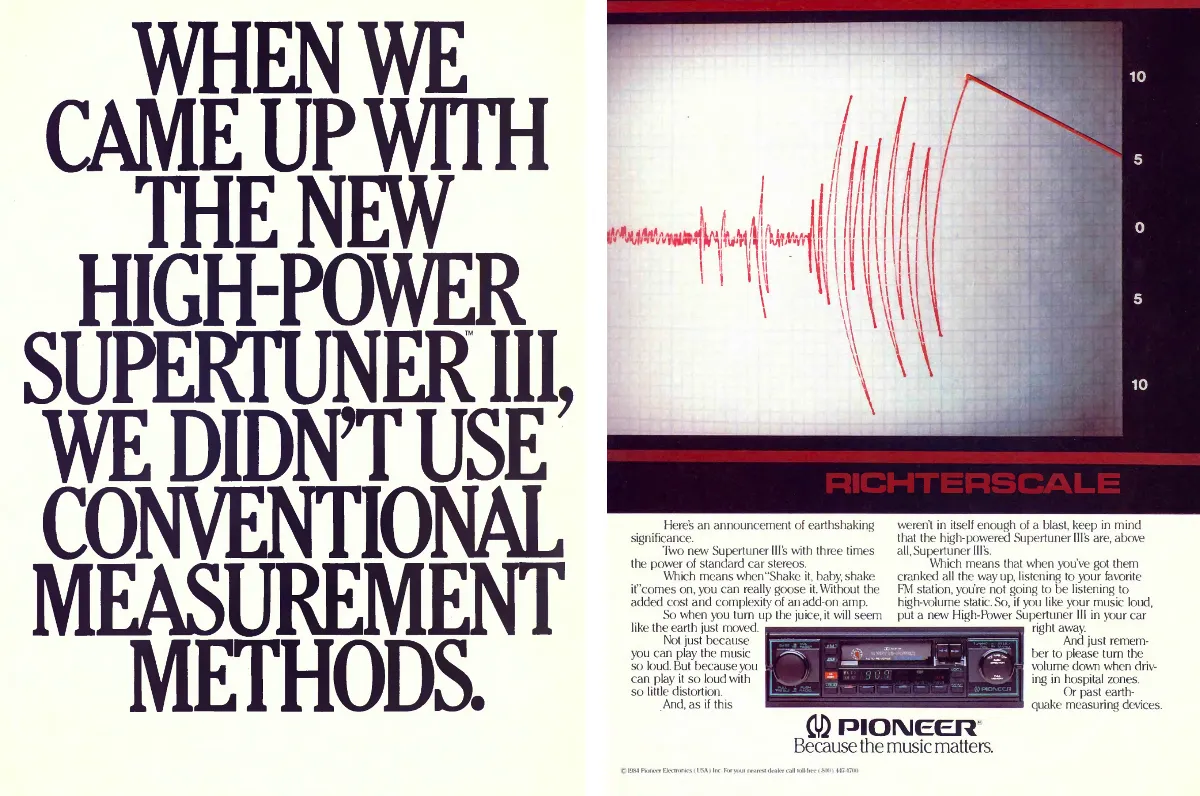
When we came up with the new high-power Supertuner III, we didn't use conventional measurement methods.
FROM THE PRINTED PAGEOriginal ad copy
OCR transcription from the archived page. Scanning and reading-order errors may remain.
WHEN WE CAME UP WITH THE NEW HIGH-POWER SUPERTUNER™ III, WE DIDN'T USE CONVENTIONAL MEASUREMENT METHODS. 10 5 0 5 10 RICHTERSCALE Here's an announcement of earthshaking significance. Two new Supertuner III's with three times the power of standard car stereos. Which means when “Shake it, baby, shake it” comes on, you can really goose it. Without the added cost and complexity of an add-on amp. So when you turn up the juice, it will seem like the earth just moved. Not just because you can play the music so loud. But because you can play it so loud with so little distortion. And, as if this weren't in itself enough of a blast, keep in mind that the high-powered Supertuner III's are, above all, Supertuner III's. Which means that when you've got them cranked all the way up, listening to your favorite FM station, you're not going to be listening to high-volume static. So, if you like your music loud, put a new High-Power Supertuner III in your car right away. And just remember to please turn the volume down when driving in hospital zones. Or past earthquake measuring devices. PIONEER® Because the music matters. © 1984 Pioneer Electronics (USA) Inc. For your nearest dealer call toll free (800) 447-4700.
Commentary
I first try to read the headline at normal magazine speed, and discover that the typography has other plans. The sentence fills almost an entire page. Across the gutter, a red trace develops violent excursions on graph paper. Before Pioneer shows much of the stereo, it has already made the spread feel loud.
The word under the trace supplies the joke: RICHTERSCALE. This is theatrical evidence, not an acoustic measurement. The body then introduces the actual selling propositions: three times the power of standard car stereos, no separate amplifier, little distortion and good FM reception. The comparison leaves the standard stereo undefined. That qualification matters; the memorable chart cannot fill in missing test conditions.
What interests me is the distinction between loud music and amplified static. Power alone could intensify an unpleasant signal. Pioneer therefore uses the Supertuner name as a second assurance after the power claim. A small photograph of the dashboard unit finally turns the geological disturbance into something a dealer can install. The closing warning about hospital zones briefly admits that private enjoyment has public consequences, before the earthquake joke takes over again.
The toll-free dealer line records a different route to purchase from a contemporary receiver page. A reader had to locate a seller rather than immediately compare installation fit, connectivity and prices online. Today’s Pioneer receiver range foregrounds products including wireless smartphone integration. Here, the decisive experience begins with an FM broadcast and the volume knob.
For young copywriters, the useful device is delayed completion. A solemn sentence about measurement sends the reader across the spread to a deliberately absurd instrument. The body keeps the same vocabulary of shaking and disturbance, then gives the joke a final callback. Build that continuity around a real benefit; otherwise the spectacular opening risks advertising only its own cleverness.
Pioneer’s chronology traces the company to 1938 and its speaker-making origins. The company today continues in car electronics and mobility products and services.
Clean, enjoyable sound in a car remains a recognizable need. This particular expression belongs to an age of prominent aftermarket dashboard units and FM reception anxiety. The earthquake is still legible; the equipment and the listener’s source of music have changed.