Consumer Goods 1970
American Tourister
"Dear American Tourister: You’ll never believe this one."
FROM THE PRINTED PAGEOriginal ad copy
OCR transcription from the archived page. Scanning and reading-order errors may remain.
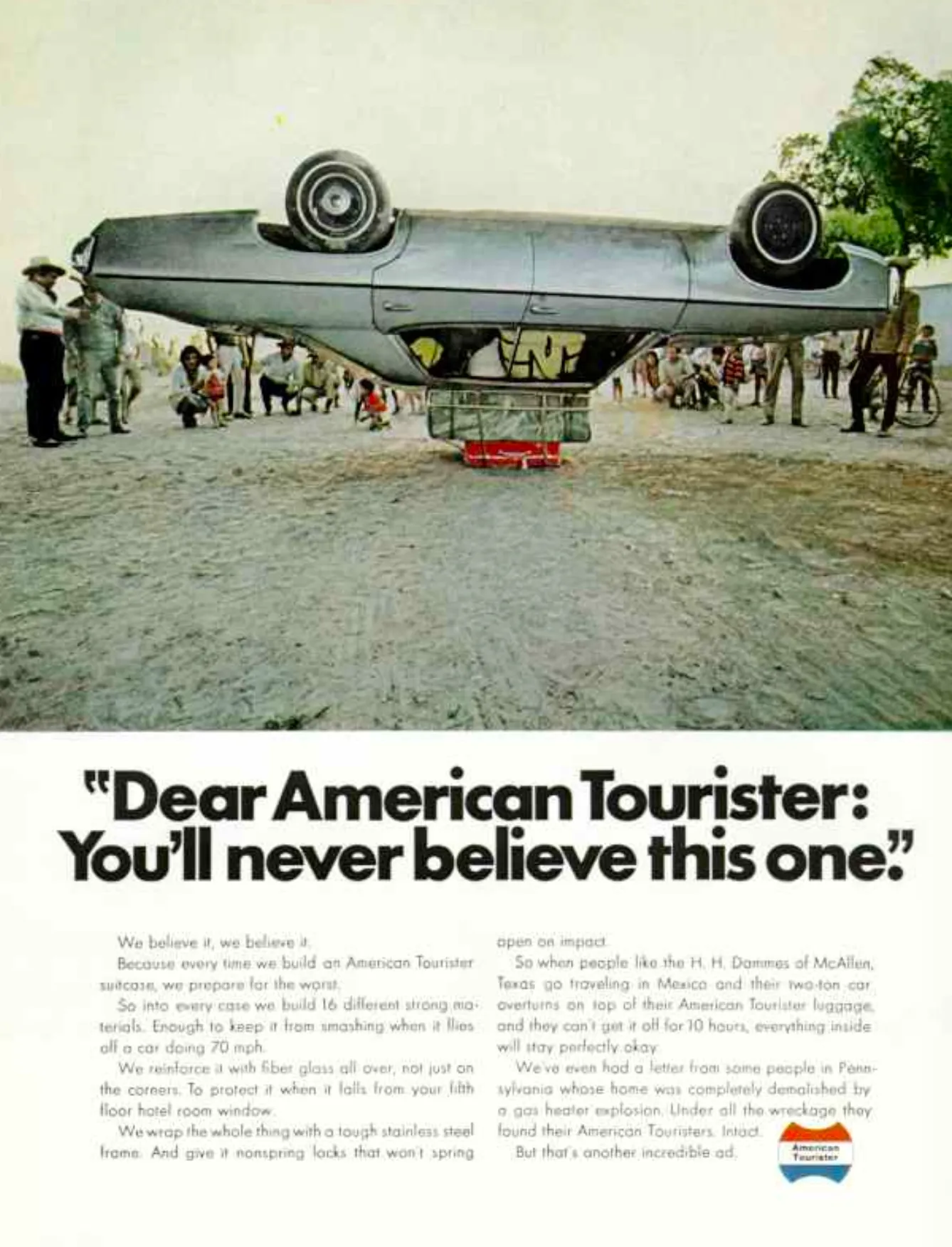
“Dear American Tourister: You'll never believe this one.” We believe it, we believe it. Because every time we build an American Tourister suitcase, we prepare for the worst. So into every case we build 16 different strong materials. Enough to keep it from smashing when it flies off a car doing 70 mph. We reinforce it with fiber glass all over, not just on the corners. To protect it when it falls from your fifth floor hotel room window. We wrap the whole thing with a tough stainless steel frame. And give it nonspring locks that won't spring open on impact. So when people like the H. H. Dommes of McAllen, Texas go traveling in Mexico and their two-ton car overturns on top of their American Tourister luggage, and they can't get it off for 10 hours, everything inside will stay perfectly okay. We've even had a letter from some people in Pennsylvania whose home was completely demolished by a gas heater explosion. Under all the wreckage they found their American Touristers. Intact. But that's another incredible ad. American Tourister
Commentary
An overturned car fills the upper half of the page. Bystanders gather, but the visual punch line is below the roof: a suitcase appears to be taking the weight. The headline borrows the opening of a customer letter—“Dear American Tourister”—and its incredulous “You’ll never believe this one” promises an outlandish story. The photograph makes us look for the luggage before the body copy tells us what happened.
The copy answers with an almost comic confidence: “We believe it, we believe it.” Sixteen materials, fiber glass reinforcement, a steel frame and locks that will not spring open form the construction case. Yet the page does not stop at material specifications. It names the H. H. Dommes of McAllen, Texas, a trip in Mexico, a two-ton car and ten hours beneath it. Those particulars create the texture of testimony, though the scan alone cannot independently verify the reported incident. A second letter about a gas heater explosion is teased at the end, as if durability stories arrive faster than the company can print them.
The implied fear is not that luggage will look worn; it is that everything inside will be lost or damaged when travel goes wrong. Modern cases are often advertised around mobility, weight, wheels and airport handling. This one offers survival under conditions so extreme that ordinary baggage handling seems easy. The sensational scene is a way of making a mundane promise—your belongings will be protected—hard to forget.
For a young copywriter, the exchange between “You’ll never believe” and “We believe it” is the mechanism. Repeating “we believe it” gives the brand a calm, knowing voice against the absurd photograph. The short final “Intact” works like a verdict after the second accident story. Specific names, places, weights and time spans make the anecdote vivid; the lesson is to distinguish a persuasive reported story from evidence you can independently establish.
American Tourister was founded by Sol Koffler in 1933 and was acquired by Samsonite in 1993. It remains a luggage brand selling suitcases and backpacks internationally.
Protection remains a plausible luggage promise, but the ad’s theatrical car wreck belongs to a more extravagant style of demonstration. Its durable idea is the narrative structure: turn the customer’s worst imaginable journey into a story about the case’s survival.