Electronics 1976
Technics
What you don’t hear is as impressive as what you do.
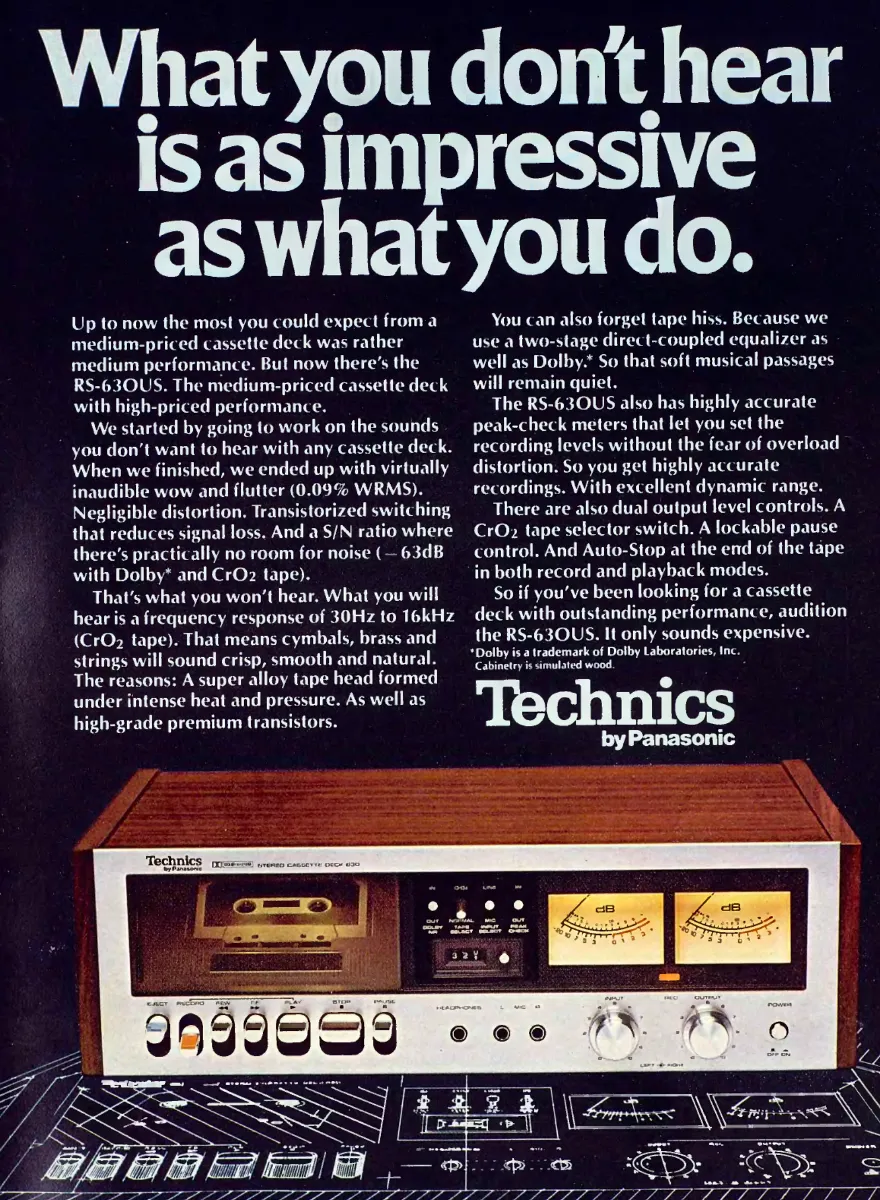
FROM THE PRINTED PAGEOriginal ad copy
OCR transcription from the archived page. Scanning and reading-order errors may remain.
What you don’t hear is as impressive as what you do. Up to now the most you could expect from a medium-priced cassette deck was rather medium performance. But now there’s the RS-630US. The medium-priced cassette deck with high-priced performance. We started by going to work on the sounds you don’t want to hear with any cassette deck. When we finished, we ended up with virtually inaudible wow and flutter (0.09% WRMS). Negligible distortion. Transistorized switching that reduces signal loss. And a S/N ratio where there’s practically no room for noise (−63dB with Dolby* and CrO₂ tape). That’s what you won’t hear. What you will hear is a frequency response of 30Hz to 16kHz (CrO₂ tape). That means cymbals, brass and strings will sound crisp, smooth and natural. The reasons: A super alloy tape head formed under intense heat and pressure. As well as high-grade premium transistors. You can also forget tape hiss. Because we use a two-stage direct-coupled equalizer as well as Dolby.* So that soft musical passages will remain quiet. The RS-630US also has highly accurate peak-check meters that let you set the recording levels without the fear of overload distortion. So you get highly accurate recordings. With excellent dynamic range. There are also dual output level controls. A CrO₂ tape selector switch. A lockable pause control. And Auto-Stop at the end of the tape in both record and playback modes. So if you’ve been looking for a cassette deck with outstanding performance, audition the RS-630US. It only sounds expensive. *Dolby is a trademark of Dolby Laboratories, Inc. Cabinetry is simulated wood. Technics by Panasonic
Commentary
I found myself looking at the meters before reading the specifications. Their warm yellow windows make the machine appear alert, ready to reveal what the ear might miss. Beneath it lie engineering drawings; above it, white type occupies a black field. The whole composition gives the promise of quiet a visible setting, while the wood-effect cabinet keeps the laboratory suitable for a living room.
The argument begins by splitting price from performance. “Medium” is acceptable when attached to the bill and disappointing when attached to the sound. Technics then builds its case through things removed: wow, flutter, distortion, signal loss and hiss. The numbers are the advertiser’s stated specifications, with qualifications about Dolby and chromium-dioxide tape retained in the copy. They are not independent measurements supplied by this scan. What matters rhetorically is that each objection gets an answer before the ad invites the reader to listen.
I like the moment when the frequency range turns into cymbals, brass and strings. It briefly returns the customer from measurement to music. The peak-check meters perform a related translation: they promise confidence while recording, not merely an impressive front panel. The small admission that the cabinetry is simulated wood makes a useful counterpoint. Appearance can be economical; the sound is where the ad insists the money has gone.
The recording controls also expose a different distribution habit. This listener is expected to choose tape, set levels and manage a physical recording. Against present-day access to a stream, that is a conspicuously active relationship with a copy of a song. The desired convenience is less interference from the machine, even while using the machine requires attention.
For a beginner writing copy, trace the hinge from “won’t hear” to “will hear.” The repeated verb keeps two technical lists inside one simple proposition. The closing “It only sounds expensive” then makes “sounds” mean both audible quality and apparent cost. That line earns its brevity because the preceding paragraphs have done the explanatory work.
Technics began in 1965 with the Technics 1 speaker system, as its brand history records. Today its turntable range continues to make precision audio hardware central to the brand’s offer.
The cassette-specific anxieties belong to the recording medium shown here. The larger promise still travels: let the listener notice the performance instead of the apparatus. This ad’s useful discipline is that it names the obstacles before announcing their absence.