Electronics 1980
Maxell
What's happening on this page shouldn't happen on your recording tape.
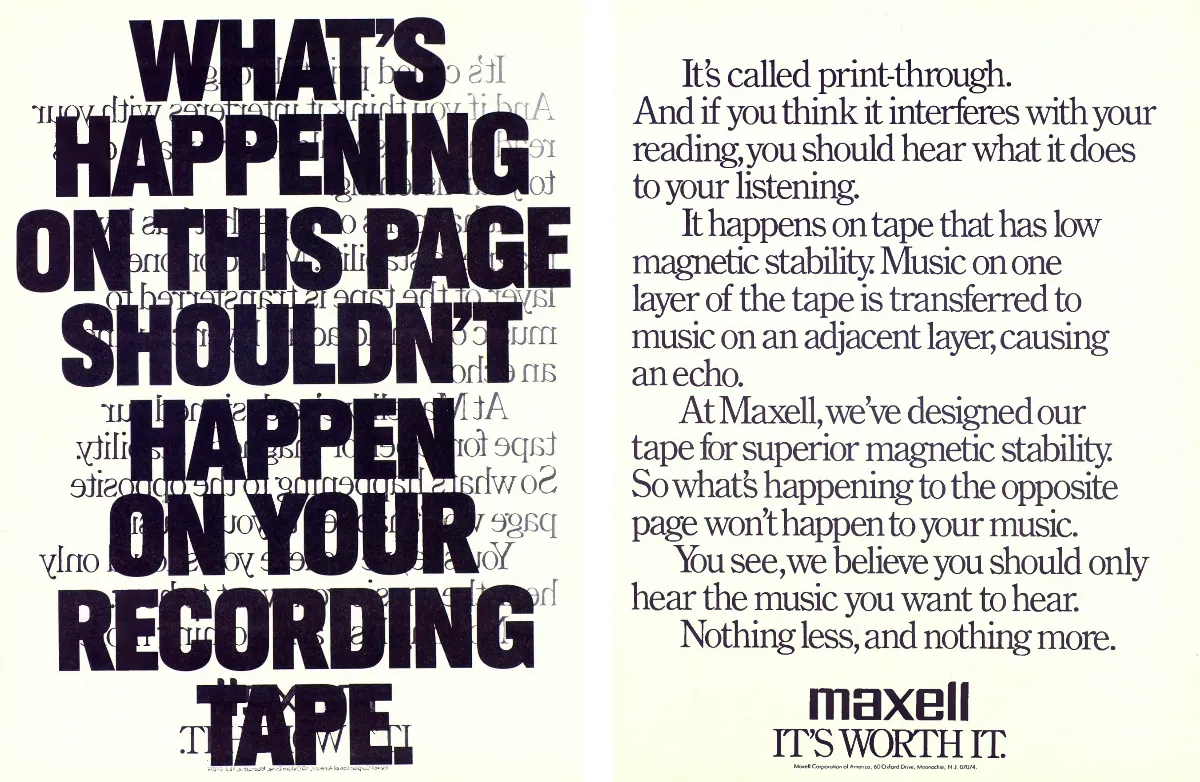
FROM THE PRINTED PAGEOriginal ad copy
OCR transcription from the archived page. Scanning and reading-order errors may remain.
WHAT'S HAPPENING ON THIS PAGE SHOULDN'T HAPPEN ON YOUR RECORDING TAPE. It's called print-through. And if you think it interferes with your reading, you should hear what it does to your listening. It happens on tape that has low magnetic stability. Music on one layer of the tape is transferred to music on an adjacent layer, causing an echo. At Maxell, we've designed our tape for superior magnetic stability. So what's happening to the opposite page won't happen to your music. You see, we believe you should only hear the music you want to hear. Nothing less, and nothing more. maxell IT'S WORTH IT.
Commentary
I looked first at the apparent printing mistake. Ghostly reversed letters show through the left page while the huge black headline makes reading harder still. The right page names the condition: “print-through.” The ad makes a tape defect briefly happen to paper. It asks the reader to feel an interruption before explaining why magnetic stability matters. The demonstration is imperfect as physics, but precise as communication: an unwanted second signal invades the intended one.
The composition gives the technical account room to breathe. Nothing competes with the right page’s large serif paragraphs, which explain how sound from one layer of tape can leave an echo on another. “You should hear what it does to your listening” turns the visual stunt into a promise about recorded music. No deck, cassette shell, or celebrity appears. The tape is sold through the absence of interference, a benefit that is inherently difficult to photograph.
This is also a small document of a listening habit. Music lived on a physical spool, with one length of tape lying against another; a listener could hear storage itself. The ad does not tell us how common print-through was, but its explanation assumes readers will care enough about a recording to notice an extra sound. Digital playback has changed the mechanism of failure, while the wish to hear only the intended track remains familiar.
For a new copywriter, the headline’s repeated “happening” is worth studying. It starts with a visible puzzle, then transfers the same word to “your recording tape.” The phrase “Nothing less, and nothing more” closes with balanced, plain language after a technical explanation. The lesson is to make an unfamiliar defect observable before asking the audience to value its prevention.
Maxell’s current materials business traces some of its manufacturing knowledge to magnetic tape, while the company now supplies products including industrial materials and batteries. The ad belongs to its consumer recording era.
The durable promise is control over what reaches the listener. The tape-layer explanation is tied to analog recording, but the ad’s method remains useful: let the audience experience the problem in the medium of the advertisement itself.