Automotive 1982
Volvo
Cars people swear by, not at.
FROM THE PRINTED PAGEOriginal ad copy
OCR transcription from the archived page. Scanning and reading-order errors may remain.
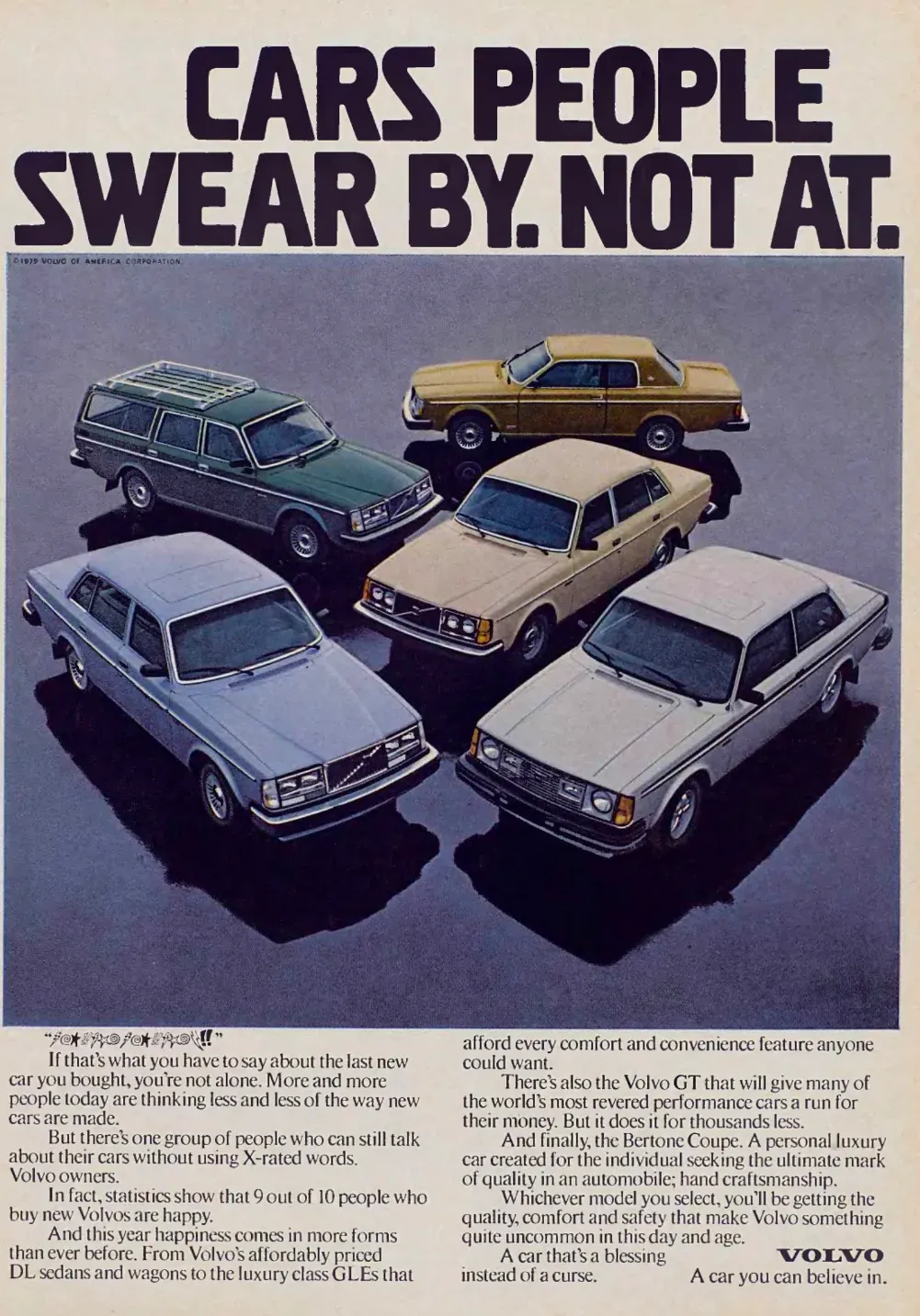
CARS PEOPLE SWEAR BY. NOT AT. If that's what you have to say about the last new car you bought, you're not alone. More and more people today are thinking less and less of the way new cars are made. But there's one group of people who can still talk about their cars without using X-rated words. Volvo owners. In fact, statistics show that 9 out of 10 people who buy new Volvos are happy. And this year happiness comes in more forms than ever before. From Volvo's affordably priced DL sedans and wagons to the luxury class GLEs that afford every comfort and convenience feature anyone could want. There's also the Volvo GT that will give many of the world's most revered performance cars a run for their money. But it does it for thousands less. And finally, the Bertone Coupe. A personal luxury car created for the individual seeking the ultimate mark of quality in an automobile: hand craftsmanship. Whichever model you select, you'll be getting the quality, comfort and safety that make Volvo something quite uncommon in this day and age. A car that's a blessing instead of a curse. A car you can believe in.
Commentary
Volvo’s headline is a social test disguised as a joke. “Cars people swear by, not at” imagines the owner after the purchase, speaking either with loyalty or frustration. The five-car arrangement underneath expands that promise from one model to a whole range: economy, luxury, performance and personal choice all share the same visual field.
The copy uses happiness as a bridge between reputation and evidence. The “9 out of 10” statistic is presented without methodology, but it gives the emotional claim a numerical coat. From there the ad names the DL, GLE, GT and Bertone Coupe, making variety itself proof that Volvo can be believed across price and personality.
The language is conversational and slightly mischievous. “X-rated words” lets the ad acknowledge car-owner anger without showing any, while “blessing instead of a curse” turns reliability into moral relief. For young copywriters, the lesson is to let the audience’s private complaint supply the opening; the brand can then present itself as the quiet exception.
Volvo Cars’ current story continues to centre people, protection and understanding human behaviour, while its range now includes fully electric models, as described in its company story. The 1982 spread’s safety language has therefore become one part of a much broader technology and mobility narrative.
The promise that survives is confidence after purchase. The model names, “happiness” statistic and hand-built Bertone distinction are historical details; the desire for a car that reduces rather than creates trouble remains an unusually durable piece of positioning.