Automotive 1984
Volkswagen
Serious fun.
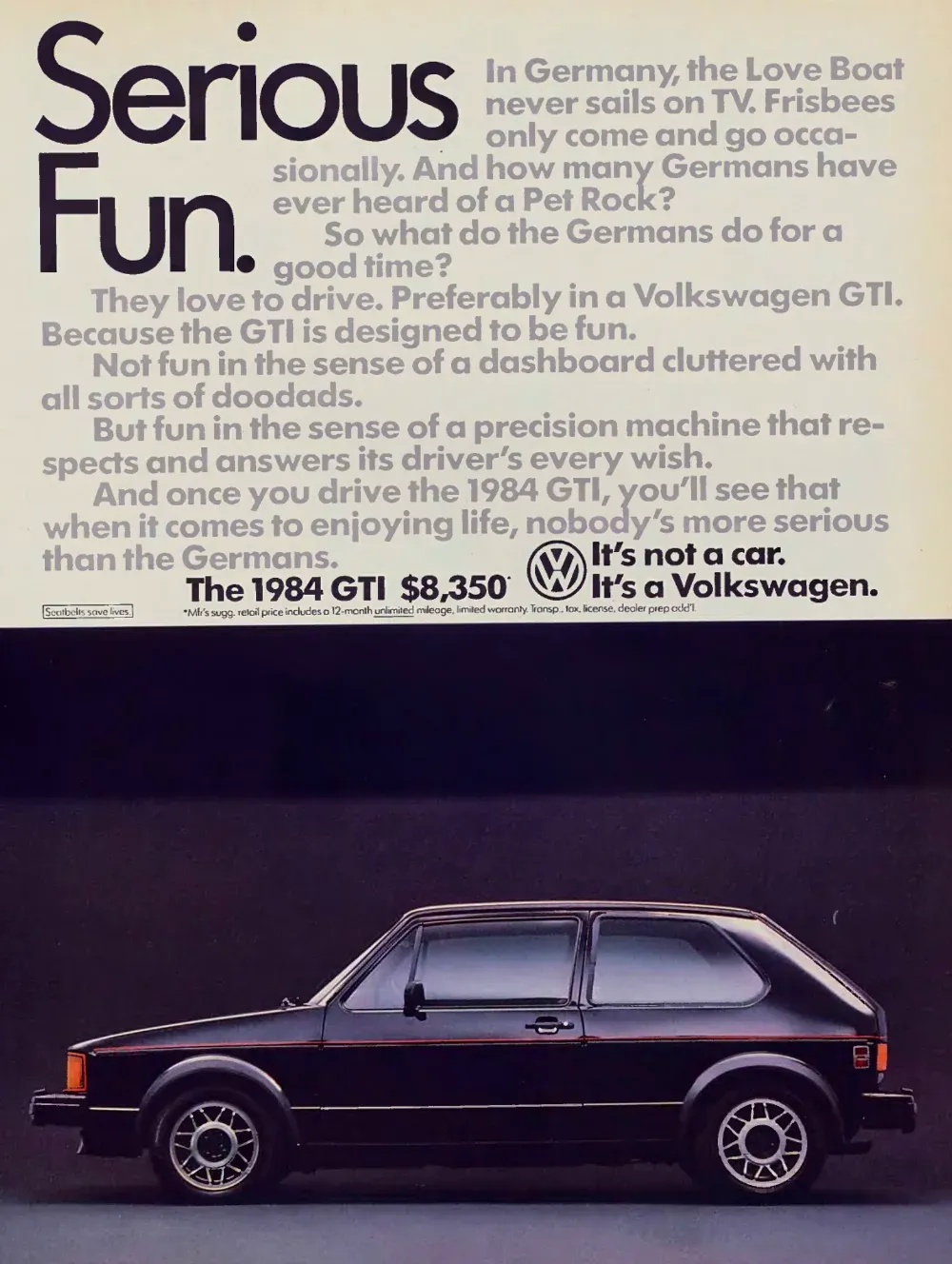
FROM THE PRINTED PAGEOriginal ad copy
OCR transcription from the archived page. Scanning and reading-order errors may remain.
Serious Fun. In Germany, the Love Boat never sails on TV. Frisbees only come and go occasionally. And how many Germans have ever heard of a Pet Rock? So what do the Germans do for a good time? They love to drive. Preferably in a Volkswagen GTI. Because the GTI is designed to be fun. Not fun in the sense of a dashboard cluttered with all sorts of doodads. But fun in the sense of a precision machine that respects and answers its driver's every wish. And once you drive the 1984 GTI, you'll see that when it comes to enjoying life, nobody's more serious than the Germans. The 1984 GTI $8,350. *Mfr.'s sugg. retail price includes a 12-month unlimited mileage, limited warranty. Transp., tax, license, dealer prep add'l. It's not a car. It's a Volkswagen. Seatbelts save lives.
Commentary
“Serious Fun” is a contradiction large enough to carry the whole GTI. The ad begins with Love Boat television, Frisbees and Pet Rocks, then jokes that Germans have a different route to pleasure: driving. The dark side-profile photograph keeps the argument disciplined. There is no clutter, only the car’s shape and a thin line of red.
The copy draws a distinction between decorative fun and responsive fun. A dashboard full of “doodads” is rejected in favour of a precision machine that answers its driver. This is a performance claim expressed as respect: the car is enjoyable because it pays attention.
The price and warranty anchor the joke in a purchase. $8,350 makes the GTI attainable within the ad’s world, while the sign-off “It’s not a car. It’s a Volkswagen” turns the model into a brand ritual. For young copywriters, the lesson is to define a vague benefit by contrast. “Fun” becomes persuasive only after the ad says what kind of fun it refuses.
Volkswagen remains a passenger-car brand within a group that now develops combustion, hybrid and electric vehicles and mobility technologies. The historical continuity is not in the drivetrain but in the brand’s habit of making engineering and character part of the same sentence.
The lasting idea is disciplined enjoyment: performance need not look extravagant. The old television references, price and manual-era machine no longer describe the market, but the contrast between gadgetry and purposeful design still gives a performance car a point of view.