Automotive 1973
Volvo
It's hard to keep your mind on the road when your back is killing you.
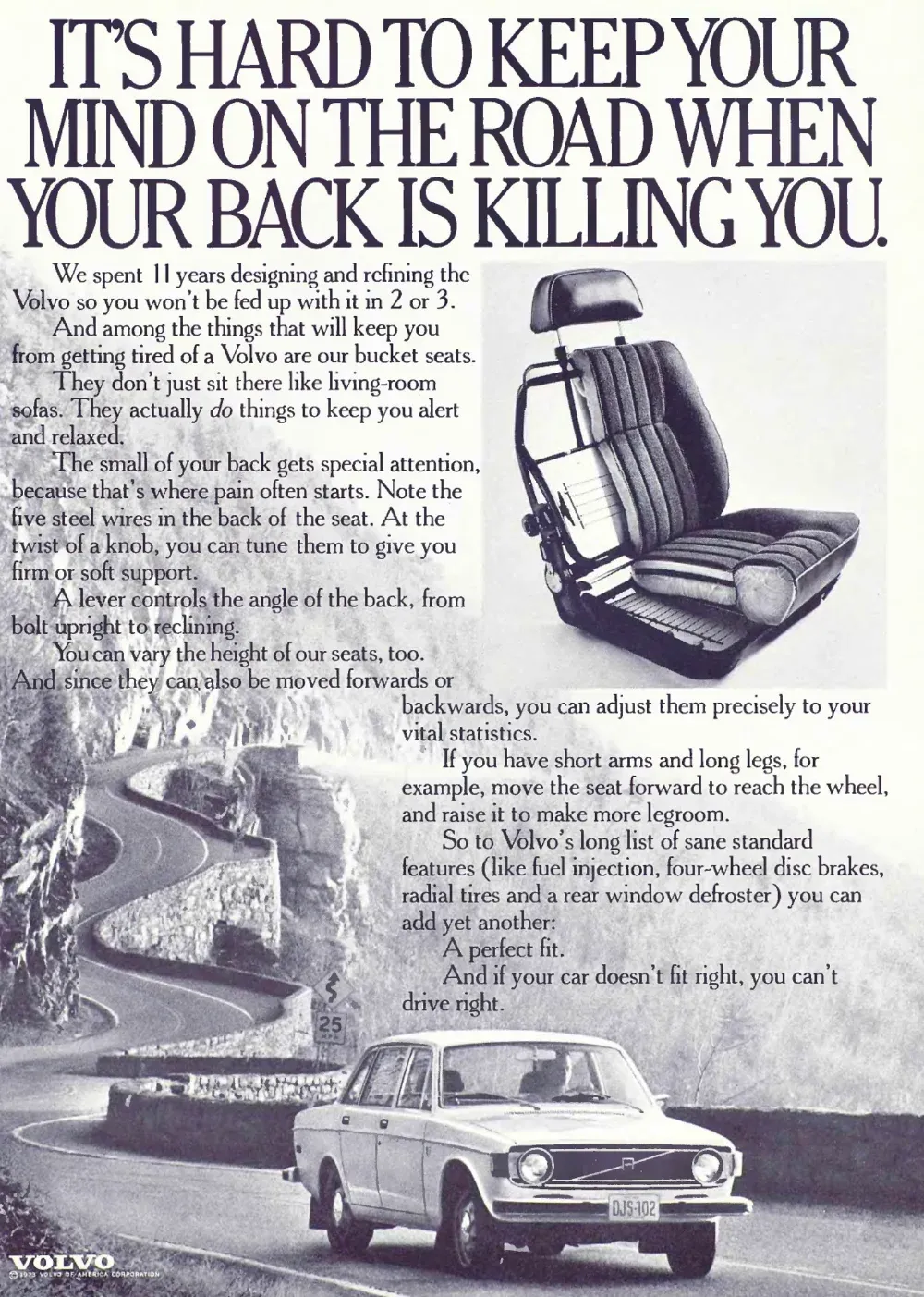
FROM THE PRINTED PAGEOriginal ad copy
OCR transcription from the archived page. Scanning and reading-order errors may remain.
IT'S HARD TO KEEP YOUR MIND ON THE ROAD WHEN YOUR BACK IS KILLING YOU. We spent 11 years designing and refining the Volvo so you won't be fed up with it in 2 or 3. And among the things that will keep you from getting tired of a Volvo are our bucket seats. They don't just sit there like living-room sofas. They actually do things to keep you alert and relaxed. The small of your back gets special attention, because that's where pain often starts. Note the five steel wires in the back of the seat. At the twist of a knob, you can tune them to give you firm or soft support. A lever controls the angle of the back, from bolt upright to reclining. You can vary the height of our seats, too. And since they can also be moved forwards or backwards, you can adjust them precisely to your vital statistics. If you have short arms and long legs, for example, move the seat forward to reach the wheel, and raise it to make more legroom. So to Volvo's long list of sane standard features (like fuel injection, four-wheel disc brakes, radial tires and a rear window defroster) you can add yet another: A perfect fit. And if your car doesn't fit right, you can't drive right. VOLVO ©1973 VOLVO OF AMERICA CORPORATION
Commentary
The headline made me look down the page for a crash scene. Instead I found a seat. Its back is partly opened to show the support inside, while a small Volvo negotiates a winding road below. That pairing is the whole argument: discomfort in the body can become distraction at the wheel. The enormous capitals make back pain urgent; the mechanically detailed seat supplies an answer that can be examined rather than simply trusted.
The body copy is unusually patient. It points out five steel wires behind the driver’s lower back, a knob for firm or soft support, a lever for the backrest angle, and adjustments for height and fore-aft position. The example of a person with “short arms and long legs” turns an abstract notion of ergonomics into a body a reader can recognize. The final claim, “A perfect fit,” is set apart as its own line. Fuel injection, disc brakes and radial tires are mentioned, but the seat gets the picture and most of the explanation. Volvo is selling comfort as part of attentive driving, while the ad itself remains the source of that connection.
The road photograph puts this argument beyond a showroom sit-test. A curving route asks the driver to pay attention over time. In a present-day comparison, seats still advertise adjustability, but this scan gives every adjustment a physical control and a reason to use it. Its picture of a car fitted to a particular body is more individual than the generic claim that a cabin is “comfortable.”
For a new copywriter, the headline shows how a blunt bodily phrase can earn its place when the rest of the ad is exact. “Your back is killing you” creates the problem; “five steel wires” and “twist of a knob” make the solution concrete. The paired closing sentences, “A perfect fit” and “you can’t drive right,” shorten the copy just as the argument resolves. A useful lesson is to move from the reader’s felt symptom to an observable mechanism, then close on the benefit.
Volvo Cars dates its first car to 1927. It remains a carmaker with a stated focus on people and safety, and its current seating description still emphasizes adjustability and ergonomics.
The promise that fit helps a driver stay comfortable and focused continues. The exposed wires and manual controls belong to this design, but the ad’s durable choice is to show the hidden support and explain how a particular person can use it.