Automotive 1973
Volkswagen
The $3300 luxury car Detroit won't build.
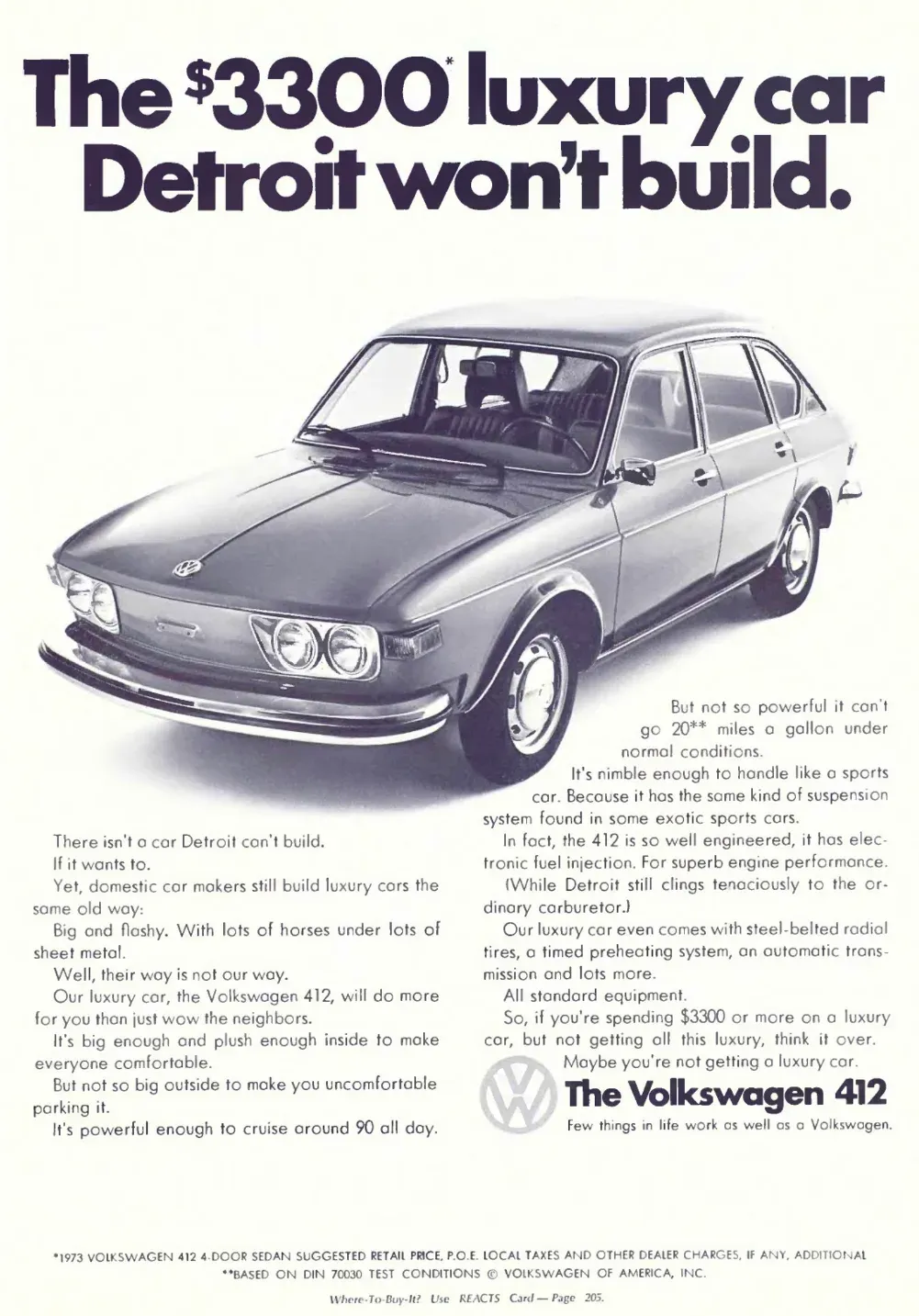
FROM THE PRINTED PAGEOriginal ad copy
OCR transcription from the archived page. Scanning and reading-order errors may remain.
The $3300* luxury car Detroit won't build. There isn't a car Detroit can't build. If it wants to. Yet, domestic car makers still build luxury cars the same old way: Big and flashy. With lots of horses under lots of sheet metal. Well, their way is not our way. Our luxury car, the Volkswagen 412, will do more for you than just wow the neighbors. It's big enough and plush enough inside to make everyone comfortable. But not so big outside to make you uncomfortable parking it. It's powerful enough to cruise around 90 all day. But not so powerful it can't go 20** miles a gallon under normal conditions. It's nimble enough to handle like a sports car. Because it has the same kind of suspension system found in some exotic sports cars. In fact, the 412 is so well engineered, it has electronic fuel injection. For superb engine performance. (While Detroit still clings tenaciously to the ordinary carburetor.) Our luxury car even comes with steel-belted radial tires, a timed preheating system, an automatic transmission and lots more. All standard equipment. So, if you're spending $3300 or more on a luxury car, but not getting all this luxury, think it over. Maybe you're not getting a luxury car. The Volkswagen 412 Few things in life work as well as a Volkswagen. *1973 Volkswagen 412 4-door sedan suggested retail price, P.O.E. Local taxes and other dealer charges, if any, additional. **Based on DIN 70030 test conditions. © Volkswagen of America, Inc. Where-To-Buy-It? Use REACTS Card—Page 205.
Commentary
I stop at the word “won’t.” The headline does not say Detroit lacks the skill to make a $3300 luxury car; it says Detroit chooses not to. That distinction lets Volkswagen attack a habit rather than a factory. Under the giant lettering, the 412 is shown almost clinically against white space. Four doors, a long body and paired headlights are the visual evidence offered for its new use of the word “luxury.”
The copy gives the buyer a sequence of reversals. The car is roomy inside but manageable outside; capable of cruising fast, the ad says, yet able to return 20 miles per gallon under specified conditions. It calls the suspension sporty and presents electronic fuel injection as an advantage over Detroit’s “ordinary carburetor.” Steel-belted radial tires, automatic transmission and a timed preheating system become part of the standard-equipment case. These are advertiser claims, not independent measurements. The two asterisks matter: the $3300 is a suggested retail price before certain charges, and the economy figure refers to DIN 70030 test conditions.
I can see how the argument would appeal to someone who wants comfort but dislikes paying for sheer size and display. The line “wow the neighbors” makes conspicuous consumption sound slightly foolish. The car itself is still displayed prominently, of course; the ad is selling a different form of status, one based on sensible selection. In today’s market, fuel economy, equipment and parking ease remain comparison points, while a single printed price tells less of the story than a detailed online configuration and local inventory.
For a new copywriter, the opening two lines are the mechanism: “There isn’t a car Detroit can’t build. If it wants to.” The second sentence changes the charge from inability to unwillingness. Short paired claims—“big enough” but “not so big”—then keep that distinction alive in product terms. The lesson is to make a comparative headline precise enough that the features can substantiate it, while leaving the qualifying figures visible.
Volkswagen’s model history says the Type 4 was revised and renamed the 412 for the 1973 model year; production ended in 1974. Volkswagen remains a passenger-car brand with current combustion and electric models described in its model archive and news.
The claim that practical value can itself be luxurious still resonates. The $3300 threshold, the specific 20-mpg test claim and the jab at Detroit carburetors belong to this 1973 contest. What lasts is the ad’s way of defining a category by the trade-offs a buyer actually lives with.