Automotive 1976
Volkswagen
The Rabbit is the best car in the world for under $3500.
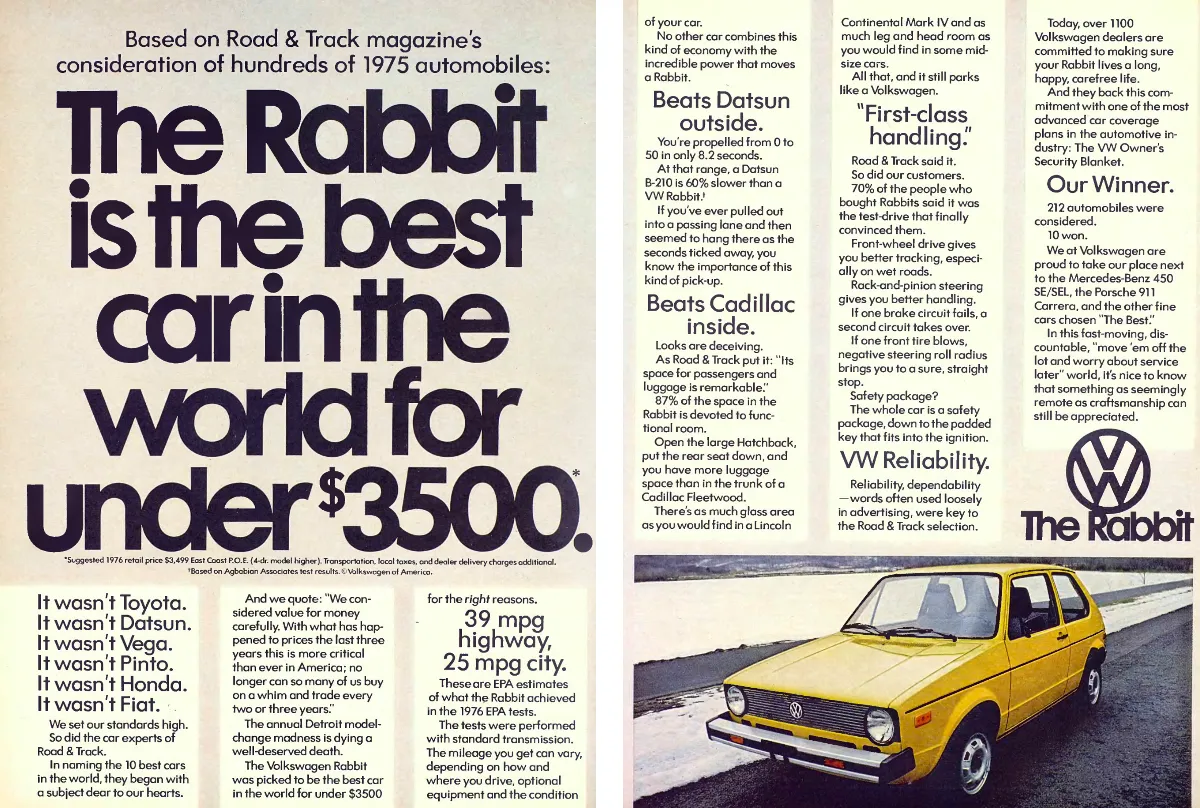
FROM THE PRINTED PAGEOriginal ad copy
OCR transcription from the archived page. Scanning and reading-order errors may remain.
Based on Road & Track magazine’s consideration of hundreds of 1975 automobiles: The Rabbit is the best car in the world for under $3500.* *Suggested 1976 retail price $3,499 East Coast P.O.E. (4-dr. model higher). Transportation, local taxes, and dealer delivery charges additional. †Based on Agbabian Associates test results. © Volkswagen of America. It wasn’t Toyota. It wasn’t Datsun. It wasn’t Vega. It wasn’t Pinto. It wasn’t Honda. It wasn’t Fiat. We set our standards high. So did the car experts of Road & Track. In naming the 10 best cars in the world, they began with a subject dear to our hearts. And we quote: “We considered value for money carefully. With what has happened to prices the last three years this is more critical than ever in America; no longer can so many of us buy on a whim and trade every two or three years.” The annual Detroit model-change madness is dying a well-deserved death. The Volkswagen Rabbit was picked to be the best car in the world for under $3500 for the right reasons. 39 mpg highway, 25 mpg city. These are EPA estimates of what the Rabbit achieved in the 1976 EPA tests. The tests were performed with standard transmission. The mileage you get can vary, depending on how and where you drive, optional equipment and the condition of your car. No other car combines this kind of economy with the incredible power that moves a Rabbit. Beats Datsun outside. You’re propelled from 0 to 50 in only 8.2 seconds. At that range, a Datsun B-210 is 60% slower than a VW Rabbit.† If you’ve ever pulled out into a passing lane and then seemed to hang there as the seconds ticked away, you know the importance of this kind of pick-up. Beats Cadillac inside. Looks are deceiving. As Road & Track put it: “Its space for passengers and luggage is remarkable.” 87% of the space in the Rabbit is devoted to functional room. Open the large Hatchback, put the rear seat down, and you have more luggage space than in the trunk of a Cadillac Fleetwood. There’s as much glass area as you would find in a Lincoln Continental Mark IV and as much leg and head room as you would find in some mid-size cars. All that, and it still parks like a Volkswagen. “First-class handling.” Road & Track said it. So did our customers. 70% of the people who bought Rabbits said it was the test-drive that finally convinced them. Front-wheel drive gives you better tracking, especially on wet roads. Rack-and-pinion steering gives you better handling. If one brake circuit fails, a second circuit takes over. If one front tire blows, negative steering roll radius brings you to a sure, straight stop. Safety package? The whole car is a safety package, down to the padded key that fits into the ignition. VW Reliability. Reliability, dependability—words often used loosely in advertising, were key to the Road & Track selection. Today, over 1100 Volkswagen dealers are committed to making sure your Rabbit lives a long, happy, carefree life. And they back this commitment with one of the most advanced car coverage plans in the automotive industry: The VW Owner’s Security Blanket. Our Winner. 212 automobiles were considered. 10 won. We at Volkswagen are proud to take our place next to the Mercedes-Benz 450 SE/SEL, the Porsche 911 Carrera, and the other fine cars chosen “The Best.” In this fast-moving, discountable, “move ’em off the lot and worry about service later” world, it’s nice to know that something as seemingly remote as craftsmanship can still be appreciated. VW The Rabbit
Commentary
I reached the price before I reached the car. Volkswagen gives the headline nearly an entire page, leaving the yellow Rabbit to appear beneath the evidence on the facing page. The hierarchy is deliberate: first a verdict, then a budget, then the object that apparently reconciles them. The introductory line attributes the judgment to Road & Track; the footnote makes the sub-$3,500 threshold depend on a $3,499 suggested price before specified additional charges.
Following the columns reveals a carefully selected collection of opponents. Datsun supplies the acceleration comparison, Cadillac the luggage-space comparison, and Lincoln the glass-area comparison. Volkswagen is not claiming to beat one rival in every respect. It borrows a different reference point for each advantage. The comparison with a Fleetwood’s trunk also depends on folding the Rabbit’s rear seat, a condition worth keeping attached to the boast. The advertisement gives the budget buyer permission to shop across categories without actually crossing the price boundary.
The economic argument is unusually explicit. The quoted review says buyers can no longer replace cars casually every few years; Volkswagen then attacks annual model changes. That is evidence of the pressure the ad chooses to address, not proof that every American buyer behaved that way. Its answer combines mileage, useful room, dealer support and a padded ignition key. The accumulation makes thrift feel like considered judgment rather than resignation.
The page also shows how a magazine verdict could travel. Readers encounter selected quotations inside a manufacturer’s advertisement, then are invited to test the car for themselves. Today the equivalent comparison can open into multiple reviews immediately. Here, source attribution must carry a substantial share of the credibility within the printed spread; I would not treat the reproduced extracts as the complete Road & Track assessment.
For new copywriters, the six repetitions of “It wasn’t” turn a shortlist into a drumbeat. The paired “outside” and “inside” headings make a long technical argument easy to navigate, while the tiny price qualification bears substantial factual weight. The lesson is to keep the energy of the claim and the conditions of the claim equally intelligible.
Volkswagen’s history of the Golf describes its 1974 arrival as a transition from the Beetle to front-wheel drive and hatchback versatility. The family continues in today’s American Golf GTI.
Useful space and enjoyable handling still sit comfortably together. The historical price, test figures and competitor comparisons do not transfer to a current model. What survives is the creative argument that economy can be an informed preference, with its own pleasures and standards.