Automotive 1967
Volkswagen
With technological triumphs like this
FROM THE PRINTED PAGEOriginal ad copy
OCR transcription from the archived page. Scanning and reading-order errors may remain.
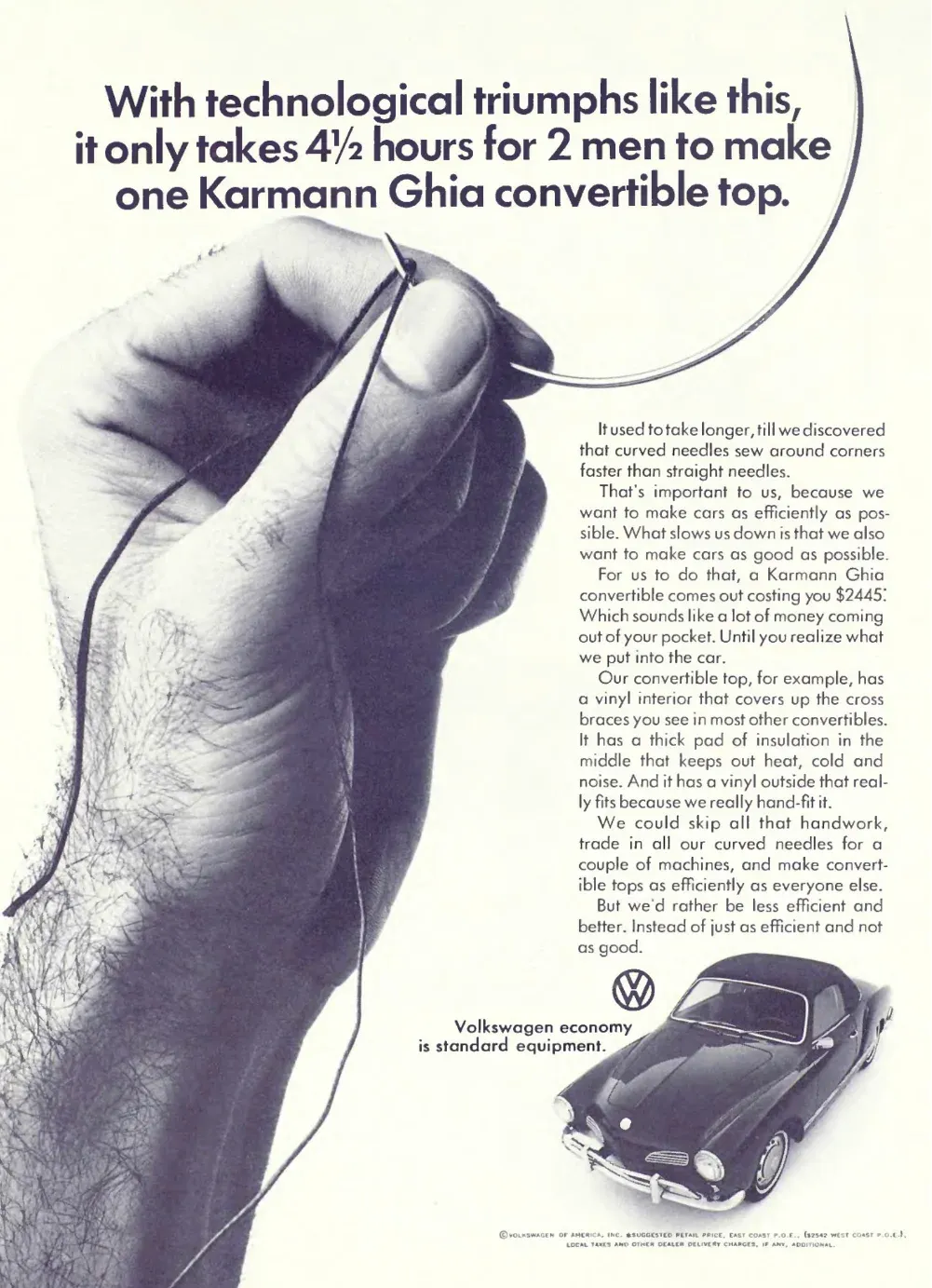
With technological triumphs like this, it only takes 4½ hours for 2 men to make one Karmann Ghia convertible top. It used to take longer, till we discovered that curved needles sew around corners faster than straight needles. That's important to us, because we want to make cars as efficiently as possible. What slows us down is that we also want to make cars as good as possible. For us to do that, a Karmann Ghia convertible comes out costing you $2445: Which sounds like a lot of money coming out of your pocket. Until you realize what we put into the car. Our convertible top, for example, has a vinyl interior that covers up the cross braces you see in most other convertibles. It has a thick pad of insulation in the middle that keeps out heat, cold and noise. And it has a vinyl outside that really fits because we really hand-fit it. We could skip all that handwork, trade in all our curved needles for a couple of machines, and make convertible tops as efficiently as everyone else. But we'd rather be less efficient and better. Instead of just as efficient and not as good. Volkswagen economy is standard equipment. © VOLKSWAGEN OF AMERICA, INC. *SUGGESTED RETAIL PRICE, EAST COAST P.O.E., ($2542 WEST COAST P.O.E.). LOCAL TAXES AND OTHER DEALER DELIVERY CHARGES, IF ANY, ADDITIONAL.
Commentary
The needle is almost absurdly large. I follow its curve across the top of the page before finding the little Karmann Ghia at the bottom. A hand, thread, and tool occupy more space than the car itself. The headline calls the needle a “technological triumph,” then reveals that two men still need four and a half hours to make one convertible top. The joke is deliberate: a grand word for a modest piece of equipment, attached to a conspicuously laborious process.
The body copy makes the curved needle do more than raise a smile. It says the tool speeds stitching around corners, then admits that the company wants efficiency and quality at once. The promised top has a vinyl interior hiding cross braces, an insulating pad against heat, cold, and noise, and an exterior that fits because workers hand-fit it. The $2445 price appears before these details, so the reader is invited to feel the cost and then account for it. At the bottom, a footnote adds a higher West Coast suggested price and dealer charges. The ad does not conceal the objection; it builds its explanation around it.
I find the most revealing line near the end: Volkswagen says it could trade curved needles for machines, but would rather be “less efficient and better.” That is a claim about what labor is worth, not merely how a roof is made. For a present-day reader, the pitch has a different edge. Production efficiency is often treated as an unquestioned virtue, while this ad asks whether a slower process can justify a visible price. Its labor and quality claims remain the advertiser’s; the scan gives no independent measure of the finished roof.
For a new copywriter, the headline shows how to use understatement as a hook. “Technological triumphs” sounds like a laboratory breakthrough, but the visual answer is a curved needle. The copy then repeats “efficient” and “good” until the last two short sentences force a choice between them. The lesson is to let a surprising object earn attention, then connect it to a specific construction detail and a buyer’s actual objection.
Volkswagen’s Karmann Ghia history describes the convertible introduced in 1957 and the collaboration among Volkswagen, Karmann, and Ghia. The cabriolet is long out of production; Volkswagen continues to make passenger cars and now develops electric models.
The durable promise is that the cost of a car should be explained through useful details a buyer can inspect. The hand-sewn top, curved needle, and 1967 dollar figures belong to this particular car and sale; the demand for a credible account of price and workmanship does not.