Electronics 1994
Apple
Think of it as the Macintosh for people who thought they could never have a Macintosh
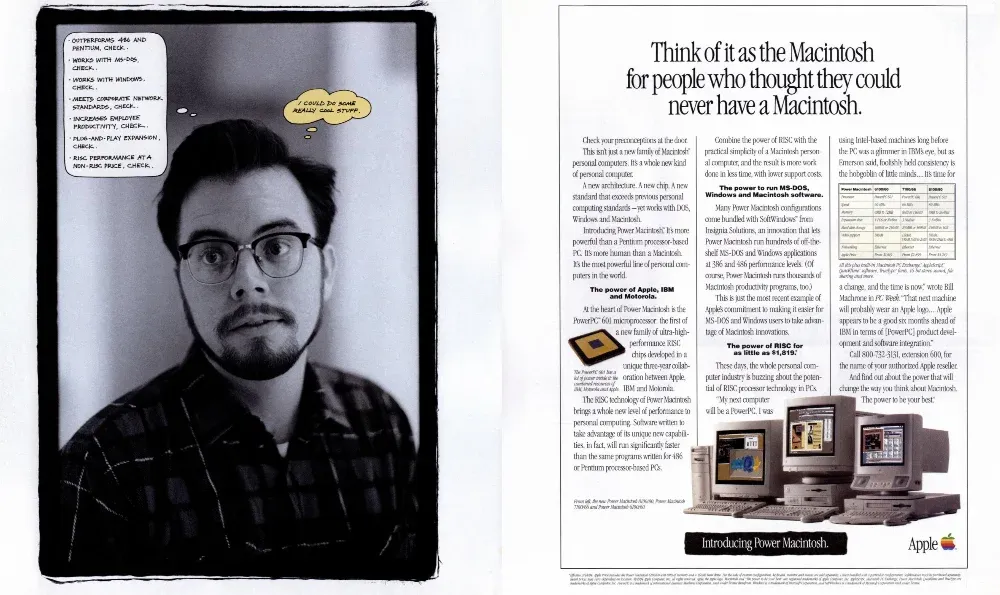
FROM THE PRINTED PAGEOriginal ad copy
OCR transcription from the archived page. Scanning and reading-order errors may remain.
OUTPERFORMS 486 AND PENTIUM. CHECK. WORKS WITH MS-DOS. CHECK. WORKS WITH WINDOWS. CHECK. MEETS CORPORATE NETWORK STANDARDS. CHECK. INCREASES EMPLOYEE PRODUCTIVITY. CHECK. PLUG-AND-PLAY EXPANSION. CHECK. RISC PERFORMANCE AT A NON-RISC PRICE. CHECK. I COULD DO SOME REALLY COOL STUFF. Think of it as the Macintosh for people who thought they could never have a Macintosh. Check your preconceptions at the door. This isn't just a new family of Macintosh personal computers. It's a whole new kind of personal computer. A new architecture. A new chip. A new standard that exceeds previous personal computing standards—yet works with DOS, Windows and Macintosh. Introducing Power Macintosh. It's more powerful than a Pentium processor-based PC. It's more than a Macintosh. It's the most powerful line of personal computers in the world. The power of Apple, IBM and Motorola. At the heart of Power Macintosh is the PowerPC 601 microprocessor, the first of a new family of ultra-high-performance RISC chips developed in a unique three-corporation collaboration between Apple, IBM and Motorola. The RISC technology of Power Macintosh brings a whole new level of performance to personal computing. Software written to take advantage of its unique new capabilities, in fact, will run significantly faster than the same programs written for 486 or Pentium processor-based PCs. Combine the power of RISC with the practical simplicity of a Macintosh personal computer, and the result is more work done in less time, with lower support costs. The power to run MS-DOS, Windows and Macintosh software. Many Power Macintosh configurations come bundled with SoftWindows from Insignia Solutions, an innovation that lets Power Macintosh run hundreds of off-the-shelf MS-DOS and Windows applications at 386 and 486 performance levels. (Of course, Power Macintosh runs thousands of Macintosh productivity programs, too.) This is just the most recent example of Apple's commitment to making it easier for MS-DOS and Windows users to take advantage of Macintosh innovations. The power of RISC for as little as $1,819. These days, the whole personal computer industry is buzzing about the potential of RISC processor technology in PCs. “My next computer may be a PowerPC.” [Illegible opening] using Intel-based machines long before the PC was a glimmer in IBM's eye. But, as Emerson said, “Foolish consistency is the hobgoblin of little minds.” It's time for a change, and the time is now. [Illegible configurations table] [Illegible source attribution] “That next machine will probably wear an Apple logo. Apple appears to be a good six months ahead of IBM in terms of PowerPC product development and software integration.” Call 800-732-3131, extension 600, for the name of your authorized Apple reseller. And find out about the power that will change the way you think about Macintosh. The power to be your best. Introducing Power Macintosh. Apple. [Illegible fine print]
Commentary
I start with the man in the dark computer-shaped frame. His glasses, beard and quiet stare could belong to a familiar stereotype of the computer expert, but the yellow thought bubble says, “I could do some really cool stuff.” Beside him, a checklist answers the practical questions a Windows or DOS user might bring to a Macintosh: 486 and Pentium performance, MS-DOS, Windows, corporate networks, expansion. Every line ends with “CHECK.” The headline names the perceived barrier outright: this is a Macintosh for people who thought they could never have one.
The right page turns the checklist into an argument about architecture. Power Macintosh’s PowerPC 601 is described as a joint Apple, IBM and Motorola effort, while SoftWindows is the bridge for off-the-shelf MS-DOS and Windows applications. The ad also names a starting price of $1,819 and lays a configuration table beside the copy. Its promise is not simply that the Mac is powerful; it is that switching need not mean abandoning the software and standards already embedded in an office. These are the advertiser’s comparative claims, not independent performance measurements.
The route to a purchase is revealing. After laying out processor details and a price, the ad asks readers to call for an authorized Apple reseller. The computer industry may be “buzzing” about RISC, but the next step is still to speak to a dealer. That visible combination of technical comparison, telephone number and shop-mediated sale marks an era when a personal computer purchase could involve substantial research and a specialist channel.
For a new copywriter, the headline’s “Think of it as” softens what could have been a boast into a reframing. The repeated “CHECK” makes a dense compatibility argument scannable; the smaller “new chip” and RISC explanations then reward readers who want proof. The lesson is to make the promise accessible first, then let concrete evidence carry the technical detail.
In this ad Apple presents PowerPC as a collaboration with IBM and Motorola. Apple now designs its own Mac silicon; its current Mac announcements feature M-series chips. Apple’s account of the 2026 M-series launch describes that present direction.
The enduring concern is compatibility: buyers still want to know whether a new computer will run the tools their work depends on. The 1994 answer was a shared processor architecture, bundled SoftWindows, and a reseller’s advice; today Apple’s pitch is built around its own silicon and integrated software. The ad’s invitation to people who felt excluded from the Mac still has an echo in the question of who a computer is designed to serve.