Fashion & Accessories 1969
Universal Genève
Man on the moon!
FROM THE PRINTED PAGEOriginal ad copy
OCR transcription from the archived page. Scanning and reading-order errors may remain.
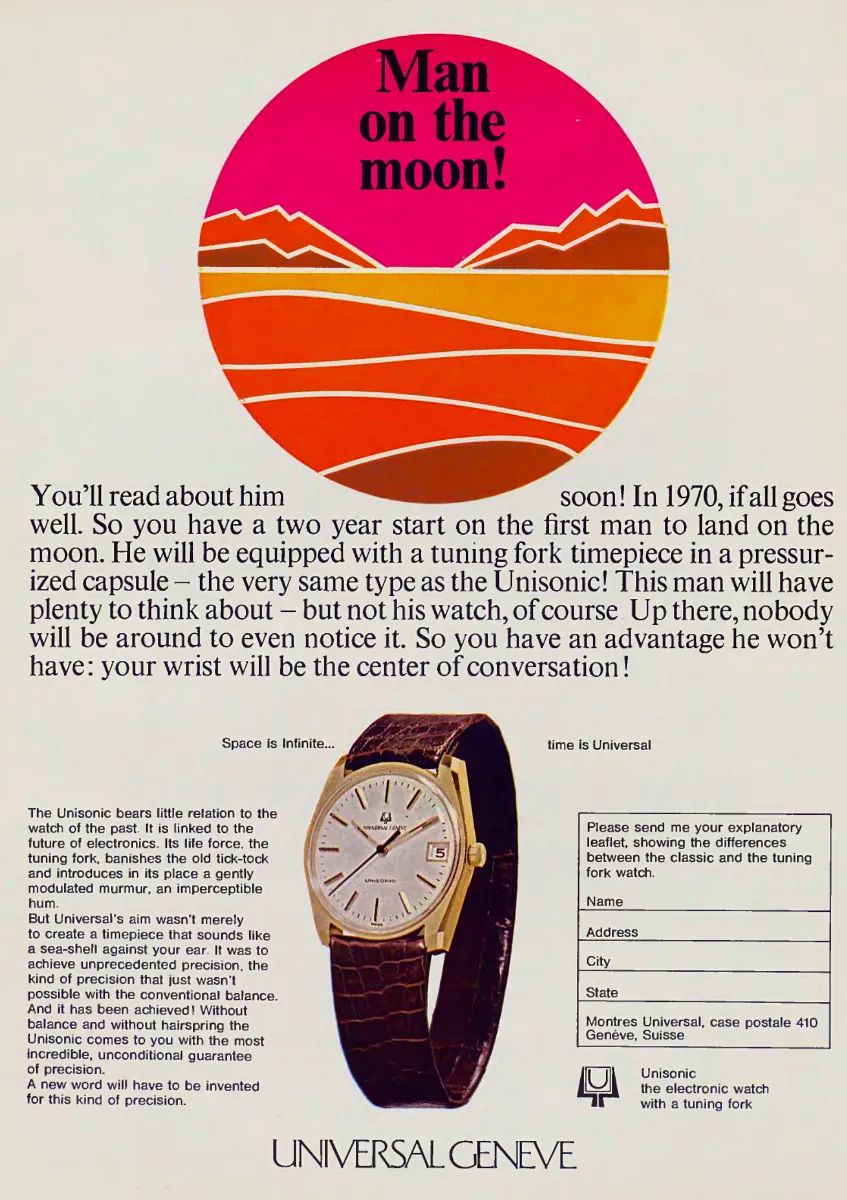
Man on the moon! You'll read about him soon! In 1970, if all goes well. So you have a two year start on the first man to land on the moon. He will be equipped with a tuning fork timepiece in a pressurized capsule — the very same type as the Unisonic! This man will have plenty to think about — but not his watch, of course Up there, nobody will be around to even notice it. So you have an advantage he won't have: your wrist will be the center of conversation! Space is Infinite... time is Universal The Unisonic bears little relation to the watch of the past. It is linked to the future of electronics. Its life force, the tuning fork, banishes the old tick-tock and introduces in its place a gently modulated murmur, an imperceptible hum. But Universal's aim wasn't merely to create a timepiece that sounds like a sea-shell against your ear. It was to achieve unprecedented precision, the kind of precision that just wasn't possible with the conventional balance. And it has been achieved! Without balance and without hairspring the Unisonic comes to you with the most incredible, unconditional guarantee of precision. A new word will have to be invented for this kind of precision. UNIVERSAL GENEVE UNISONIC 5 Please send me your explanatory leaflet, showing the differences between the classic and the tuning fork watch. Name Address City State Montres Universal, case postale 410 Genève, Suisse Unisonic the electronic watch with a tuning fork UNIVERSAL GENEVE
Commentary
I meet the moon before the watch. A large circle of pink sky and orange terrain occupies the upper half of the page, but no astronaut appears inside it. The headline supplies the missing figure. Below, a gold-tone watch on a brown strap looks surprisingly conventional for an object being introduced through space travel. Its claim to the future is inside the case.
Then the chronology catches my eye. The copy predicts a landing in 1970 and offers a “two year start.” This entry retains the collector-confirmed 1969 date; the wording is preserved rather than silently brought into line with it. Apollo 11 actually landed on July 20, 1969. The advertisement’s prediction is evidence of its speculative sales pitch, not a reliable account of the eventual mission or proof that astronauts wore this particular watch.
The argument makes an unexpected turn from technical kinship to social advantage. The astronaut will have important things to think about, but no audience for his wrist. The buyer, supposedly ahead of him, can enjoy conversation as well as precision. Universal borrows the scale of a public technological adventure and brings it down to the intimate business of being noticed across a table.
The coupon is a second, quieter piece of evidence. A reader who wants to understand the difference between a conventional watch and a tuning-fork watch must request a leaflet from Geneva. The mechanism deserves explanation, but the page gives its largest space to anticipation and status. Today that comparison can begin immediately online; here the first task is to make curiosity strong enough to survive filling in a form and waiting for the post.
For beginning copywriters, the sound words do useful explanatory work. “Tick-tock” belongs to the familiar watch; “murmur” and “hum” make an unfamiliar mechanism imaginable through the ear. “Space is Infinite… time is Universal” turns the brand name into the completion of an expansive thought. Notice, too, the difference between a vivid claim and a measurable one: the emphatic guarantee supplies no numerical tolerance on this page. Language creates confidence here; it does not substitute for the missing specification.
Universal Genève traces its founding to Le Locle in 1894. Its current collections include Polerouter, Compax and Cabriolet watches, with the revived house emphasizing design and mechanical watchmaking.
Distinctive engineering can still furnish a watch owner with a story. What has changed is the direction of the prestige: this page treats electronic novelty as an escape from the past, while the present collections also draw value from historical designs and mechanical craft. The enduring desire is to wear something worth explaining, even when the explanation changes.